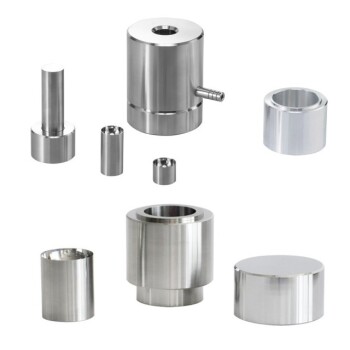
The primary limitations of isostatic pressing equipment lie in its significant financial barriers and operational complexity when compared to the starch consolidation method. Specifically, isostatic pressing requires a high initial capital investment for specialized machinery capable of maintaining high-pressure argon environments, making it a far more capital-intensive route than non-pressure molding alternatives.
Isostatic pressing involves a complex, multi-step workflow that struggles to match the efficiency of modern alternatives. By switching to starch consolidation, manufacturers can reduce production costs by approximately 36% while gaining superior adaptability for various bearing sizes and porosity levels.
The Economic and Operational Barriers
High Capital Expenditure
The most immediate limitation of isostatic pressing is the cost of the equipment itself.
To function correctly, this method requires machinery capable of operating safely under high-pressure conditions. This results in a heavy upfront investment that raises the barrier to entry for industrial production.
Process Complexity
Beyond the price tag, the operational workflow of isostatic pressing is inherently intricate.
The process involves vibration filling and partial sintering within a controlled high-pressure argon environment. These rigorous requirements demand specialized controls and maintenance, complicating the daily manufacturing routine.
Advantages of the Starch Consolidation Alternative
Significant Cost Reduction
In direct contrast to the high costs of isostatic pressing, starch consolidation utilizes a non-pressure molding technique.
By eliminating the need for high-pressure equipment and simplifying the molding process, this method lowers overall production costs by approximately 36%. This makes it a far more economically viable option for mass production.
Superior Industrial Adaptability
Isostatic pressing can be rigid regarding the types of components it can efficiently produce.
Starch consolidation, however, is highly adaptable. It allows for greater flexibility in manufacturing bearings of varying sizes and specific porosity levels, offering better general applicability for diverse industrial needs.
Understanding the Trade-offs
Complexity vs. Efficiency
While isostatic pressing is a proven method for creating porous materials, its technical requirements often outweigh its benefits in a cost-sensitive environment.
The trade-off here is clear: isostatic pressing offers a high-tech, high-pressure solution, but it comes at the expense of agility and profit margins. Starch consolidation sacrifices the high-pressure environment to gain operational speed, design flexibility, and significant cost savings.
Making the Right Choice for Your Goal
When selecting a manufacturing method for porous ceramic bearings, align your choice with your specific production constraints.
- If your primary focus is cost efficiency: Adopt the starch consolidation method to realize an approximate 36% reduction in production costs.
- If your primary focus is design versatility: Prioritize starch consolidation for its superior ability to adapt to different bearing sizes and required porosity levels.
By moving away from complex high-pressure systems, you gain a more scalable and adaptable manufacturing process.
Summary Table:
| Feature | Isostatic Pressing | Starch Consolidation |
|---|---|---|
| Equipment Cost | High Capital Investment | Low (Non-pressure) |
| Operational Complexity | High (Multi-step, Argon) | Low (Simplified workflow) |
| Production Cost | Baseline (100%) | ~36% Reduction |
| Adaptability | Rigid / Limited | High (Variable size/porosity) |
| Processing Environment | High-Pressure Argon | Ambient / Non-pressure |
Optimize Your Ceramic Manufacturing with KINTEK
Are the high costs and complexities of traditional isostatic pressing hindering your laboratory’s research or production efficiency? At KINTEK, we understand the delicate balance between precision and profitability. We specialize in comprehensive laboratory pressing solutions—including manual, automatic, heated, multifunctional, and glovebox-compatible models—as well as cold and warm isostatic presses tailored for cutting-edge battery research.
Whether you are looking to refine your starch consolidation process or require high-performance isostatic equipment for specialized materials, our experts are here to help you select the ideal configuration for your specific porosity and size requirements.
Ready to reduce your overhead and enhance material performance? Contact KINTEK Today to Consult Our Experts
References
- Isidro Durazo-Cardenas, David Stephenson. The performance of a porous ceramic hydrostatic journal bearing. DOI: 10.1243/13506501jet570
This article is also based on technical information from Kintek Solution Knowledge Base .
Related Products
- Lab Isostatic Pressing Molds for Isostatic Molding
- Automatic Lab Cold Isostatic Pressing CIP Machine
- Electric Lab Cold Isostatic Press CIP Machine
- Manual Cold Isostatic Pressing CIP Machine Pellet Press
- Electric Split Lab Cold Isostatic Pressing CIP Machine
People Also Ask
- What is the purpose of incorporating cartridge heaters into a lab press mold for MLCC block compression? Optimize Results
- What is the function of an isostatic lab press in energy storage research? Achieve Superior Material Standardization
- How do laboratory press machines resolve increased impedance in solid-state batteries? Achieve Low-Resistance Interfaces
- How does controlling the parameters of a laboratory isostatic press contribute to reducing deformation in LTCC channels?
- Why is a laboratory isostatic press preferred for zeolite A ceramic green bodies? Achieve 95%+ Density Today