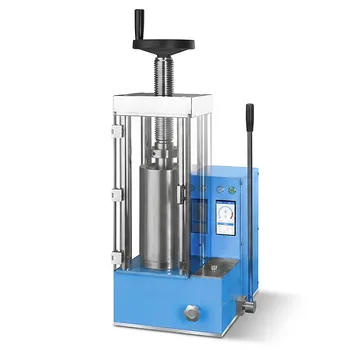
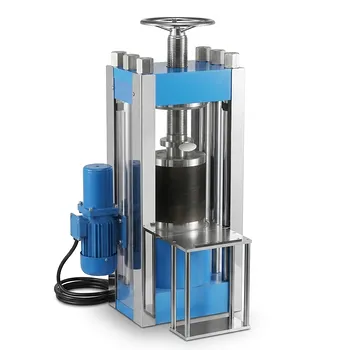
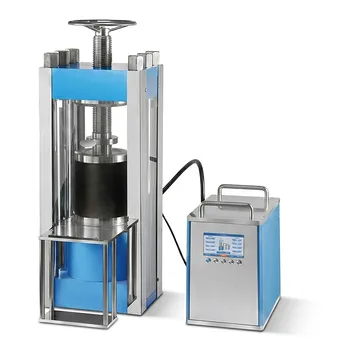
Cold isostatic pressing (CIP) utilizes a fluid medium to apply equal, omnidirectional pressure to a ceramic powder compact. This mechanism effectively eliminates the friction-induced density gradients and internal stress imbalances inherent in traditional uniaxial dry pressing. By ensuring a perfectly uniform green body, CIP prevents the cracking, warping, and structural heterogeneity that often occur during high-temperature sintering.
Core Takeaway: The fundamental advantage of a cold isostatic press is its ability to deliver isotropic pressure, which creates a green body with uniform density and minimal internal stress. This structural consistency is the primary prerequisite for producing high-performance ceramics with superior mechanical strength and dimensional stability.
The Physics of Isotropic Pressure Transmission
Pascal’s Principle in Three Dimensions
Unlike traditional dry pressing, which applies force along a single axis, CIP operates on the principle of fluid pressure transmission. The powder is sealed in a flexible mold and submerged in a liquid, ensuring that equal pressure is applied from every direction simultaneously.
Overcoming Particle Rearrangement Barriers
The omnidirectional force state in a CIP allows for more efficient particle rearrangement compared to rigid die pressing. This process overcomes internal friction between particles, leading to a denser structure and significantly enhanced adhesion throughout the entire volume of the part.
High-Pressure Capabilities
Laboratory and industrial CIP systems can achieve extremely high pressures, often reaching 300 MPa. This intense, uniform pressure is critical for achieving the high green densities (such as 68% relative density for alumina) required for high-performance applications.
Eliminating Density Gradients and Internal Stress
Bypassing Mold Wall Friction
In traditional dry pressing, friction between the powder and the rigid mold walls leads to a loss of pressure as it moves deeper into the compact. CIP uses a flexible sheath surrounded by fluid, which virtually eliminates these wall friction effects and the resulting "pressure shadows."
Preventing Differential Shrinkage
Because dry pressing creates areas of high and low density, the part will shrink at different rates during sintering, leading to warping or "hourglassing." Because CIP ensures isotropic density distribution, the green body undergoes uniform linear shrinkage, maintaining its intended geometric structure.
Eradicating Micro-cracks and Defects
Internal stress gradients in uniaxially pressed parts often manifest as micro-cracks during the expansion and contraction cycles of sintering. CIP provides the physical foundation to prevent internal micro-cracks and structural failure, which is essential for components requiring high transparency or thermal diffusivity.
Mechanical and Microstructural Superiority
Significant Increases in Flexural Strength
The uniform densification provided by CIP directly translates to improved mechanical properties. Ceramic materials formed via isostatic pressing can exhibit a flexural strength increase of over 35 percent compared to those produced by axial pressing (e.g., rising from 367 MPa to 493 MPa).
Foundations for Advanced Sintering
High green density and microstructural uniformity provide a superior starting point for the sintering phase. This consistency allows for lower sintering temperatures and enables the construction of accurate Master Sintering Curves (MSC), which are vital for research and precision manufacturing.
Achieving High Optical and Thermal Clarity
For specialized ceramics like Yb:YAG or Silicon Nitride, even minor density variations can ruin performance. CIP ensures the homogeneity of the microstructure, which is a non-negotiable requirement for achieving high transparency and consistent thermal properties in the final product.
Understanding the Trade-offs
While CIP offers superior physical properties, it is not always the most efficient choice for every application. The process typically involves longer cycle times than high-speed automated dry pressing, making it less ideal for high-volume, low-cost commodity parts.
Furthermore, because CIP relies on flexible elastomer molds, achieving tight dimensional tolerances on the "as-pressed" green body is more difficult than with rigid steel dies. This often necessitates additional green machining or post-sintering finishing to reach final specifications.
Applying This to Your Production Goal
- If your primary focus is maximum mechanical strength: Use cold isostatic pressing to eliminate the internal stress gradients that lead to premature structural failure.
- If your primary focus is complex, large-scale geometry: Utilize CIP to ensure uniform density throughout the volume, which prevents warping and cracking in large or thick-walled components.
- If your primary focus is high-volume cost efficiency: Stick with traditional uniaxial dry pressing for simple shapes where slight density variations do not compromise the final application.
- If your primary focus is optical transparency or high thermal conductivity: Employ CIP to reach the necessary microstructural uniformity that uniaxial pressing cannot provide.
The shift from uniaxial to isostatic pressure is the single most effective way to ensure the structural integrity and performance consistency of high-performance ceramic components.
Summary Table:
| Feature | Traditional Dry Pressing | Cold Isostatic Pressing (CIP) |
|---|---|---|
| Pressure Direction | Uniaxial (Single axis) | Isotropic (Omnidirectional) |
| Density Uniformity | Low (Friction gradients) | High (Homogeneous) |
| Flexural Strength | Standard Baseline | >35% Improvement |
| Sintering Result | Risk of warping/cracking | Uniform shrinkage & stability |
| Microstructure | Potential heterogeneity | Superior homogeneity |
| Best For | Simple shapes, high volume | High-performance, complex parts |
Elevate Your Material Research with KINTEK Precision
Unlock the full potential of your high-performance ceramics and battery materials with KINTEK’s industry-leading technology. KINTEK specializes in comprehensive laboratory pressing solutions designed to eliminate structural defects and maximize material performance.
Our extensive portfolio includes:
- Isostatic Presses: Cold (CIP) and warm (WIP) models for perfectly uniform density.
- Versatile Lab Presses: Manual, automatic, heated, and multifunctional units.
- Specialized Solutions: Glovebox-compatible models specifically engineered for sensitive battery research.
Whether you are developing next-generation solid-state batteries or high-strength structural ceramics, our experts are here to help you achieve superior mechanical integrity and precision.
Contact KINTEK Experts Today for a Custom Solution
References
- Abdullah Alotaibi, Katabathini Narasimharao. Iron Phosphate Nanomaterials for Photocatalytic Degradation of Tetracycline Hydrochloride. DOI: 10.1002/slct.202501231
This article is also based on technical information from Kintek Solution Knowledge Base .
Related Products
- Electric Lab Cold Isostatic Press CIP Machine
- Electric Split Lab Cold Isostatic Pressing CIP Machine
- Automatic Lab Cold Isostatic Pressing CIP Machine
- Manual Cold Isostatic Pressing CIP Machine Pellet Press
- Electric Isostatic Pressing Machine 40 Tons Automatic Laboratory Powder Compacting Press
People Also Ask
- What role do electric lab cold isostatic presses play in industrial contexts? Bridge R&D and Manufacturing with Precision
- What are the applications of electric lab cold isostatic presses in research settings? Advance Material R&D with High-Pressure CIPs
- How does electrical Cold Isostatic Pressing (CIP) contribute to cost savings? Unlock Efficiency and Reduce Expenses
- What are some research applications of electric lab CIPs? Unlock Uniform Powder Densification for Advanced Materials
- What are the characteristics of standard off-the-shelf electric lab CIP solutions? Achieve Immediate, Cost-Effective Processing