
Electric lab cold isostatic presses offer extensive customization ranging from physical scaling to precise process control. You can tailor these units based on chamber dimensions, maximum pressure capabilities up to 900 MPa, and sophisticated automation features like programmable depressurization profiles.
True customization in isostatic pressing is not limited to vessel size; it encompasses the entire pressure cycle and material handling workflow to ensure consistent results for specific material properties.
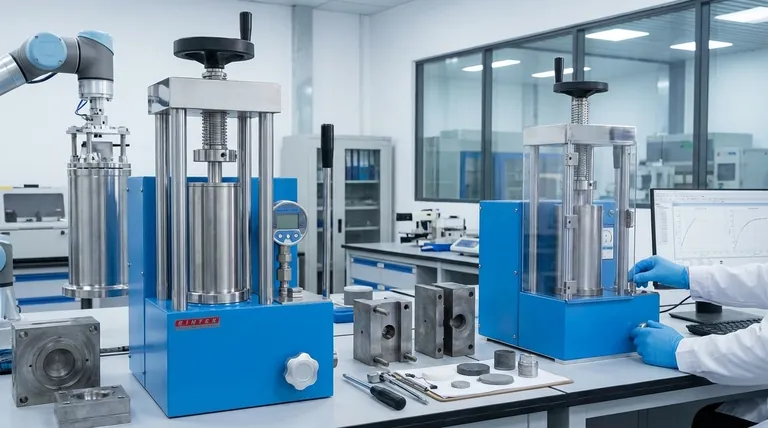
Tailoring Physical Dimensions and Capacity
Scaling for Specific Applications
The most visible customization option is the physical size of the pressure vessel. Manufacturers can design units to accommodate specific product dimensions, ensuring the chamber is optimized for your sample size.
From R&D to Industrial Scale
The spectrum of available sizes allows you to align the equipment with your operational scale. Laboratory units can feature inner diameters as small as 77 mm (3 inches), which is ideal for research and development.
Handling Bulk Requirements
On the opposite end of the spectrum, industrial-grade presses can be customized to exceed 2 meters (6 ft) in width. This capacity is essential for handling bulk production requirements or particularly large components.
Customizing Process Control and Pressure
High-Pressure Capabilities
For industries requiring extreme densification, presses can be engineered to achieve pressures up to 900 MPa (130,000 psi). This high-pressure capability is critical for achieving desired material properties in hard metals and advanced ceramics.
Controlled Pressurization Rates
Beyond maximum pressure, you can customize the rate at which pressure is applied. High pressurization rates can be engineered into the system to improve cycle times and process efficiency.
Specialized Depressurization Profiles
Perhaps the most critical customization for fragile materials is the depressurization profile. You can tailor how the machine releases pressure to prevent cracks or defects in sensitive materials like composites or complex ceramics.
Enhancing Workflow and Automation
Automated Loading Systems
To increase throughput and reduce manual handling, these presses can be integrated with fully automated loading and unloading systems. This is particularly valuable for high-volume testing or pilot production lines.
Auxiliary Equipment Modules
Customization often extends to the peripheral equipment required for operation. This includes specialized press moulds and tools designed for your specific sample shapes.
Heavy Lifting Integration
For larger batch processing, the system can include integrated cranes. These assists in the batch loading and unloading of heavier moulds, improving safety and workflow speed.
Understanding the Trade-offs
Balancing Pressure vs. Material Needs
While high-pressure capabilities (up to 900 MPa) are available, they may not be necessary for all applications. Materials like plastics or softer composites often require significantly less force than metals.
Complexity of Automation
Adding fully automated loading systems and customized depressurization profiles increases operational efficiency but also adds mechanical complexity. It is vital to ensure that the level of automation matches your actual throughput needs to avoid unnecessary maintenance overhead.
Making the Right Choice for Your Goal
To select the correct configuration, you must align the customization options with your primary operational objective.
- If your primary focus is R&D and Prototyping: Prioritize a smaller inner diameter (e.g., 77 mm) and highly flexible depressurization profiles to test various delicate materials safely.
- If your primary focus is Production Efficiency: Focus on automated loading/unloading systems and high pressurization rates to maximize daily throughput.
- If your primary focus is Material Densification: Ensure the unit is rated for maximum pressure (up to 900 MPa) to guarantee sufficient compaction for metals and ceramics.
Select the configuration that solves your specific material challenges today while leaving room for the scale of tomorrow.
Summary Table:
| Customization Area | Key Options | Ideal For |
|---|---|---|
| Physical Dimensions | Inner diameter: 77mm to 2m+ | Scaling from R&D to industrial production |
| Pressure Control | Up to 900 MPa, programmable pressurization/depressurization | Material densification, fragile materials |
| Automation & Workflow | Automated loading, specialized molds, integrated cranes | High-throughput production, safety enhancement |
Ready to customize an electric lab cold isostatic press for your specific needs? KINTEK specializes in lab press machines (including automatic lab presses, isostatic presses, and heated lab presses), serving laboratories with tailored solutions. Our experts will help you select the perfect configuration—whether you need high-pressure capabilities up to 900 MPa for material densification, automated loading for production efficiency, or precise depressurization profiles for R&D. Contact us today to discuss your requirements and achieve consistent, reliable results!
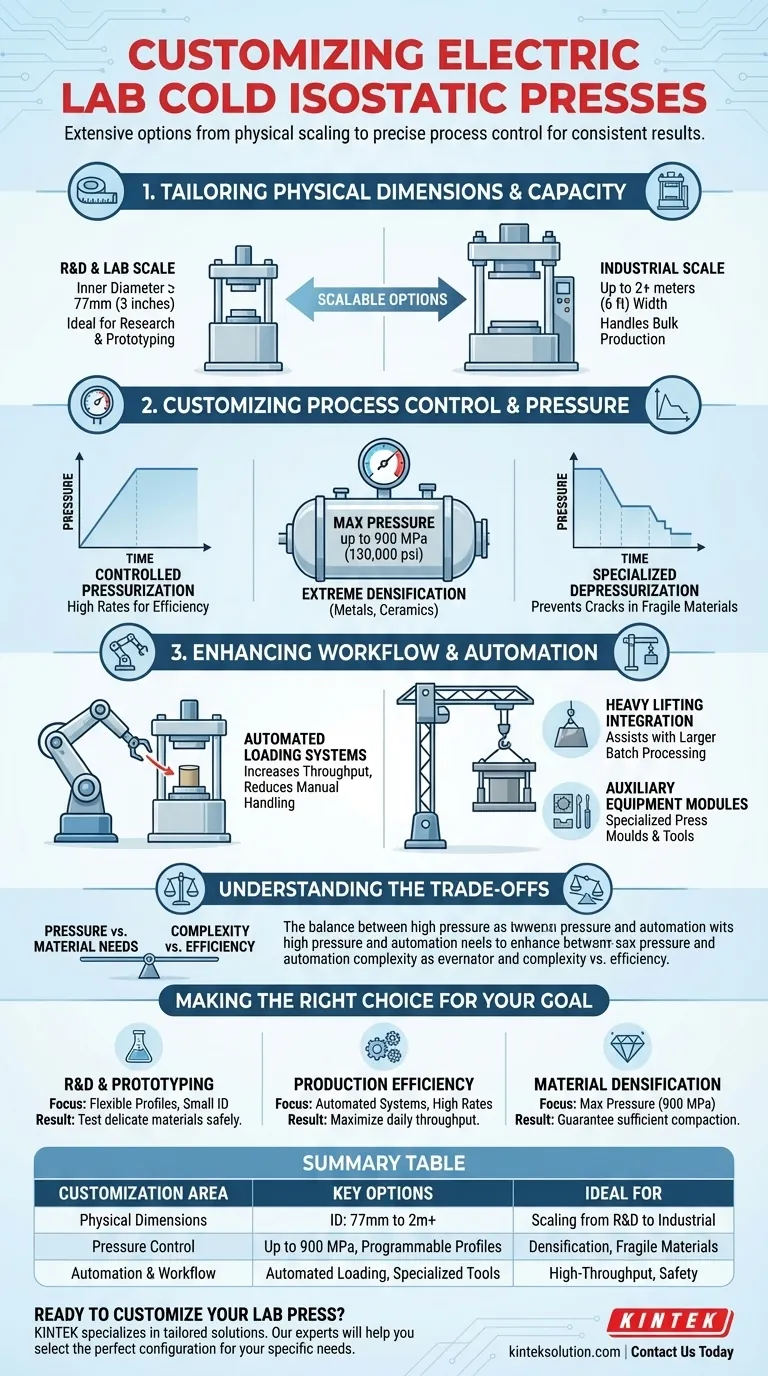
Visual Guide
Related Products
- Electric Lab Cold Isostatic Press CIP Machine
- Electric Split Lab Cold Isostatic Pressing CIP Machine
- Automatic Lab Cold Isostatic Pressing CIP Machine
- Manual Cold Isostatic Pressing CIP Machine Pellet Press
- Lab Isostatic Pressing Molds for Isostatic Molding
People Also Ask
- What role do electric lab cold isostatic presses play in industrial contexts? Bridge R&D and Manufacturing with Precision
- What are the applications of electric lab cold isostatic presses in research settings? Advance Material R&D with High-Pressure CIPs
- How does electrical Cold Isostatic Pressing (CIP) contribute to cost savings? Unlock Efficiency and Reduce Expenses
- What are some research applications of electric lab CIPs? Unlock Uniform Powder Densification for Advanced Materials
- What are the characteristics of standard off-the-shelf electric lab CIP solutions? Achieve Immediate, Cost-Effective Processing



















