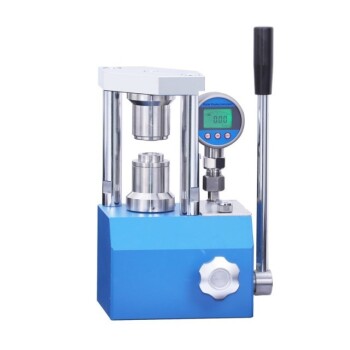
The primary function of a compacting sleeve assembly is to provide rigorous physical containment for densifying dry ice granules into solid samples. Through components such as a compaction chamber, spacers, and bushings, the assembly facilitates uniform, vertical compression stress to create a geometrically accurate and structurally sound product.
The assembly acts as a precision mold that transforms loose granules into a cohesive solid. By preventing material leakage and ensuring even stress distribution, it guarantees that the resulting samples possess the integrity required for reliable testing data.
The Mechanics of Containment and Compression
Establishing Physical Containment
The fundamental role of the assembly is to hold loose dry ice granules in a fixed space. Components like the compaction chamber, spacers, and bushings work together to define the volume of the sample.
This containment is critical for the densification process. Without a secure boundary, the granules would displace rather than compact, making solidification impossible.
Directing Vertical Stress
The design of the sleeve assembly ensures that force is applied specifically as vertical compression stress. This directionality is vital for consistent density.
By guiding the force vertically, the assembly prevents lateral dissipation of energy. This ensures the maximum amount of force is utilized for compaction rather than structural deformation.
Ensuring Sample Integrity and Quality
Preventing Uneven Stress Distribution
A key function of the assembly is to standardize how force impacts the material. It prevents uneven stress distribution, which can lead to weak points or cracks within the dry ice block.
Uniform stress ensures the internal structure of the sample is consistent throughout. This homogeneity is essential for the validity of subsequent physical tests.
Eliminating Material Leakage
The tight tolerances of the assembly components serve to prevent material leakage during high-pressure compaction. If granules escape the chamber, the density calculations and sample dimensions become compromised.
Guaranteeing Geometric Accuracy
Ultimately, the assembly ensures the final sample meets precise geometric specifications. The physical support provided by the sleeve forces the dry ice to adopt the exact shape required for testing.
This geometric accuracy ensures that the sample fits perfectly into testing apparatuses, reducing variables during experimentation.
The Critical Importance of Assembly Precision
The Risks of Poor Alignment
While the assembly is designed for vertical stress, any misalignment in the components can lead to shear forces. This can introduce structural flaws that are not immediately visible but will cause the sample to fail prematurely under test conditions.
The Impact of Component Wear
The effectiveness of the assembly relies on the tight interaction between the bushings, spacers, and chamber. Wear on these components can compromise the containment, leading to minor leakage or slight variations in pressure application that skew results.
Making the Right Choice for Your Goal
To ensure your dry ice samples yield valid experimental data, focus on the specific role the assembly plays in your formation process:
- If your primary focus is structural integrity: Ensure the assembly components (spacers and bushings) are free of wear to guarantee uniform stress distribution and prevent internal fracturing.
- If your primary focus is dimensional accuracy: Verify that the compaction chamber retains its rigid shape to prevent material leakage and ensure precise geometric output.
A well-maintained compacting sleeve assembly is the difference between a collection of compressed granules and a scientifically valid test specimen.
Summary Table:
| Component | Primary Function | Impact on Sample Quality |
|---|---|---|
| Compaction Chamber | Defines volume and provides rigid containment | Ensures precise geometric shape and dimensions |
| Spacers & Bushings | Guides vertical compression stress | Prevents internal fracturing and uneven density |
| Sealing Surfaces | Eliminates material leakage during pressure | Guarantees accurate mass-to-volume calculations |
| Precision Alignment | Prevents lateral energy dissipation | Ensures structural homogeneity for reliable testing |
Precision Laboratory Pressing Solutions by KINTEK
Ensure the integrity of your research materials with KINTEK’s advanced laboratory pressing technology. From specialized dry ice formation to complex battery research, we provide the precision tools necessary for consistent, high-quality results.
Why Choose KINTEK?
- Comprehensive Range: We offer manual, automatic, heated, and multifunctional models.
- Advanced Technology: Explore our cold and warm isostatic presses for superior material densification.
- Expertly Engineered: Our equipment is designed for durability and ease of use in diverse environments, including glovebox-compatible setups.
Take the guesswork out of sample preparation and achieve scientifically valid results every time. Contact KINTEK today to find the perfect pressing solution for your lab!
References
- John C. Morka, J. E. Okoh. Determination of the Poisson ratio of Dry Ice as a Function of its Density. DOI: 10.62292/njp.v33i1.2024.201
This article is also based on technical information from Kintek Solution Knowledge Base .
Related Products
- Lab Button Battery Disassembly and Sealing Mold
- Lab Cylindrical Press Mold for Laboratory Use
- Lab Infrared Press Mold for No Demolding
- Laboratory Hydraulic Split Electric Lab Pellet Press
- Laboratory Hydraulic Press Lab Pellet Press Machine for Glove Box
People Also Ask
- How does a sealed battery mold facilitate the assembly and testing of asymmetric supercapacitors using VO2?
- What is the function of specialized battery molds and sealing consumables? Optimize Your In-situ XRD Testing Today
- How does the geometry of laboratory molds influence mycelium-based composites? Optimize Density and Strength
- Why are specialized battery test molds used? Ensure Peak Performance for All-Solid-State Sodium Batteries (ASSIBs)
- What role do battery testing molds play in electrolyte performance? Exploring Pressure vs. Viscoelasticity