
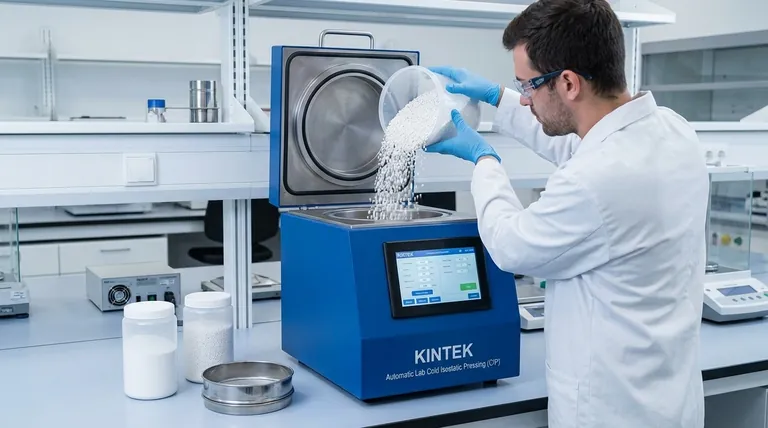
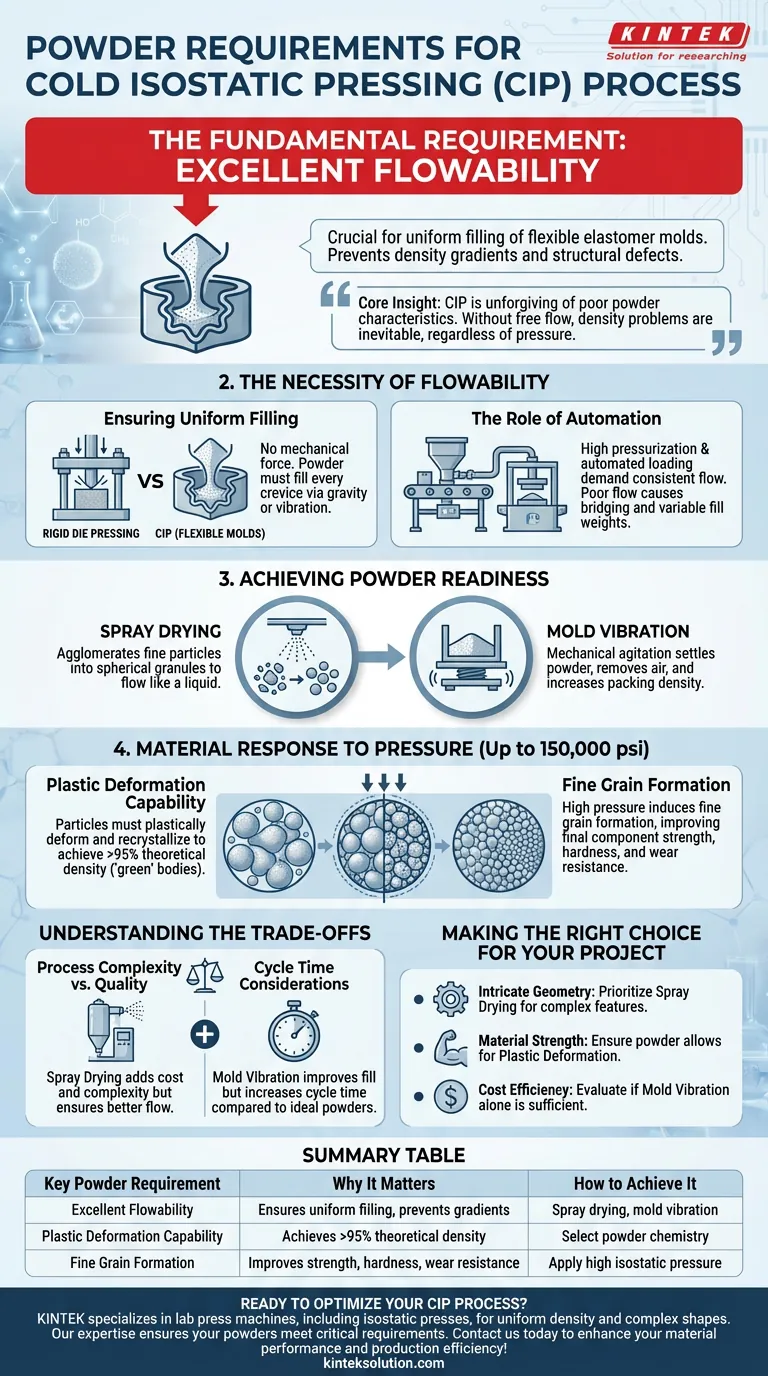
The fundamental requirement for powders used in Cold Isostatic Pressing (CIP) is excellent flowability. Because the process involves filling flexible elastomer molds rather than rigid dies, the powder must distribute itself evenly and densely into every crevice of the mold cavity to ensure a uniform component.
Core Insight: While CIP can densify a wide variety of materials, the process is unforgiving of poor powder characteristics. If the powder does not flow freely during the filling stage, you will inevitably encounter density gradients and structural defects, regardless of how high the hydrostatic pressure is applied.
The Necessity of Flowability
Ensuring Uniform Filling
The primary challenge in CIP is filling the mold, which is typically made of flexible materials like urethane, rubber, or polyvinyl chloride.
Unlike rigid die pressing, there is no mechanical ram to force powder into corners. The powder must flow under gravity or slight vibration to fill complex shapes completely.
The Role of Automation
For automated systems, which feature high pressurization rates and automated loading, flowability is even more critical. Poor flow causes bridging and variable fill weights, disrupting the uniformity required for mass production.
Achieving Powder Readiness
Spray Drying
Raw powders often lack the necessary flow characteristics naturally. To correct this, manufacturers frequently employ spray drying.
This process agglomerates fine particles into spherical granules, significantly improving their ability to flow like a liquid into the mold.
Mold Vibration
In addition to powder treatment, the process often requires mold vibration during the filling stage.
This mechanical agitation helps settle the powder, removing air pockets and ensuring a higher initial packing density before pressure is applied.
Material Response to Pressure
Plastic Deformation capability
The powder selected must respond effectively to high pressure (up to 150,000 psi). The material must undergo plastic deformation and recrystallization.
This response is what allows the CIP process to achieve "green" bodies (unfired parts) with densities often exceeding 95% of theoretical density.
Fine Grain Formation
The high pressure applied to the powder should induce the formation of fine grains. This microstructural change is essential for improving the final component's strength, hardness, and wear resistance.
Understanding the Trade-offs
Process Complexity vs. Quality
Achieving the required flowability introduces a clear trade-off: added cost and complexity.
Implementing spray drying adds a distinct processing step and energy cost before the material even reaches the press.
Cycle Time Considerations
Using mold vibration to compensate for powder flow issues increases the cycle time. While it ensures a better fill, it slows down the throughput compared to a "pour-and-press" scenario with perfectly engineered powders.
Making the Right Choice for Your Project
To optimize your CIP results, match your powder preparation to your performance goals:
- If your primary focus is intricate geometry: Prioritize spray drying to ensure the powder flows into complex mold features without bridging.
- If your primary focus is material strength: Ensure your powder chemistry allows for plastic deformation under pressure to maximize density and grain refinement.
- If your primary focus is cost efficiency: Evaluate if mold vibration alone is sufficient to achieve adequate packing, potentially skipping the expensive spray drying step.
Success in Cold Isostatic Pressing is less about the pressure applied and more about the quality and preparation of the powder before the cycle begins.
Summary Table:
| Key Powder Requirement | Why It Matters | How to Achieve It |
|---|---|---|
| Excellent Flowability | Ensures uniform filling of complex elastomer molds, preventing density gradients. | Spray drying to create spherical granules; mold vibration during filling. |
| Plastic Deformation Capability | Allows particles to densify under high pressure (up to 150,000 psi), achieving >95% theoretical density. | Select powder chemistry that deforms plastically and recrystallizes under pressure. |
| Fine Grain Formation | Improves final component strength, hardness, and wear resistance after pressing. | Apply high isostatic pressure to induce grain refinement in the green body. |
Ready to optimize your CIP process with the right powder preparation? KINTEK specializes in lab press machines, including isostatic presses, that help you achieve uniform density and complex shapes for your laboratory needs. Our expertise ensures your powders meet the critical requirements for flowability and deformation. Contact us today to discuss how our solutions can enhance your material performance and production efficiency!
Visual Guide
Related Products
- Automatic Lab Cold Isostatic Pressing CIP Machine
- Electric Lab Cold Isostatic Press CIP Machine
- Manual Cold Isostatic Pressing CIP Machine Pellet Press
- Electric Split Lab Cold Isostatic Pressing CIP Machine
- Lab Isostatic Pressing Molds for Isostatic Molding
People Also Ask
- What are the key features of automated laboratory Cold Isostatic Press (CIP) systems? Achieve Precise, High-Pressure Powder Consolidation
- Why is an Isostatic Press (CIP) Necessary After Uniaxial Pressing? Achieve Transparency in Nd:Y2O3 Ceramics
- What is the primary function of a Cold Isostatic Press (CIP) in NASICON preparation? Achieve 96% Theoretical Density
- How does a Cold Isostatic Press (CIP) facilitate the preparation of CaO-doped silicon carbide (SiC) green bodies?
- How does a Cold Isostatic Press (CIP) increase Bi-2223/Ag current density? Boost Superconductivity with Uniform Pressure


















