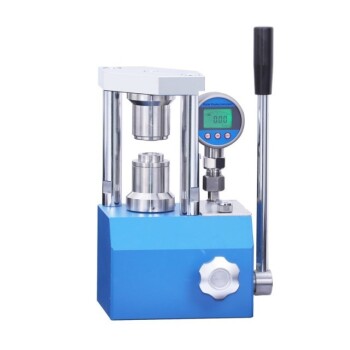
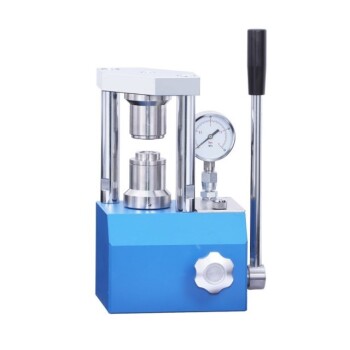
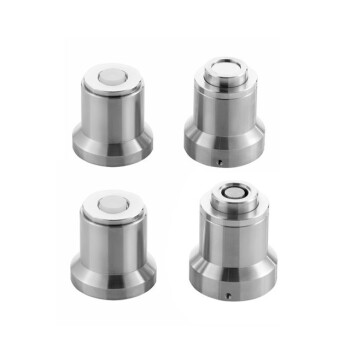
A high-precision laboratory press or crimper serves as the critical final step in battery assembly, ensuring both structural integrity and electrochemical viability. Its primary function is to apply consistent, precise mechanical pressure to the CR2032 coin cell, creating an airtight seal that prevents electrolyte leakage and environmental contamination while compressing internal components to minimize contact resistance.
Core Takeaway The crimper does more than just close the casing; it establishes the fundamental physical conditions required for electron flow. By applying precise pressure, it creates a stable, isolated electrochemical environment, which is the prerequisite for obtaining accurate, reproducible data on battery performance.
The Dual Objectives of Precise Sealing
The function of the laboratory press can be divided into two distinct but equally critical physical objectives: hermetic isolation and internal connectivity.
Achieving Hermetic Isolation
The most immediate function of the crimper is to permanently deform the stainless steel coin cell case against the sealing gasket.
This mechanical action creates an airtight (hermetic) seal that effectively contains the liquid electrolyte inside the cell.
Simultaneously, this barrier prevents the ingress of external impurities, such as moisture and oxygen, which can degrade sensitive electrode materials and skew test results.
Optimizing Internal Connectivity
Beyond sealing the shell, the press applies vertical compression to the internal "stack"—the anode, separator, cathode, spacers, and spring.
This compression eliminates gaps between layers, establishing tight physical contact between the active electrodes and the current collectors.
The result is a significant reduction in internal contact resistance (ohmic impedance), ensuring the battery operates efficiently without unnecessary voltage drops.
The Impact on Experimental Validity
For researchers and engineers, the precision of the crimping process is directly linked to the reliability of their data.
Ensuring Data Reproducibility
Inconsistent pressure during sealing leads to variable internal resistance from cell to cell.
A high-precision crimper ensures that every cell in a batch is subjected to the exact same mechanical force.
This uniformity allows researchers to attribute performance differences to material chemistry rather than assembly inconsistencies.
Managing Sensitive Chemistries
Advanced battery chemistries, such as solid-state or sodium-ion systems, are particularly sensitive to interfacial pressure.
For example, in PEO-based solid-state batteries, the crimper maintains stable contact between the bilayer electrolyte and the lithium metal anode.
This is essential for reducing interfacial impedance and obtaining accurate cycle life data.
Understanding the Trade-offs
While pressure is necessary, the application of force must be carefully balanced. It is not simply a matter of "tighter is better."
The Risk of Under-Compression
If the pressure applied by the crimper is insufficient, the seal will fail to engage the gasket fully.
This leads to the volatilization of the electrolyte and the eventual entry of air, causing the cell to fail prematurely.
Additionally, loose internal components result in high impedance, which manifests as poor rate performance during testing.
The Danger of Over-Compression
Conversely, excessive mechanical pressure can structurally damage the internal components.
Over-compression may puncture the delicate separator or crush the electrode materials.
This can lead to internal short circuits, rendering the cell dangerous or electrically dead before testing even begins.
Making the Right Choice for Your Goals
To maximize the utility of your laboratory press, consider how its function aligns with your specific testing parameters.
- If your primary focus is Cycle Life Testing: Prioritize a crimper with verified hermetic consistency to prevent electrolyte evaporation over weeks of testing.
- If your primary focus is Rate Performance: Ensure your equipment provides uniform, high-pressure compression to minimize internal ohmic resistance.
- If your primary focus is Solid-State Research: Select a crimper capable of applying higher, stable pressures to maintain difficult solid-solid interfacial contact.
The laboratory press is not merely a packaging tool; it is the instrument that defines the internal geometry and environmental security of your electrochemical cell.
Summary Table:
| Function Category | Primary Role | Impact on Battery Performance |
|---|---|---|
| Hermetic Sealing | Deforms casing against gasket | Prevents electrolyte leakage & moisture ingress |
| Internal Contact | Vertical stack compression | Minimizes contact resistance (Ohmic impedance) |
| Data Consistency | Uniform pressure application | Ensures cell-to-cell reproducibility |
| Structural Safety | Precision force control | Prevents separator puncture & internal shorts |
Elevate Your Battery Research with KINTEK Precision
Don’t let assembly inconsistencies compromise your electrochemical data. KINTEK specializes in comprehensive laboratory pressing solutions designed for the rigorous demands of battery research. Whether you are developing next-generation lithium-ion cells or exploring sensitive solid-state chemistries, our range of manual, automatic, heated, and glovebox-compatible models—including advanced cold and warm isostatic presses—delivers the exact pressure control you need.
Why choose KINTEK?
- Superior Seal Integrity: Ensure airtight CR2032 assembly every time.
- Versatile Solutions: Equipment tailored for everything from standard coin cells to complex isostatic pressing.
- Expert Support: Our tools are built to minimize impedance and maximize reproducibility.
Ready to optimize your lab’s efficiency and data accuracy? Contact KINTEK today for a consultation!
References
- Junjun Zhou, Yuling Wang. Ultrathin Al <sub>2</sub> O <sub>3</sub> ‐Coated Biomass Carbon for Sodium‐Ion Batteries via a Synergistic Storage Mechanism. DOI: 10.1002/cey2.70121
This article is also based on technical information from Kintek Solution Knowledge Base .
Related Products
- Button Battery Sealing Machine for Button Batteries
- Manual Button Battery Sealing Machine for Battery Sealing
- Lab Button Battery Disassembly and Sealing Mold
- Lab Button Battery Tablet Press Sealing Mold
- Button Battery Sealing Press Machine for Lab
People Also Ask
- Why is a laboratory hydraulic press or battery sealing machine essential? Ensure Coin Cell Data Integrity
- What role does a laboratory press perform for CR2032 coin cell assembly? Ensure Precision in Battery Research
- Why is a high-pressure manual or automatic coin cell crimper required? Optimize Solid-State Battery Performance
- How does a high-precision lab press or coin cell crimper affect the performance of assembled lithium-metal batteries?
- How does the mechanical pressure provided by a laboratory crimper affect the performance of assembled 2032-type coin cells?