
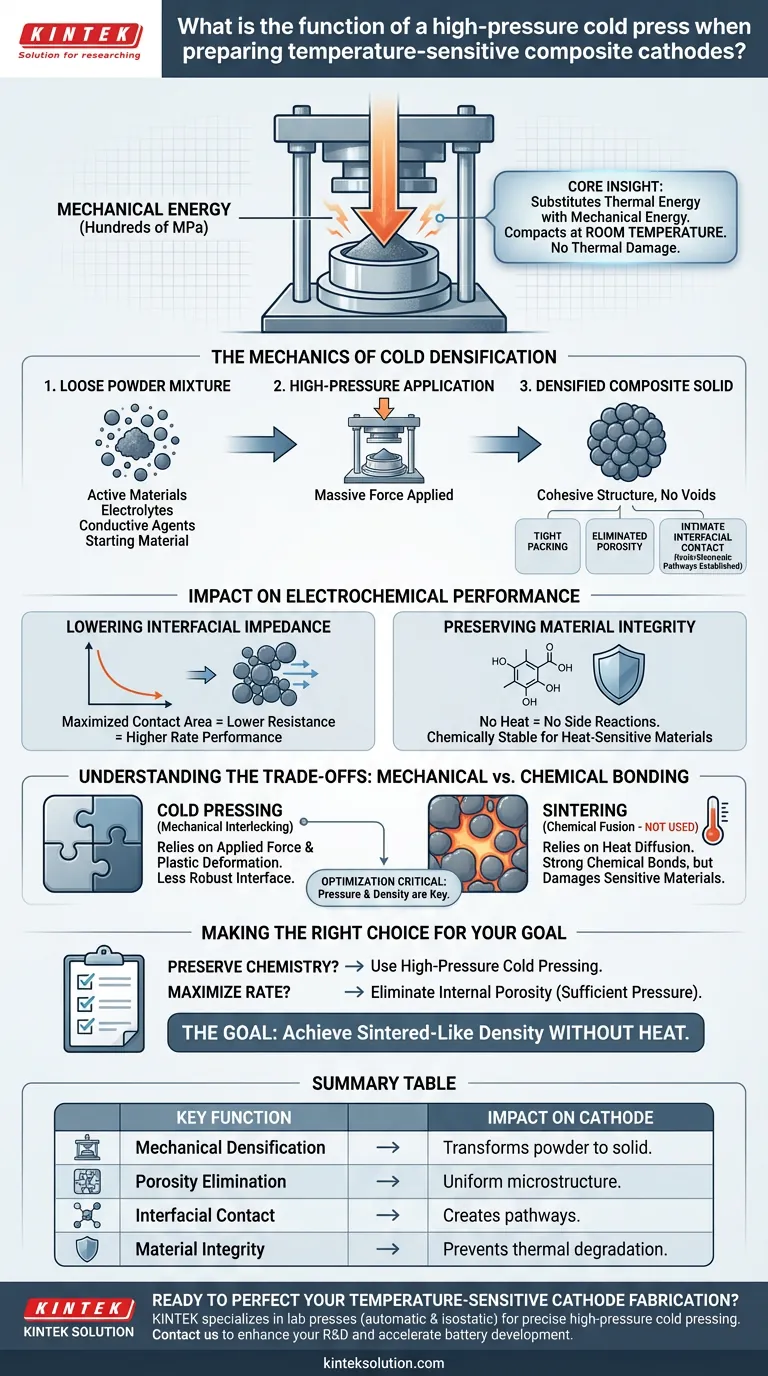
A high-pressure cold press functions as the primary mechanical densification tool for composite cathodes that cannot withstand thermal processing. By applying substantial force—often reaching several hundred megapascals (MPa)—at room temperature, it compacts powder mixtures into a cohesive electrode structure, establishing essential conductive pathways without subjecting sensitive materials to damaging heat.
Core Insight: The definitive role of a cold press is to substitute thermal energy with mechanical energy. It forces active materials and solid electrolytes into intimate physical contact, eliminating internal voids and lowering interfacial impedance in systems where high-temperature sintering would compromise material integrity.
The Mechanics of Cold Densification
Compacting Powder Mixtures
In the fabrication of solid-state battery cathodes, the starting material is often a loose powder mixture comprising active materials, solid electrolytes, and conductive agents.
The cold press applies massive pressure to force these discrete particles into a tightly packed arrangement. This mechanical action significantly reduces the distance between particles, transforming a loose powder into a dense composite solid.
Eliminating Internal Porosity
A primary objective of the cold press is the reduction of internal voids.
By crushing the particles together, the process effectively eliminates porosity within the cathode layer. Removing these voids is essential for creating a uniform microstructure required for consistent battery performance.
Establishing Interfacial Contact
For a battery to function, ions and electrons must move freely between particles.
The high pressure ensures intimate physical contact between the active material and the solid electrolyte. This contact creates the "initial" continuous networks required for transport, which would otherwise be impossible in a loosely packed powder state.
Impact on Electrochemical Performance
Lowering Interfacial Impedance
The quality of the contact between particles directly correlates to resistance.
By maximizing the effective contact area, the cold press directly lowers interfacial impedance. This reduction in resistance is fundamental to achieving high capacity and superior rate performance in the final cell.
Preserving Material Integrity
Many advanced ceramic-based composites are chemically unstable at high temperatures.
Cold pressing allows for densification without thermal damage. It preserves the chemical composition of heat-sensitive materials, ensuring that the conductive pathways are formed without triggering unwanted side reactions or degradation that occur during sintering.
Understanding the Trade-offs
Mechanical vs. Chemical Bonding
While cold pressing is essential for heat-sensitive materials, it relies primarily on mechanical interlocking and plastic deformation rather than chemical bonding.
Unlike high-temperature sintering, which fuses particles through heat diffusion to create robust interfaces, cold pressing depends entirely on the applied force to maintain contact. Consequently, the resulting structure may be less mechanically robust than a sintered equivalent, making the optimization of pressure parameters critical to prevent delamination or poor connectivity.
Making the Right Choice for Your Goal
When designing a fabrication process for composite cathodes, the use of a high-pressure cold press is dictated by your material constraints.
- If your primary focus is preserving heat-sensitive chemistry: Rely on high-pressure cold pressing (hundreds of MPa) to achieve density without thermal degradation.
- If your primary focus is maximizing rate performance: Ensure the applied pressure is sufficient to eliminate almost all internal porosity, as this directly dictates ionic conductivity.
The success of a cold-pressed cathode depends not just on the pressure applied, but on achieving a density that mimics a sintered structure without the use of heat.
Summary Table:
| Key Function | Impact on Cathode |
|---|---|
| Mechanical Densification | Transforms loose powder into a dense, cohesive solid structure. |
| Porosity Elimination | Removes internal voids to create uniform microstructure for consistent performance. |
| Interfacial Contact Establishment | Forces intimate contact between particles to create essential ion/electron pathways. |
| Material Integrity Preservation | Enables densification at room temperature, avoiding thermal degradation. |
Ready to perfect your temperature-sensitive cathode fabrication? KINTEK specializes in lab press machines, including automatic and isostatic presses, designed to deliver the precise high-pressure cold pressing your R&D requires. Our equipment helps you achieve the dense, void-free electrode structures critical for maximizing battery performance, all while preserving your sensitive materials. Contact us today via our [#ContactForm] to discuss how our solutions can enhance your laboratory's capabilities and accelerate your solid-state battery development.
Visual Guide
Related Products
- Electric Lab Cold Isostatic Press CIP Machine
- Special Shape Lab Press Mold for Laboratory Applications
- Automatic High Temperature Heated Hydraulic Press Machine with Heated Plates for Lab
- Manual Cold Isostatic Pressing CIP Machine Pellet Press
- Electric Split Lab Cold Isostatic Pressing CIP Machine
People Also Ask
- What role do electric lab cold isostatic presses play in industrial contexts? Bridge R&D and Manufacturing with Precision
- What are the applications of electric lab cold isostatic presses in research settings? Advance Material R&D with High-Pressure CIPs
- How does electrical Cold Isostatic Pressing (CIP) contribute to cost savings? Unlock Efficiency and Reduce Expenses
- What are some research applications of electric lab CIPs? Unlock Uniform Powder Densification for Advanced Materials
- What are the characteristics of standard off-the-shelf electric lab CIP solutions? Achieve Immediate, Cost-Effective Processing



















