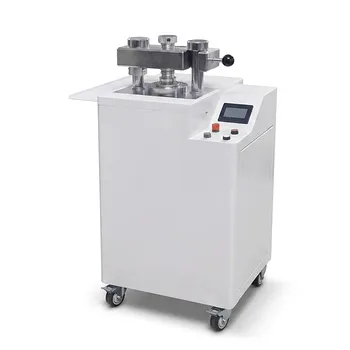
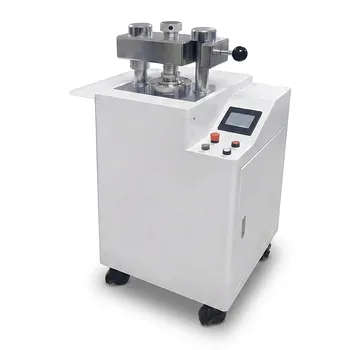
The primary function of a laboratory hydraulic press is to transform loose microcrystalline MOF powders into dense, self-supporting pellets through high-pressure mechanical consolidation. This process eliminates air-filled voids and maximizes particle-to-particle contact within the material. By creating a dense solid, the press ensures that electrochemical measurements accurately reflect the intrinsic bulk properties of the Metal-Organic Framework rather than being skewed by internal resistance.
The laboratory hydraulic press serves as the bridge between synthesized powder and a testable solid-state component. Its role is to minimize grain boundary impedance and standardize sample geometry, which is essential for obtaining reliable and reproducible ionic conductivity data.
Maximizing Ion Transport Efficiency
Reducing Grain Boundary Impedance
In its powder form, a MOF consists of individual crystals separated by significant air gaps. High-pressure compaction reduces these voids, lowering the grain boundary impedance that would otherwise hinder ion movement.
Creating Continuous Ion Pathways
The press forces particles into intimate contact, creating a continuous pathway for charge carriers. This densification is critical for achieving high ionic conductivity, as it allows ions to transition across particle interfaces with minimal resistance.
Minimizing Internal Porosity
Uncompressed powders contain internal "dead space" that does not contribute to ion transport. The hydraulic press applies uniaxial pressure (often ranging from 10 MPa to 370 MPa) to squeeze out air, ensuring the electrolyte is a "green body" with sufficient packing density.
Ensuring Data Accuracy and Reproducibility
Eliminating Measurement Artifacts
When performing Electrochemical Impedance Spectroscopy (EIS), air gaps can be mistaken for high material resistance. A laboratory press ensures the resulting data reflects the bulk properties of the MOF rather than artifacts caused by poor particle connectivity.
Geometric Standardization
The use of a precision die with the press allows for the creation of pellets with a consistent diameter and thickness (often as thin as 200 μm). This standardization is vital because geometric dimensions are core variables in the mathematical formulas used to calculate ionic conductivity.
Improving Interfacial Contact
A smooth, flat pellet surface is required for effective contact with electrodes in a battery cell or test fixture. The press creates a uniform surface morphology, which minimizes interfacial resistance between the MOF electrolyte and the metal current collectors.
Critical Considerations and Trade-offs
Risk of Framework Collapse
While high pressure increases density, MOFs are crystalline porous materials that can be sensitive to mechanical stress. Excessive pressure may collapse the internal pore structure, which can actually decrease ionic conductivity if the ion transport relies on those internal channels.
Non-Uniform Density Distribution
Friction between the powder and the walls of the pellet die can lead to pressure gradients within the sample. This can result in a pellet that is denser at the edges than in the center, potentially leading to structural cracks or inconsistent electrochemical performance.
Elastic Recovery (Spring-back)
Some MOF materials exhibit "spring-back" after the pressure is released from the hydraulic press. If the material expands too much, it can introduce micro-cracks that increase resistance, making the hold time under pressure a critical factor for pellet stability.
Optimizing Your Pellet Fabrication
To achieve the best results when preparing MOF-based solid electrolytes, the pressure application must be tailored to the specific material properties and testing goals.
- If your primary focus is Maximizing Conductivity: Apply the highest pressure the MOF framework can withstand without structural collapse to minimize grain boundary resistance.
- If your primary focus is Pore Integrity: Use lower, incremental pressure settings and verify the crystalline structure via X-ray diffraction (XRD) after pressing.
- If your primary focus is Battery Cycling: Ensure the pellet is pressed to a thickness that balances mechanical robustness with low total cell resistance.
Proper utilization of a hydraulic press transforms a laboratory-scale powder into a high-performance electrochemical component.
Summary Table:
| Function | Electrochemical Impact | Critical Parameter |
|---|---|---|
| Powder Consolidation | Reduces grain boundary impedance; creates ion pathways. | Pressure (10 - 370 MPa) |
| Geometric Standardization | Ensures reliable ionic conductivity calculations via uniform dimensions. | Precision Pellet Die Selection |
| Surface Smoothing | Improves interfacial contact with metal current collectors. | Platen Parallelism |
| Density Maximization | Eliminates air-filled voids that skew EIS measurement artifacts. | Pressing Hold Time |
Elevate Your Battery Research with KINTEK Precision Pressing
Unlock the full potential of your energy materials with KINTEK’s comprehensive laboratory pressing solutions. We specialize in providing the stability and precision needed for sensitive MOF-based solid electrolytes, offering a range of manual, automatic, heated, multifunctional, and glovebox-compatible models, as well as cold and warm isostatic presses designed for high-performance battery research.
Don't let irregular pellet density or internal resistance compromise your data. Contact KINTEK today to find the perfect pressing configuration for your specific material requirements and ensure your electrochemical results are both reliable and reproducible!
References
- Zina Deriche, Stavroula Kampouri. Navigating ionic conductivity in MOF electrolytes: addressing measurement pitfalls and performance limits. DOI: 10.1039/d5ta04415d
This article is also based on technical information from Kintek Solution Knowledge Base .
Related Products
- Automatic Laboratory Hydraulic Press for XRF and KBR Pellet Pressing
- Laboratory Hydraulic Pellet Press for XRF KBR FTIR Lab Press
- Automatic XRF Pellet Press for Laboratory Spectrometry Sample Preparation
- Laboratory Hydraulic Press 2T Lab Pellet Press for KBR FTIR
- Laboratory Hydraulic Split Electric Lab Pellet Press
People Also Ask
- Why is pressing powder into a pellet critical before sintering? Ensure Dense, Conductive Solid-State Electrolytes
- What is the role of a laboratory pressure machine and KBr in FTIR? Master Sample Preparation for Flame Retardants
- What are the advantages of using a laboratory automatic hydraulic press for HEA green compact forming?
- What are the advantages of using a lab automatic hydraulic press for HEA green body molding? Ensure Material Integrity
- What are the advantages of using an automatic laboratory hydraulic press? Enhance Precision in Sample Preparation