
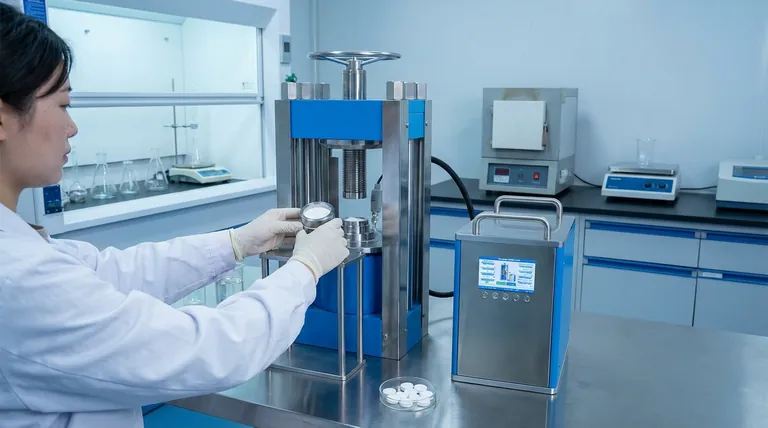
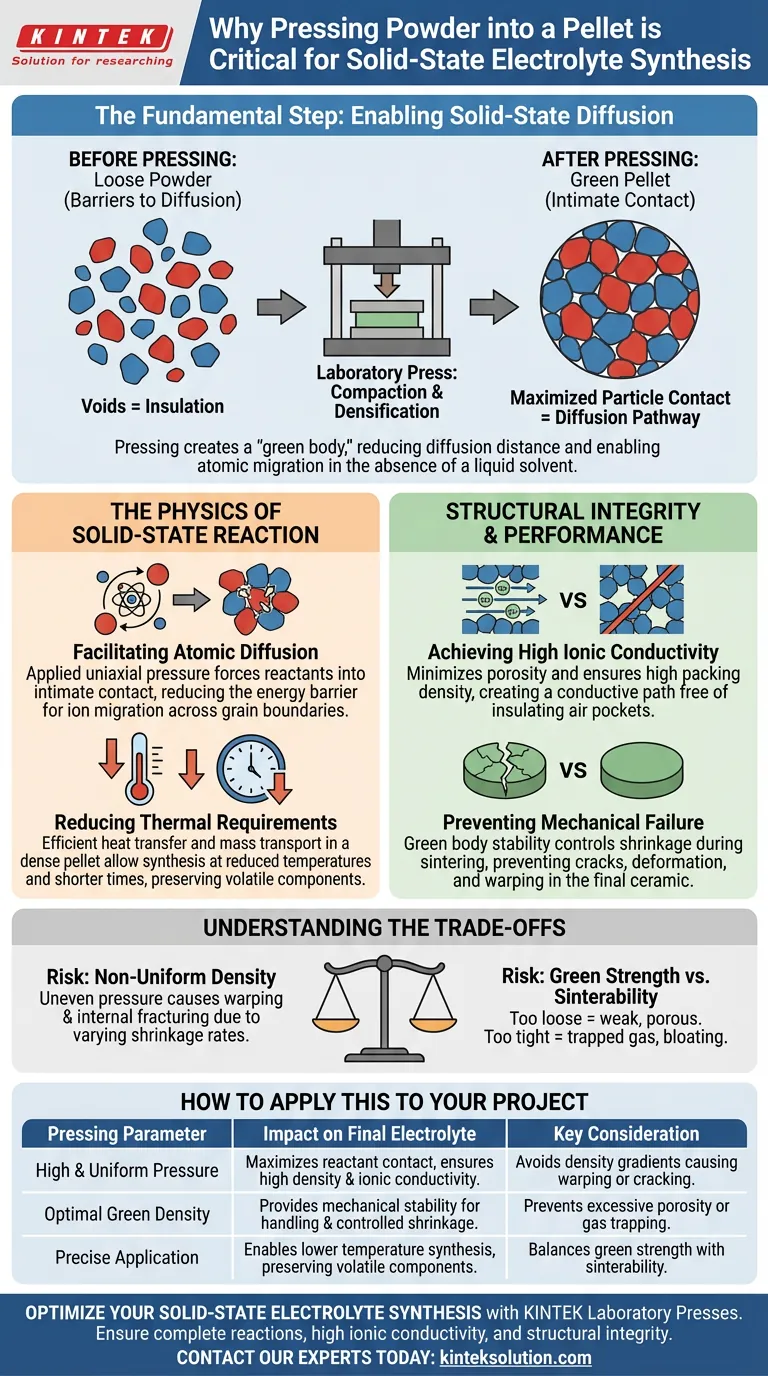
Pressing powder into a pellet is the fundamental step that enables solid-state diffusion. In the absence of a liquid solvent, the chemical reactions required to synthesize electrolytes occur solely through the physical movement of atoms between solid particles. Pressing the powder compacts it into a "green body," maximizing particle-to-particle contact and eliminating the voids that would otherwise act as barriers to this atomic migration.
By converting loose powder into a dense, mechanically stable pellet, you reduce the diffusion distance between reactants. This intimate contact is the primary driver that allows the subsequent sintering process to occur at lower temperatures and shorter timeframes while ensuring the final material is dense, conductive, and chemically pure.
The Physics of Solid-State Reaction
Facilitating Atomic Diffusion
In solid-state synthesis, the raw materials (often precursors like lithium, aluminum, or germanium compounds) are distinct solids. For them to react and form a new phase, ions must physically diffuse across grain boundaries.
Pressing bridges the gap. By applying uniaxial pressure, you force reactant particles into intimate physical contact. This reduces the energy barrier required for atoms to migrate from one particle to another, facilitating a complete and uniform chemical reaction.
Reducing Thermal Requirements
When particles are loosely packed, the heat required to drive the reaction (sintering temperature) must be significantly higher to overcome the lack of contact points.
A highly compacted green pellet increases the efficiency of heat transfer and mass transport. This allows the synthesis to proceed at reduced temperatures and shorter durations, preserving the stoichiometry of volatile components (like lithium) that might otherwise evaporate under excessive heat.
Structural Integrity and Performance
Achieving High Ionic Conductivity
For an electrolyte to function, ions must move freely through the material. Porosity (air pockets) acts as an insulator, drastically lowering ionic conductivity.
The pressing stage minimizes inter-particle voids before heating begins. This creates a solid foundation for densification, ensuring the final ceramic electrolyte has low porosity and high packing density, which are direct prerequisites for optimal electrochemical performance.
Preventing Mechanical Failure
During sintering, materials undergo volume changes as they densify and react. If the starting powder is loosely packed, this shrinkage is drastic and often uneven.
Pressing creates a "green body" with specific mechanical strength and initial density. This structural stability helps control shrinkage during the high-temperature phase, preventing the formation of cracks, deformation, or warping in the finished product.
Understanding the Trade-offs
While pressing is critical, the application of pressure must be precise to avoid synthesis defects.
The Risk of Non-Uniform Density
If pressure is applied unevenly, the green pellet will have density gradients—areas that are tightly packed alongside areas that are loose. During sintering, these areas will shrink at different rates, leading to warping or internal fracturing.
Balancing Green Strength vs. Sinterability
There is a specific window of "green density" required. If the pellet is pressed too loosely, it lacks the mechanical strength to be handled and will result in a porous, low-conductivity product. Conversely, extreme pressure without proper binder burnout (if binders are used) can trap gases, leading to bloating or defects during the heating stage.
How to Apply This to Your Project
To maximize the quality of your solid-state electrolyte, tailor your pressing parameters to your specific outcome:
- If your primary focus is Chemical Purity: Ensure high pressing density to maximize reactant contact, which promotes a complete reaction and eliminates unreacted secondary phases.
- If your primary focus is Ionic Conductivity: Prioritize the elimination of voids through uniform high-pressure compaction to ensure the final sintered pellet is dense and non-porous.
Ultimately, the quality of your final electrolyte is determined by the density and uniformity of the green body you create before the furnace is ever turned on.
Summary Table:
| Pressing Parameter | Impact on Final Electrolyte | Key Consideration |
|---|---|---|
| High & Uniform Pressure | Maximizes reactant contact, promotes complete reaction, ensures high density and ionic conductivity. | Avoids density gradients that cause warping or cracking during sintering. |
| Optimal Green Density | Provides mechanical stability for handling and controlled shrinkage during sintering. | Prevents excessive porosity or gas trapping defects. |
| Precise Application | Enables synthesis at lower temperatures, preserving volatile components like lithium. | Balances green strength with sinterability to avoid bloating or fracturing. |
Ready to optimize your solid-state electrolyte synthesis? The quality of your final material is determined by the density and uniformity of the green body you create. KINTEK specializes in laboratory press machines—including automatic, isostatic, and heated lab presses—designed to deliver the precise, uniform pressure required for dense, defect-free pellets.
Ensure complete reactions, high ionic conductivity, and structural integrity in your electrolytes. Contact our experts today to find the perfect lab press for your research needs!
Visual Guide
Related Products
- Automatic Laboratory Hydraulic Press for XRF and KBR Pellet Pressing
- Laboratory Hydraulic Pellet Press for XRF KBR FTIR Lab Press
- Automatic Laboratory Hydraulic Press Lab Pellet Press Machine
- Laboratory Hydraulic Press 2T Lab Pellet Press for KBR FTIR
- Laboratory Hydraulic Split Electric Lab Pellet Press
People Also Ask
- What is the role of a laboratory pressure machine and KBr in FTIR? Master Sample Preparation for Flame Retardants
- What are the advantages of using a laboratory automatic hydraulic press for HEA green compact forming?
- What are the advantages of using a lab automatic hydraulic press for HEA green body molding? Ensure Material Integrity
- How does an automatic laboratory hydraulic press improve KBr pellet preparation? Achieve Precision IR Spectroscopy
- Why are high-precision automatic hydraulic presses required for Martian ISRU? Ensure Reliable Regolith Forming



















