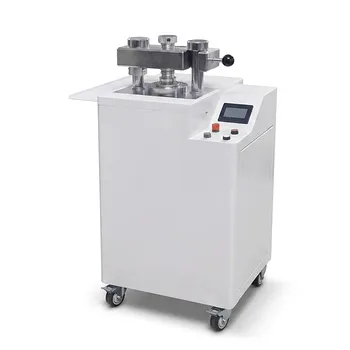
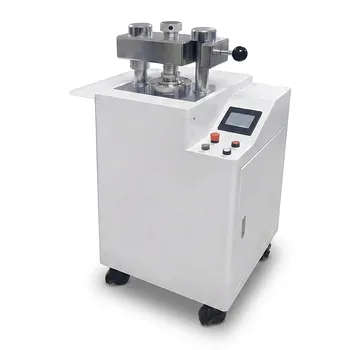
Hydraulic pellet presses are essential instruments in material science for characterizing how substances behave under extreme mechanical stress. By applying controlled high pressure, these devices allow researchers to evaluate critical mechanical properties such as elasticity, plasticity, and durability, while also serving as a primary method for preparing standardized samples for analytical testing.
The core value of a hydraulic pellet press lies in its ability to simulate extreme environmental conditions in a controlled laboratory setting. This capability transforms raw data into actionable insights, driving innovation in engineering, manufacturing, and new material synthesis.
Evaluating Material Behavior Under Stress
Simulating Extreme Pressure Environments
To predict how a material will perform in real-world applications, it must be tested against forces that exceed normal operating conditions. Hydraulic presses allow researchers to simulate high-pressure environments to observe how materials react when compressed. This is vital for industries where materials face immense structural loads, such as aerospace or construction.
Measuring Elasticity and Plasticity
A primary function of these tests is to determine a material's elasticity and plasticity. Researchers observe whether a material returns to its original shape after compression (elasticity) or undergoes permanent deformation (plasticity). Understanding these thresholds is crucial for selecting the right materials for specific engineering functions.
Determining Fracture Points
Beyond deformation, researchers use these presses to identify the exact fracture point of a substance. By compressing a sample until it fails, scientists can quantify its maximum strength and durability. This data helps in establishing safety margins for manufacturing and construction materials.
Sample Preparation and Standardization
Creating Homogenous Analytical Samples
In analytical chemistry and spectroscopy, the quality of the data is only as good as the quality of the sample. Hydraulic presses are used to compress powder mixtures into uniform, dense pellets. This ensures a consistent distribution of components, which is critical for obtaining accurate compositional analysis.
Densification and Dimensional Control
Hydraulic presses increase the density and strength of loose raw materials through densification. This process allows for precise control over the sample's shape and dimensions. Creating standardized samples effectively eliminates variables, making comparative studies and quality control checks reliable.
Assessing Manufacturing Suitability
Presses are also used to simulate manufacturing issues, such as blocking resistance. For example, in print materials, a press can simulate stacking pressure to test if a material will adhere to itself (block) during storage or shipping.
Driving Material Innovation
Synthesizing Composite and Superhard Materials
Hydraulic presses do more than test existing materials; they help create new ones. High-pressure conditions enable the synthesis of composite materials and superhard substances. Materials valued for exceptional hardness and heat resistance often require these intense pressure environments for their formation.
Testing Under Combined Heat and Pressure
Advanced material research often utilizes heated hydraulic presses. These devices test materials under the simultaneous stress of high temperature and high pressure. This dual-constraint testing provides deeper insights into how materials will behave in volatile or extreme industrial environments.
Understanding the Trade-offs
The Necessity of Homogeneity
While presses create dense pellets, they cannot correct a poorly mixed sample. Uniform distribution of the powder mixture prior to pressing is non-negotiable. If the raw material is not homogenous, the resulting pellet will yield skewed analytical data regardless of the press's precision.
Simulation vs. Reality
A hydraulic press provides a controlled simulation, but it isolates variables that may interact differently in the real world. Researchers must carefully correlate laboratory compression data with other environmental factors. Relying solely on compression data without considering shear forces or chemical exposure can lead to an incomplete understanding of a material's lifecycle.
Making the Right Choice for Your Goal
To maximize the utility of a hydraulic pellet press, align your usage with your specific research objectives.
- If your primary focus is fundamental research: Prioritize testing for elasticity, plasticity, and fracture points to understand the theoretical limits of the material.
- If your primary focus is analytical chemistry: Focus on the preparation of perfectly uniform powder pellets to ensure accuracy in spectroscopic analysis.
- If your primary focus is new product development: Utilize heated presses to simulate combined environmental stressors and synthesize novel superhard or composite materials.
Success in material testing depends not just on applying pressure, but on interpreting how that pressure reveals the hidden properties of the substance.
Summary Table:
| Application Category | Key Functions & Measurements | Research & Industrial Value |
|---|---|---|
| Mechanical Testing | Elasticity, Plasticity, Fracture Point | Predicts structural integrity under extreme stress |
| Sample Preparation | Densification, Homogenization | Ensures high-accuracy spectroscopic and chemical analysis |
| Material Synthesis | Composite & Superhard Material Creation | Enables development of heat-resistant and ultra-hard materials |
| Manufacturing Simulation | Blocking Resistance & Stack Pressure | Prevents material failure during storage and transport |
Elevate Your Material Research with KINTEK Precision
Unlock the full potential of your laboratory with KINTEK’s comprehensive laboratory pressing solutions. Whether you are conducting cutting-edge battery research or fundamental material science, our diverse range of equipment—including manual, automatic, heated, multifunctional, and glovebox-compatible models, as well as cold and warm isostatic presses—is designed to meet the most rigorous standards of precision and durability.
Why choose KINTEK?
- Versatility: Solutions tailored for everything from simple pelletizing to complex thermal-pressure synthesis.
- Reliability: Achieve consistent densification and perfectly homogenous samples every time.
- Expertise: Specialized equipment optimized for the demanding needs of battery and superhard material researchers.
Ready to transform your raw data into actionable insights? Contact our technical experts today to find the perfect pressing solution for your application.
Related Products
- Laboratory Hydraulic Pellet Press for XRF KBR FTIR Lab Press
- Automatic Laboratory Hydraulic Press Lab Pellet Press Machine
- Manual Laboratory Hydraulic Pellet Press Lab Hydraulic Press
- Laboratory Hydraulic Press Lab Pellet Press Machine for Glove Box
- Automatic Laboratory Hydraulic Press for XRF and KBR Pellet Pressing
People Also Ask
- Laboratory Pellet Press for Solar PV Recycling: Ensuring High-Precision Material Analysis and Purity
- Why is a professional laboratory pellet press required for XRF of silica sand? Achieve +/- 0.10% Precision
- Why is high consistency in holding pressure from a laboratory pellet press required when preparing multi-component alloy specimens?
- Why Use a Laboratory Pellet Press for PXRD Anode Material Prep? Standardize Samples for Precise Analysis
- What are the different types of pellet-making tools available for labs? Choose the Right Press for Your Sample