
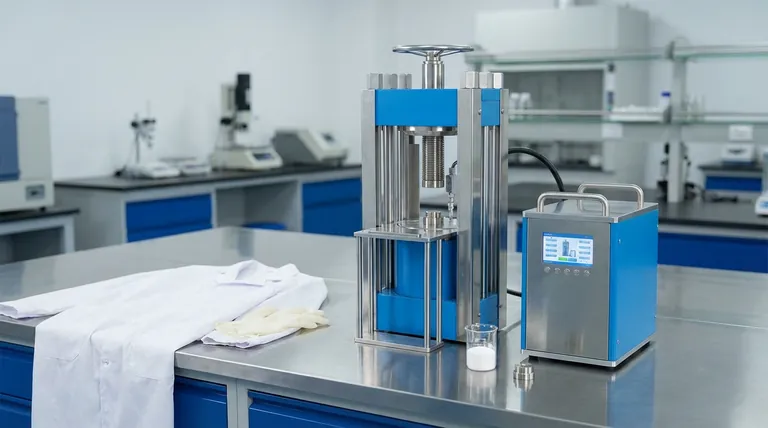
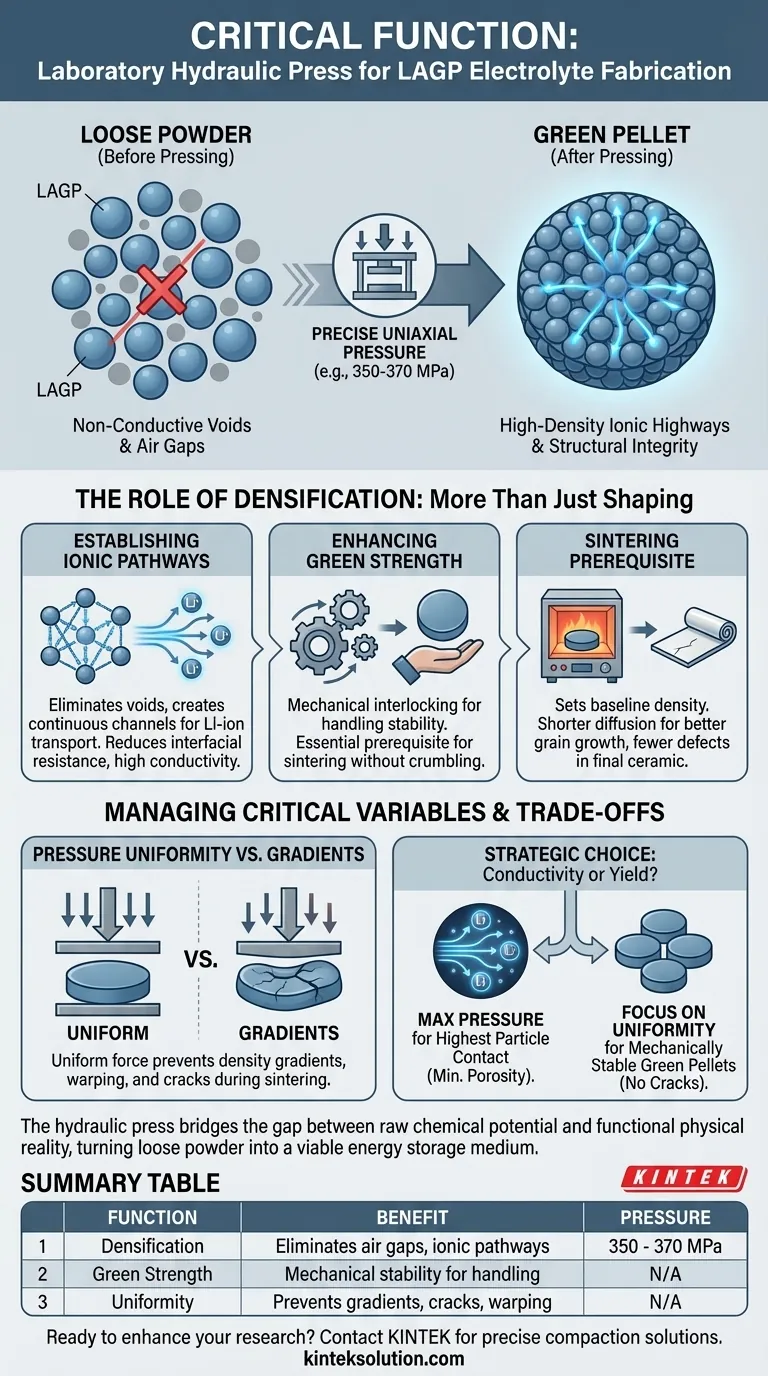
The critical function of a laboratory hydraulic press in LAGP fabrication is to apply precise, uniaxial pressure to cold-press loose powder into a high-density "green pellet." This process mechanically forces particles together to eliminate voids, creating the continuous physical contact required for lithium-ion transport and providing the structural integrity needed for subsequent sintering.
The Core Reality In solid-state batteries, ions cannot travel through air gaps; they require continuous solid matter. The hydraulic press transforms a non-conductive pile of powder into a functional ionic conductor by mechanically minimizing porosity, establishing the fundamental "highways" for energy flow.
The Role of Densification in Performance
The press is not simply a shaping tool; it is a density-engineering tool. The performance of the final LAGP electrolyte is directly determined by how effectively the press compacts the material.
Establishing Ionic Pathways
Loose LAGP powder contains significant air gaps (voids) between particles. These voids act as insulators, blocking the movement of lithium ions.
By applying high pressure (often ranging from 350 to 370 MPa), the hydraulic press forces particles into an intimate, void-free arrangement. This contact creates continuous diffusion channels, which are essential for reducing interfacial resistance and achieving high ionic conductivity.
Enhancing Green Strength
Before the LAGP pellet undergoes high-temperature sintering, it exists as a "green pellet." This compacted powder must be strong enough to withstand handling and transfer without crumbling.
The hydraulic press provides the necessary mechanical interlocking of particles. This structural stability is a prerequisite for the sintering stage, ensuring the pellet maintains its shape and integrity during the transition to a final ceramic state.
The Mechanics of the "Green Pellet"
The quality of the final ceramic electrolyte is often dictated by the quality of the green pellet formed in the press.
Prerequisites for Sintering
High-temperature sintering is used to fuse particles chemically, but it cannot fix large defects left by poor pressing. The press sets the baseline density.
A tightly packed green pellet creates a shorter diffusion distance for atoms during sintering. This facilitates better grain growth and results in a crack-free, highly dense ceramic sheet that offers superior electrochemical performance.
Structural Resilience
Beyond electrochemical needs, the pellet must endure physical stress. The densification provided by the press imparts the mechanical strength required for the pellet to survive the pressures of battery cell assembly and the physical stresses associated with electrochemical cycling.
Understanding the Trade-offs
While pressing is vital, the application of pressure involves critical variables that must be managed to avoid fabrication failure.
Pressure Uniformity vs. Density Gradients
The pressure applied must be absolutely uniform across the surface of the pellet. If the hydraulic press applies uneven force, the pellet will develop density gradients—areas that are tightly packed next to areas that are porous.
These gradients lead to inconsistent ionic conductivity and mechanical weak points. In extreme cases, non-uniform pressure can cause the pellet to warp or crack during the subsequent sintering phase due to uneven shrinkage.
The Limits of Cold Pressing
There is a limit to how much density can be achieved through cold pressing alone. While the press maximizes "green density," pushing pressure beyond the material's limit can damage the die or cause "spring-back" effects where the pellet fractures upon pressure release. The press establishes the potential for high density, which is then finalized by heat.
Making the Right Choice for Your Goal
The hydraulic press is a precision instrument in your workflow. How you utilize it depends on the specific limitations of your LAGP synthesis.
- If your primary focus is Ionic Conductivity: Prioritize maximizing pressure (e.g., up to 370 MPa) to minimize internal porosity and ensure the absolute highest particle-to-particle contact area.
- If your primary focus is Manufacturing Yield: Focus on pressure uniformity and dwell time to ensure mechanically stable green pellets that will not crack or crumble during the transfer to the sintering furnace.
Ultimately, the hydraulic press bridges the gap between raw chemical potential and functional physical reality, turning loose powder into a viable energy storage medium.
Summary Table:
| Function | Benefit for LAGP Pellet | Typical Pressure Range |
|---|---|---|
| Densification | Eliminates air gaps, creates continuous ionic pathways | 350 - 370 MPa |
| Green Strength | Provides mechanical stability for handling and sintering | N/A |
| Uniformity | Prevents density gradients, cracks, and warping | N/A |
Ready to enhance your solid-state battery research with precise, reliable compaction? KINTEK specializes in laboratory hydraulic presses, including automatic and heated models, designed to meet the exacting demands of fabricating LAGP and other advanced electrolyte pellets. Our presses deliver the uniform high pressure and control necessary to achieve high-density green bodies with superior ionic conductivity and yield. Contact us today to discuss how our solutions can optimize your lab's efficiency and accelerate your battery development. Get in touch now!
Visual Guide
Related Products
- Laboratory Hydraulic Press Lab Pellet Press Button Battery Press
- Laboratory Hydraulic Press 2T Lab Pellet Press for KBR FTIR
- Laboratory Hydraulic Press Lab Pellet Press Machine for Glove Box
- 24T 30T 60T Heated Hydraulic Lab Press Machine with Hot Plates for Laboratory
- Automatic Laboratory Hydraulic Press Lab Pellet Press Machine
People Also Ask
- How is a laboratory hydraulic press used for HAP composite gels? Master Mineral Substrate Standardization
- What role does a laboratory hydraulic press play in reaction pellets? Optimizing Lunar Soil and Metal Fuel Density
- What role does a laboratory hydraulic press play in the preparation of piezoelectric ceramic discs for DC-PG? | KINTEK
- Why is a laboratory hydraulic press required for PBAT and PLA sample preparation? Achieve Flawless Characterization
- What role does a laboratory hydraulic press play in the assembly of all-solid-state battery test cells? Expert Guide



















