Preparing a high-quality KBr pellet requires a meticulous four-step process designed to transform a solid sample into a transparent medium for infrared spectroscopy. The procedure begins by mixing a precise ratio of sample (1-2 mg) with potassium bromide powder (100-200 mg), followed by fine grinding, and finally compressing the mixture under 8-10 tons of pressure to create a solid, clear disc.
The ultimate goal of this process is not just to create a pellet, but to achieve optical transparency. A successful KBr pellet acts as a clear window for infrared light, requiring uniform particle size and the total exclusion of moisture to ensure accurate spectral data.
The Standard Preparation Procedure
1. Sample Formulation
To begin, you must establish the correct concentration ratio. Standard practice dictates mixing approximately 1-2 mg of the specific sample with 100-200 mg of KBr powder. This results in a sample concentration of roughly 1-2%, which is ideal for keeping absorbance within the detector's dynamic range.
2. Homogenization and Grinding
The mixture must be ground to a fine powder to reduce particle size and ensure uniformity. An agate mortar and pestle is the preferred tool for this step due to its hardness and smooth surface, which minimizes contamination and sample loss. Thorough grinding is critical; if the particles are too large, the final pellet will scatter light rather than transmit it.
3. Loading the Die
Once the powder is finely ground and mixed, it is carefully transferred into a pellet die set. It is essential to distribute the powder evenly within the die to ensure the final pellet has a uniform thickness.
4. Compression
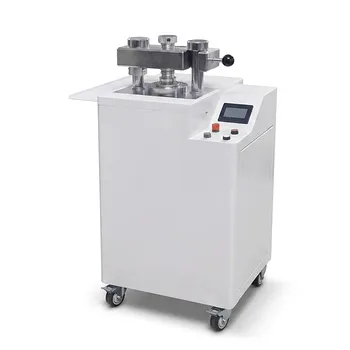
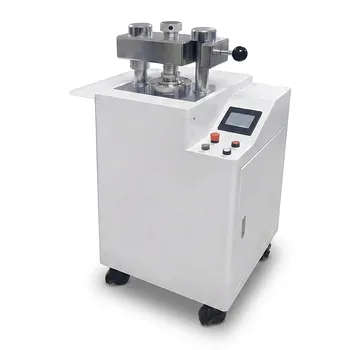
The die containing the mixture is placed into a hydraulic press. You must apply a load of approximately 8-10 tons (for a standard 13 mm die) to the system. This high pressure fuses the KBr powder into a solid state, resulting in a thin disc approximately 2 mm thick.
5. Final Evaluation
After releasing the pressure and ejecting the pellet, visual inspection is required. The pellet should be transparent or clear. It is then ready to be mounted in the FTIR spectrometer for analysis.
Critical Factors for Success
Controlling Moisture
KBr is hygroscopic, meaning it absorbs water from the air, which ruins the spectrum. To prevent this, ensure your KBr powder is completely dry before use. It is also highly recommended to heat the anvils and die body prior to pressing to drive off residual moisture.
Temperature Equilibrium
Thermal shock can cause pellets to fracture or become cloudy. Ensure that the KBr powder, the die set, and the anvils are all at the same temperature before applying pressure.
Pellet Geometry
The physical dimensions of the pellet affect the path length of the infrared light. A thickness of approximately 2 mm is standard. If the pellet is significantly thicker, it may become opaque; if too thin, it may be too fragile to handle.
Understanding the Trade-offs
Transparency vs. Sample Concentration
There is a delicate balance between signal strength and pellet clarity. Increasing the sample amount typically increases signal intensity, but it often leads to opaque pellets that scatter light and distort the baseline. It is almost always better to err on the side of a lower concentration to maintain transparency.
Grinding Time
While fine particles are necessary for a clear pellet, over-grinding can sometimes degrade sensitive crystalline structures or lead to excessive moisture absorption from the atmosphere. You must grind enough to homogenize the mixture, but strictly limit exposure time to ambient air.
Equipment Selection
Using an agate mortar is non-negotiable for high-quality work. Softer materials may contaminate the sample, introducing artifact peaks into your final spectrum that can be mistaken for sample characteristics.
Making the Right Choice for Your Goal
- If your primary focus is spectral clarity: Prioritize the dryness of the equipment and the fineness of the grind to minimize light scattering.
- If your primary focus is quantitative analysis: Ensure the mass ratio of the sample to KBr is weighed with extreme precision (e.g., exactly 1:100).
- If your primary focus is throughput: Pre-heat your die sets and keep KBr powder in a desiccator to reduce setup time between samples.
Mastering the KBr pellet technique turns a simple mixture of powders into a precision optical component that unlocks the chemical identity of your sample.
Summary Table:
| Step | Process Phase | Key Requirement | Purpose |
|---|---|---|---|
| 1 | Sample Formulation | 1-2 mg sample : 100-200 mg KBr | Optimal concentration (1-2%) |
| 2 | Homogenization | Agate mortar & pestle grinding | Reduce particle size, prevent light scattering |
| 3 | Loading the Die | Even powder distribution | Ensure uniform pellet thickness |
| 4 | Compression | 8-10 tons of hydraulic pressure | Fuse powder into a 2 mm transparent disc |
| 5 | Evaluation | Visual inspection | Verify optical clarity for IR transmission |
Elevate Your Spectroscopic Accuracy with Kintek
Precise KBr pellet preparation is the cornerstone of reliable FTIR data. KINTEK specializes in comprehensive laboratory pressing solutions, offering manual, automatic, heated, and glovebox-compatible models designed to eliminate moisture contamination and ensure perfect transparency. Whether you are conducting battery research or material characterization, our cold and warm isostatic presses provide the uniform pressure needed for high-quality optical discs.
Ready to optimize your sample preparation? Contact us today to find the ideal pressing solution for your lab's needs!
Related Products
- Laboratory Hydraulic Press 2T Lab Pellet Press for KBR FTIR
- XRF KBR Plastic Ring Lab Powder Pellet Pressing Mold for FTIR
- Laboratory Hydraulic Pellet Press for XRF KBR FTIR Lab Press
- Automatic Laboratory Hydraulic Press for XRF and KBR Pellet Pressing
- Lab Infrared Press Mold for No Demolding
People Also Ask
- What is the role of a laboratory pressure machine and KBr in FTIR? Master Sample Preparation for Flame Retardants
- What is the role of a laboratory hydraulic press in high-loading NCM811 cathode prep for solid-state batteries?
- Why is a laboratory hydraulic press necessary for sample preparation? Precise Pelleting for Spiro Heterocyclic Analysis
- What role does a laboratory hydraulic press play in reaction pellets? Optimizing Lunar Soil and Metal Fuel Density
- What are some examples of technical parameter options available for laboratory hydraulic presses? Customizing Your Lab