
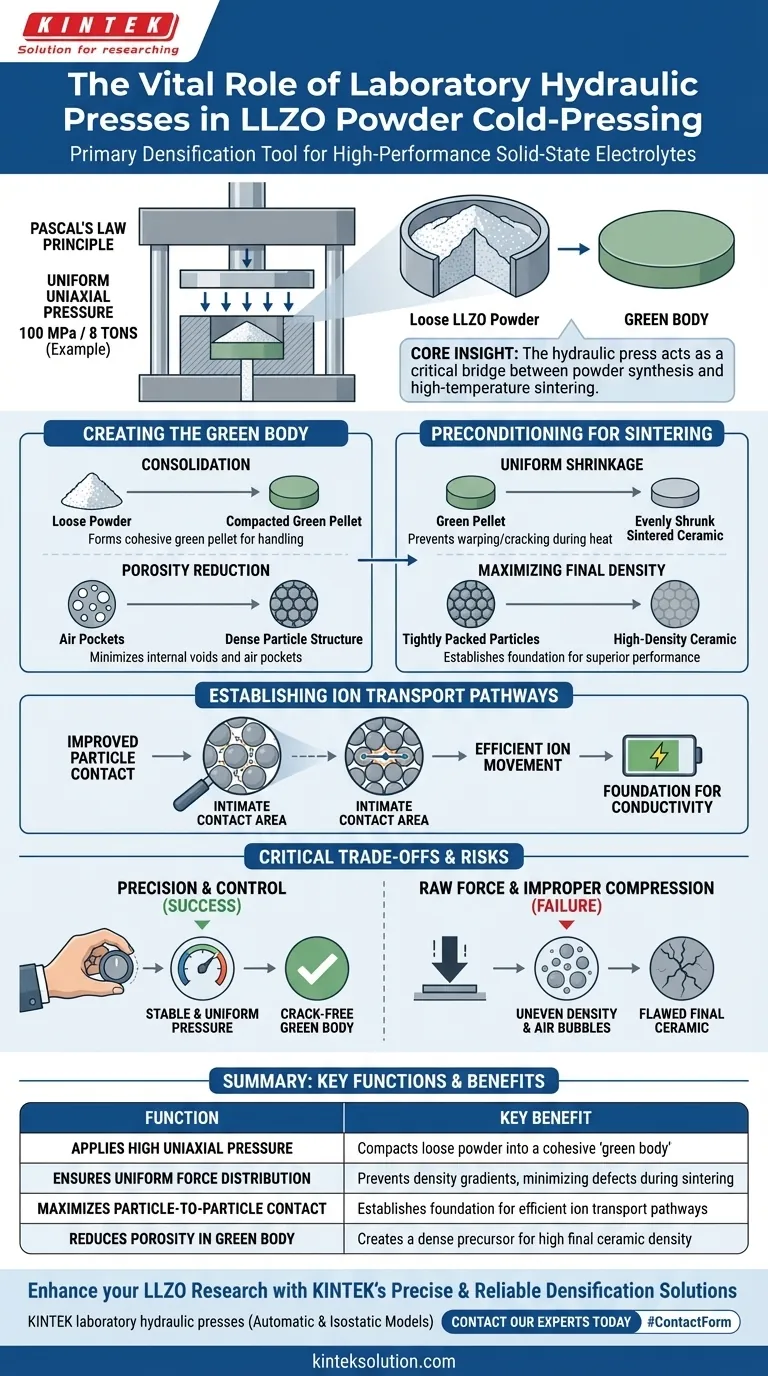
A laboratory hydraulic press serves as the primary densification tool in the processing of LLZO powder. It functions to apply precise, uniaxial pressure—often reaching levels such as 100 MPa or 8 tons—to compact loose synthesized powder into a cohesive, solid geometric shape known as a "green body."
Core Insight The hydraulic press is not merely for shaping; it acts as a critical bridge between powder synthesis and high-temperature sintering. By maximizing particle-to-particle contact and minimizing voids at this stage, the press establishes the microstructural foundation required to achieve a high-density, crack-free ceramic electrolyte.

The Mechanics of Cold-Pressing
Applying Uniform Force
The press operates on Pascal’s law, utilizing a confined fluid (typically oil) to transmit force. This allows the system to generate high pressure with a relatively small amount of input force, ensuring energy efficiency.
Ensuring Isostatic Consistency
The hydraulic cylinder applies this pressure evenly across the mold. This uniformity is vital for preventing density gradients within the pellet, which could otherwise lead to warping or cracking during later processing stages.
Creating the "Green Body"
Consolidation of Loose Powder
The immediate physical output of the press is the green body (or green pellet). This is a compacted form that possesses sufficient mechanical strength to be handled and transferred without crumbling, despite not yet being sintered.
Reduction of Porosity
By applying substantial pressure (e.g., 100 MPa), the press forces loose particles closer together. This significantly reduces the volume of internal voids and air pockets that naturally exist in the bulk powder.
Preconditioning for Sintering
Facilitating Uniform Shrinkage
The quality of the green body directly dictates the success of the subsequent hot-press sintering. A well-pressed pellet ensures that when the material shrinks under heat, it does so uniformly, preventing the formation of stress fractures.
Maximizing Final Density
The ultimate goal of using LLZO is often to create a solid-state electrolyte. The hydraulic press initiates the high-density characteristics required for this application by establishing tight packing, which allows the final ceramic to achieve superior performance metrics.
Establishing Ion Transport Pathways
Improving Particle Contact
For solid-state batteries, ion transport efficiency relies on continuous pathways. The press increases the intimate contact area between powder particles.
The Foundation for Conductivity
By minimizing porosity and maximizing contact, the press effectively builds the physical infrastructure necessary for efficient ion movement within the battery electrode or electrolyte layer.
Understanding the Critical Trade-offs
The Necessity of Precision vs. Raw Force
While a hydraulic press generates immense power, the control of that pressure is equally important. The references highlight that the environment must be "stable and precise."
Risks of Improper Compression
If pressure is not applied uniformly, or if the hydraulic cylinder fails to transmit pressure consistently, issues such as air bubble formation or uneven density can occur. These defects in the green stage are often irreversible and will result in a flawed final ceramic.
Making the Right Choice for Your Goal
To maximize the utility of your laboratory hydraulic press in LLZO processing, align your operation with your specific research objectives:
- If your primary focus is Ion Conductivity: Prioritize higher pressure settings (within mold limits) to maximize particle-to-particle contact and minimize void space before sintering.
- If your primary focus is Sample Integrity: Focus on the uniformity and stability of the pressure application to ensure a crack-free green body that shrinks evenly during heat treatment.
The hydraulic press ultimately transforms a volatile powder into a structured precursor, defining the potential quality of your final ceramic electrolyte.
Summary Table:
| Function | Key Benefit for LLZO Processing |
|---|---|
| Applies High Uniaxial Pressure | Compacts loose powder into a cohesive 'green body' for handling. |
| Ensures Uniform Force Distribution | Prevents density gradients, minimizing warping or cracking during sintering. |
| Maximizes Particle-to-Particle Contact | Establishes the foundation for efficient ion transport pathways. |
| Reduces Porosity in the Green Body | Creates a dense precursor for achieving high final ceramic density. |
Ready to enhance your LLZO research with precise and reliable densification?
KINTEK specializes in laboratory hydraulic presses, including automatic and isostatic models, designed to meet the exacting demands of solid-state battery development. Our presses provide the stable, uniform pressure essential for creating high-integrity green bodies, helping you achieve superior sample density and ion conductivity.
Contact our experts today to find the perfect lab press solution for your laboratory's needs!
Visual Guide
Related Products
- Laboratory Hydraulic Press Lab Pellet Press Machine for Glove Box
- Laboratory Hydraulic Press 2T Lab Pellet Press for KBR FTIR
- Lab Round Bidirectional Press Mold
- Automatic Laboratory Hydraulic Press Lab Pellet Press Machine
- Manual Laboratory Hydraulic Pellet Press Lab Hydraulic Press
People Also Ask
- How does a laboratory hydraulic press contribute to the preparation of Li3-3xScxSb samples? Optimize Ionic Conductivity
- What is the function of a laboratory hydraulic press in FT-IR of curcumin-coated MWCNTs? Achieve Optical Clarity.
- Why is a laboratory hydraulic press required for compression molding boron-siloxane? Solve High-Loading Density Challenges
- What role does a laboratory hydraulic press play in the preparation of piezoelectric ceramic discs for DC-PG? | KINTEK
- What role does a laboratory hydraulic press play in reaction pellets? Optimizing Lunar Soil and Metal Fuel Density



















