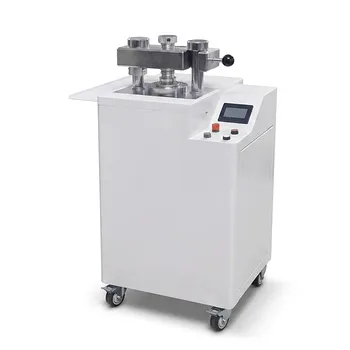
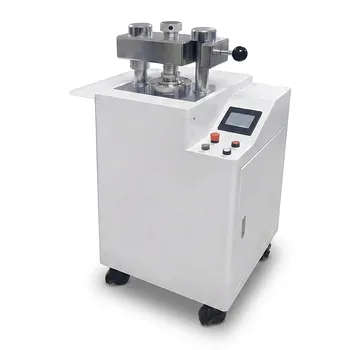
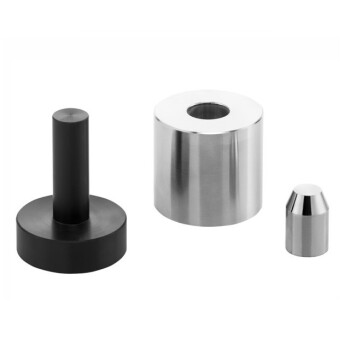
Evacuable pellet press dies are specialized tools designed to compact powdered samples into solid, uniform discs or briquettes. Their primary function is to transform loose material into high-quality, stable pellets—often 13 mm in diameter—suitable for demanding spectroscopic analysis.
Core Takeaway: By subjecting powdered materials to mechanical compression within a die, these tools induce plastic deformation and particle bonding. This process creates a dense, homogeneous sample essential for accurate scientific testing, such as XRF and FTIR spectroscopy.
The Mechanics of Pellet Formation
Material Loading and Compression
The process begins with material loading, where raw powder is carefully placed into the die cavity.
A pressing system then applies force, initiating the compaction phase. This mechanical pressure is the catalyst for transforming the state of the sample.
Plastic Deformation
As pressure increases, the material undergoes plastic deformation. This physical change forces the particles closer together, significantly reducing the microscopic gaps between them.
This reduction in void space is critical for creating a solid structure out of loose dust or granules.
Particle Bonding and Stabilization
The combination of friction and deformation causes the particles to bond strongly. Continuous pressure ensures the pellet achieves the desired shape and density.
Finally, upon pressure release, the material retains its new form, allowing the solid pellet to be removed for analysis.
The Role in Scientific Analysis
Ensuring Analytical Consistency
The primary goal of using an evacuable die is to produce high-quality spectroscopy pellets.
In analytical techniques like XRF analysis and FTIR spectroscopy, the uniformity of the sample is paramount. A pellet that is evenly compacted ensures that the results reflect the material's true properties, not artifacts of preparation.
Standardizing Sample Sizes
These dies are capable of producing circular pellets in various sizes to fit different instrument holders.
The 13 mm pellet is a standard size mentioned explicitly for these dies, serving as a common format for many laboratory spectrometers.
Understanding the Trade-offs
The Necessity of Plastic Deformation
It is important to understand that this process relies on the material's ability to deform plastically.
If a material is too elastic or brittle, it may not bond correctly without binders. The quality of the final briquette depends heavily on the material's response to mechanical compression.
Precision vs. Speed
Creating a high-quality pellet is a multi-step process involving loading, pressing, and releasing.
While this ensures reliable results, it requires more time and attention to detail than analyzing loose powders. Rush the process, and you risk density gradients that skew analytical data.
Making the Right Choice for Your Goal
To maximize the utility of evacuable pellet press dies, align your approach with your specific analytical requirements:
- If your primary focus is FTIR or XRF Spectroscopy: Prioritize the "high-quality" aspect of these dies to ensure your 13 mm pellets are chemically homogeneous and physically stable.
- If your primary focus is General Sample Storage: Utilize the compression capability to turn loose, hazardous powders into safer, solid briquettes.
The function of the die is not just to compress, but to standardize your sample for the sake of scientific truth.
Summary Table:
| Feature | Function & Benefit |
|---|---|
| Primary Goal | Transforms loose powder into solid, uniform discs (e.g., 13 mm) |
| Mechanics | Uses mechanical compression to induce plastic deformation and particle bonding |
| Applications | Essential for XRF analysis, FTIR spectroscopy, and material characterization |
| Sample Quality | Ensures density, homogeneity, and reduction of void spaces for accurate data |
| Standardization | Produces repeatable pellet sizes compatible with laboratory spectrometers |
Elevate Your Sample Preparation with KINTEK Precision
Unlock the full potential of your spectroscopic analysis with KINTEK’s comprehensive laboratory pressing solutions. Whether you are conducting cutting-edge battery research or routine material testing, our range of manual, automatic, heated, and multifunctional models ensures perfectly compacted pellets every time.
From glovebox-compatible dies to high-pressure cold and warm isostatic presses, we provide the tools needed for chemical homogeneity and physical stability.
Ready to standardize your scientific results? Contact our experts today to find the ideal pressing solution for your lab!
Related Products
- Lab Infrared Press Mold for No Demolding
- XRF KBR Plastic Ring Lab Powder Pellet Pressing Mold for FTIR
- Lab XRF Boric Acid Powder Pellet Pressing Mold for Laboratory Use
- XRF KBR Steel Ring Lab Powder Pellet Pressing Mold for FTIR
- Lab Ring Press Mold for Sample Preparation
People Also Ask
- What is the purpose of incorporating cartridge heaters into a lab press mold for MLCC block compression? Optimize Results
- What is the function of a pressing tool in thermoplastic panels? Master Precision Shaping & Fusion Bonding
- Why is precise cooling management of the lab press mold necessary? Protect Core Integrity in Thermoforming
- What role do precision positioning and pressure molds play in single-lap joints? Ensure 100% Data Integrity
- Why is a lab press used for KBr pellet preparation in polyurethane FTIR? Achieve High-Resolution Spectral Data