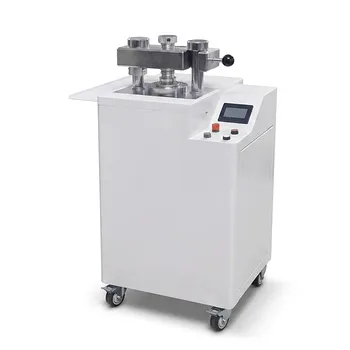
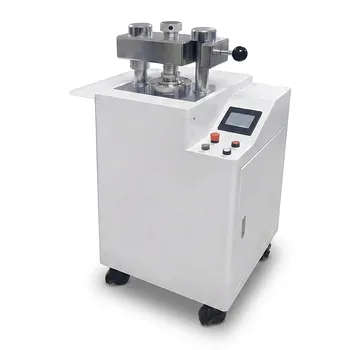
The fundamental principle of the KBr pellet method relies on the unique physical property of potassium bromide (KBr) to become plastic under high pressure. When a small amount of solid sample is finely ground and mixed with KBr powder, compressing the mixture fuses the salt into a solid, transparent matrix. This resulting disk acts as an optical window, allowing infrared light to pass through and interact with the suspended sample molecules for detection.
Core Takeaway The KBr pellet method leverages the pressure-induced plasticity and optical transparency of potassium bromide to transform opaque solids into clear disks. This creates a non-interfering medium that allows for high-sensitivity transmission spectroscopy of solid materials.
The Mechanics of the Method
The Phenomenon of Plasticity
The cornerstone of this technique is that potassium bromide becomes plastic—meaning it flows and fuses—when subjected to high mechanical pressure.
Unlike many other solids that would shatter or remain powdery, KBr coalesces into a unified, glass-like sheet. This creates a stable physical support for the sample material.
Creating an Optical Window
Once the pellet is formed, the KBr acts as a transparent medium for infrared light.
Because KBr is naturally transparent to infrared radiation, it does not absorb light in the regions typically used for analysis. This ensures that the spectrum generated by the instrument reflects only the molecular vibrations of your sample, not the carrier matrix.
Homogeneous Dispersion
The method relies on a specific dilution ratio to function correctly, typically mixing the sample with KBr at a 1:100 to 1:200 ratio.
This high dilution factor ensures the sample is evenly distributed throughout the transparent matrix. It prevents the sample from being too dense, which would block the IR beam entirely, while ensuring enough material is present to generate a detectable signal.
Why Potassium Bromide is the Standard
Chemical Inertness
Beyond its optical properties, KBr is chemically inert regarding most standard samples.
This allows it to be mixed with a wide variety of organic and inorganic compounds without causing undesirable chemical reactions. The integrity of the sample structure is preserved during the compression process.
Enhanced Sensitivity
The transmission nature of the KBr pellet method often offers superior sensitivity compared to surface techniques like ATR (Attenuated Total Reflectance).
By forcing the light through the entire bulk of the sample, rather than just bouncing it off the surface, this method is particularly effective for identifying trace components in pharmaceuticals, polymers, and environmental samples.
Understanding the Trade-offs
Moisture Sensitivity (Hygroscopy)
The most significant limitation is that KBr is hygroscopic, meaning it aggressively absorbs moisture from the air.
If the KBr powder or the environment is not perfectly dry, water bands will appear in the spectrum, obscuring the sample data. You must use heated anvils or desiccated powder to mitigate this risk.
Particle Size Criticality
The success of the principle depends on the physical state of the mixture; both the sample and the KBr must be ground to a fine powder.
If particle sizes are too large, they will scatter the IR light rather than transmit it. This results in a sloping baseline and a distorted spectrum, often referred to as the Christiansen effect.
Pressure Calibration
The application of pressure requires a "Goldilocks" approach—it must be just right.
Excessive pressure can physically crack the pellet, rendering it useless. Conversely, insufficient pressure will fail to fuse the powder into a transparent disk, resulting in an opaque pellet that blocks the signal.
Making the Right Choice for Your Goal
While the KBr method is a gold standard for transmission spectroscopy, its effectiveness depends on your specific analytical needs.
- If your primary focus is High Sensitivity: Choose this method when surface techniques (like ATR) fail to provide a strong enough signal for trace ingredients.
- If your primary focus is Spectral Purity: Ensure you have access to a desiccator and dry box to prevent atmospheric moisture from contaminating your results.
- If your primary focus is Quantitative Analysis: Maintain strict control over the sample-to-KBr weight ratio (1-2%) to ensure reproducible path lengths and absorption intensities.
Mastering the KBr pellet method requires balancing the physical requirements of pressure and particle size with the chemical necessity of absolute dryness.
Summary Table:
| Feature | KBr Pellet Principle & Requirement |
|---|---|
| Core Phenomenon | Pressure-induced plasticity and fusion |
| Optical Property | IR transparency (no absorption in key regions) |
| Sample Ratio | 1:100 to 1:200 (Sample to KBr) |
| Key Advantage | High sensitivity for trace component detection |
| Major Constraint | Hygroscopic nature (requires moisture control) |
| Critical Step | Fine grinding to prevent light scattering |
Elevate Your Spectroscopy Results with KBr Expertise
Precision in IR analysis starts with the perfect pellet. KINTEK specializes in comprehensive laboratory pressing solutions, offering manual, automatic, heated, multifunctional, and glovebox-compatible models designed to eliminate moisture contamination and ensure homogeneous sample dispersion.
Whether you are conducting battery research or pharmaceutical analysis, our cold and warm isostatic presses provide the exact pressure calibration needed for crystal-clear optical windows. Contact KINTEK today to find your ideal pressing solution and achieve superior spectral purity.
Related Products
- XRF KBR Plastic Ring Lab Powder Pellet Pressing Mold for FTIR
- Laboratory Hydraulic Press 2T Lab Pellet Press for KBR FTIR
- XRF KBR Steel Ring Lab Powder Pellet Pressing Mold for FTIR
- Automatic Laboratory Hydraulic Press for XRF and KBR Pellet Pressing
- Laboratory Hydraulic Pellet Press for XRF KBR FTIR Lab Press
People Also Ask
- What is the purpose of making KBr pellets for FTIR? Achieve Precise Molecular Analysis with Solid Samples
- What factors should be considered when choosing a lab press for XRF pellet preparation? Ensure Accurate and Consistent Results
- Why are pellets used in XRF analysis, and what is their limitation? Boost Accuracy and Speed in Your Lab
- How are pellets prepared for XRF analysis and what is a potential drawback? Master XRF Sample Prep and Accuracy
- What should be included in a checklist for making XRF pellets? Ensure Accurate and Repeatable XRF Analysis