
The mechanism of the cold sintering process operates fundamentally through a mediated dissolution-precipitation cycle driven by mechanical force. It utilizes a laboratory press to apply uniaxial pressure to ceramic powder mixed with a specific transient liquid phase additive. Rather than relying on the extreme heat of traditional sintering to fuse particles, this process uses the liquid to chemically dissolve particle surfaces, allowing them to rearrange and bond densely at temperatures typically below 300°C.
The cold sintering process replaces thermal energy with chemical energy and mechanical pressure. By introducing a transient liquid phase, it enables particle rearrangement and bonding at a fraction of the temperatures required for conventional ceramic processing.
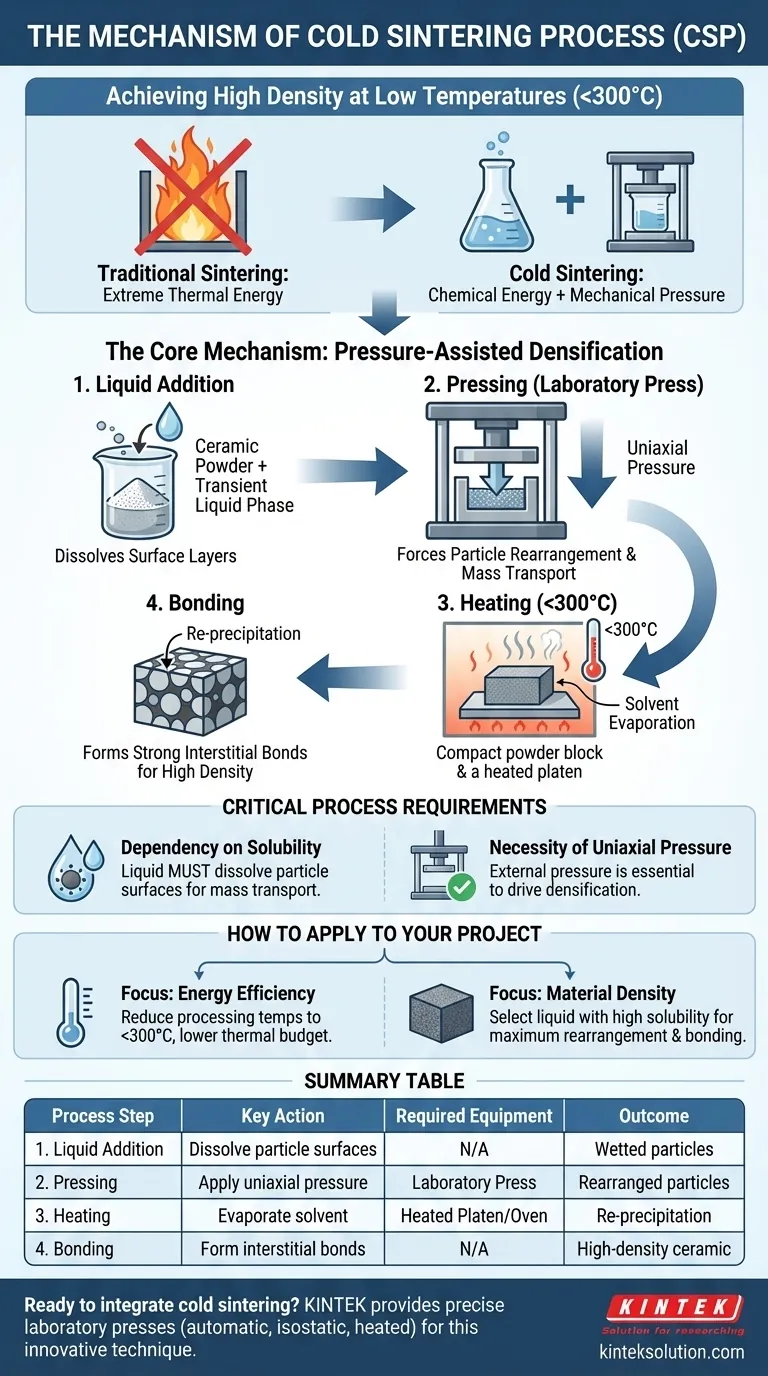
The Core Mechanism: Pressure-Assisted Densification
The success of cold sintering relies on a precise sequence of chemical and mechanical interactions. This process manipulates the physical state of the ceramic powder to achieve high density without high heat.
1. The Role of the Transient Liquid Phase
The process begins by mixing the ceramic powder with a small amount of a fluid additive, known as a transient liquid phase.
This liquid is not merely a binder; it is an active chemical agent.
Its primary function is to wet the particles and temporarily dissolve the surface layers of the ceramic powder.
2. Mechanical Rearrangement via Laboratory Press
Once the mixture is prepared, it is subjected to significant mechanical force using a laboratory press.
The press applies uniaxial pressure to the powder-liquid mixture.
This pressure is critical because it forces the particles closer together, greatly facilitating mass transport.
As the surfaces dissolve into the liquid phase, the pressure helps the particles slide past one another, rearranging them into a tightly packed configuration.
3. Evaporation and Re-precipitation
Following the pressurized rearrangement, the material undergoes a gentle heating step.
This heating is maintained at a low temperature, specifically below 300°C.
The heat serves to evaporate the solvent from the liquid phase.
As the solvent leaves, the ceramic material that was dissolved in the liquid cannot remain in solution.
4. Formation of Interstitial Bonds
This forces the dissolved material to re-precipitate in the gaps (interstitial spaces) between the solid particles.
This precipitated material acts as a "glue," creating strong chemical bonds between the particles.
The result is a highly densified ceramic body formed through chemical stability rather than thermal fusion.
Critical Process Requirements
While cold sintering offers energy efficiency, it is not a passive process. It relies on specific physical constraints to function correctly.
Dependency on Solubility
The mechanism is entirely dependent on the interaction between the ceramic powder and the additive.
The liquid phase must be capable of dissolving the particle surfaces; if the ceramic is insoluble in the additive, the necessary mass transport cannot occur.
The Necessity of Uniaxial Pressure
Heat alone is insufficient for this technique.
Without the application of external pressure via the laboratory press, the particles will not rearrange sufficiently to achieve high density.
The mechanical force is the catalyst that drives the densification during the wet stage.
How to Apply This to Your Project
Understanding the mechanism allows you to determine if cold sintering is the appropriate fabrication method for your specific material goals.
- If your primary focus is energy efficiency: Utilize cold sintering to reduce processing temperatures to below 300°C, significantly lowering the thermal budget compared to traditional methods.
- If your primary focus is material density: Ensure you select a transient liquid phase that offers high solubility for your specific ceramic powder to maximize particle rearrangement and interstitial bonding.
Cold sintering offers a pathway to robust ceramic manufacturing that trades extreme thermal energy for smart chemical and mechanical engineering.
Summary Table:
| Process Step | Key Action | Required Equipment |
|---|---|---|
| 1. Liquid Addition | Mix ceramic powder with a transient liquid phase to dissolve particle surfaces. | N/A |
| 2. Pressing | Apply uniaxial pressure to force particle rearrangement and mass transport. | Laboratory Press |
| 3. Heating | Gently heat (<300°C) to evaporate solvent and cause re-precipitation. | Heated Platen / Oven |
| 4. Bonding | Dissolved material re-precipitates, forming strong interstitial bonds for high density. | N/A |
Ready to integrate the cold sintering process into your lab?
KINTEK specializes in providing the precise laboratory presses—including automatic, isostatic, and heated models—that are critical for applying the uniaxial pressure required in this innovative technique. Our equipment helps researchers and laboratory professionals achieve high-density ceramic components with exceptional energy efficiency.
Contact our experts today to find the perfect press for your cold sintering application and start reducing your thermal budget.
Visual Guide
Related Products
- Electric Lab Cold Isostatic Press CIP Machine
- Automatic Lab Cold Isostatic Pressing CIP Machine
- Electric Split Lab Cold Isostatic Pressing CIP Machine
- Manual Cold Isostatic Pressing CIP Machine Pellet Press
- Automatic High Temperature Heated Hydraulic Press Machine with Heated Plates for Lab
People Also Ask
- What role do electric lab cold isostatic presses play in industrial contexts? Bridge R&D and Manufacturing with Precision
- What are the applications of electric lab cold isostatic presses in research settings? Advance Material R&D with High-Pressure CIPs
- How does electrical Cold Isostatic Pressing (CIP) contribute to cost savings? Unlock Efficiency and Reduce Expenses
- What are some research applications of electric lab CIPs? Unlock Uniform Powder Densification for Advanced Materials
- What are the characteristics of standard off-the-shelf electric lab CIP solutions? Achieve Immediate, Cost-Effective Processing



















