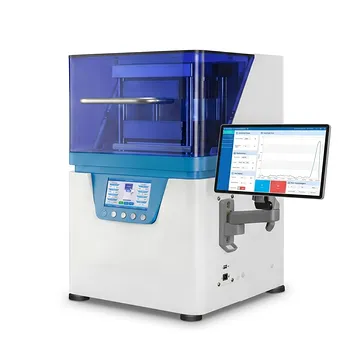
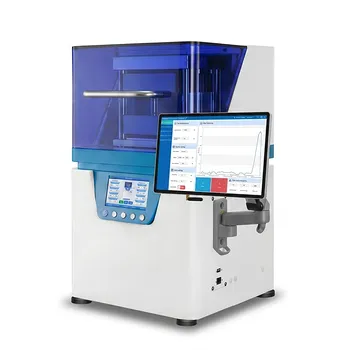
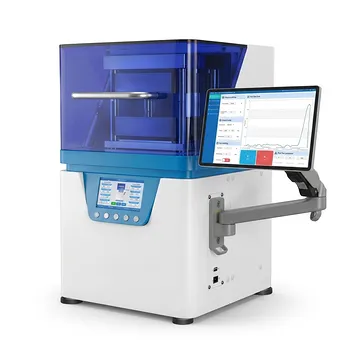
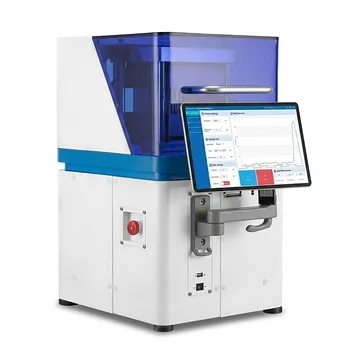
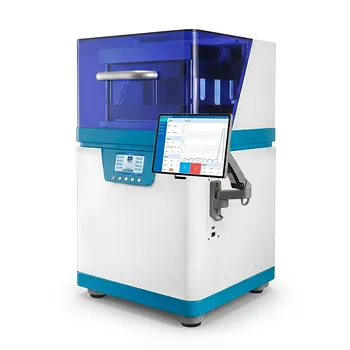
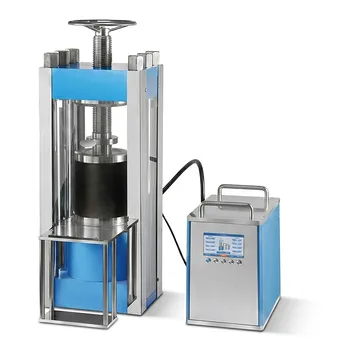
The laboratory hydraulic press is the fundamental engine for rubber vulcanization, providing the dual-stimuli required to transform raw compounds into engineered materials. It serves as a controlled environment that simultaneously applies high mechanical pressure and consistent thermal energy to trigger essential chemical changes. Without this precise combination, a natural rubber composite would fail to achieve its intended mechanical properties, dimensional stability, or internal structural density.
The necessity of a heated laboratory hydraulic press lies in its ability to provide a "double-trigger" environment: thermal energy initiates the chemical cross-linking reaction (vulcanization), while mechanical pressure ensures the material flows perfectly into the mold and remains free of air-born defects.
The Role of Controlled Thermal Energy
Triggering the Cross-Linking Reaction
The primary necessity of the heating function is to provide the activation energy required for vulcanizing agents to react. This process transforms the rubber from a linear, plastic state into a three-dimensional molecular network, which is the foundation of high elasticity.
Maintaining Temperature Stability
Precise temperature control, often ranging from 140°C to 160°C, is critical for ensuring a uniform reaction throughout the sample. Stable heat prevents localized under-curing or over-curing, which would otherwise result in inconsistent mechanical strengths across the composite.
Facilitating Interfacial Bonding
In complex composites involving compatibilizers like Liquid Nitrile-Isoprene Rubber (LIR), heat drives the co-vulcanization between different molecular chains. This creates a "networking effect" that locks the micro-morphology in place and enhances the material’s dynamic modulus.
The Critical Function of Mechanical Pressure
Ensuring Complete Mold Infusion
High pressure, typically ranging from 10 MPa to 20 MPa, forces the viscous rubber compound to flow into every detail of the steel mold. This is essential for achieving the standardized geometric dimensions, such as 2 mm sheets, required for accurate ASTM or ISO tensile testing.
Elimination of Internal Defects
Pressure acts to exclude gases and air bubbles that are naturally trapped within the raw compound during the mixing phase. By expelling these voids, the hydraulic press ensures a dense, homogenous microstructure, preventing premature failure under mechanical stress.
Enhancing Material Density
The application of constant pressure during the cooling and curing phases results in a dimensionally stable product. This prevents the rubber from shrinking or warping, ensuring that the final specimen accurately represents the material's true physical properties.
Understanding the Trade-offs
The Risk of Thermal Scorch
Applying heat for too long or at too high a temperature can lead to scorch, where the rubber begins to harden before it has fully filled the mold. This creates internal stresses and ruins the sample's surface finish.
Balancing Pressure and Mold Integrity
While high pressure eliminates voids, excessive force can lead to flash (excess material leaking from the mold) or even damage to precision-machined mold plates. Finding the "optimum cure" requires a careful balance between temperature, pressure, and time.
Energy Consumption vs. Precision
Electric heating plates provide excellent precision but require significant warm-up times compared to other methods. Researchers must weigh the need for thermal stability against the throughput requirements of the laboratory.
How to Apply This to Your Project
Recommendations for Equipment Use
To achieve the highest quality results with natural rubber composites, your approach should vary based on your specific research objectives:
- If your primary focus is material characterization: Prioritize a press with high-precision temperature sensors to ensure the cross-link density is uniform across all test specimens.
- If your primary focus is defect-free prototyping: Focus on the pressure-holding capability of the hydraulic system to ensure that air is fully evacuated and the mold is completely filled.
- If your primary focus is complex chemical bonding: Ensure the press can maintain a constant thermal environment over longer durations to facilitate the slow co-vulcanization of diverse rubber phases.
By mastering the intersection of heat and pressure, you ensure that your laboratory specimens are not just samples, but high-performance materials with predictable and repeatable properties.
Summary Table:
| Feature | Role in Vulcanization | Impact on Material Quality |
|---|---|---|
| Controlled Heat | Triggers chemical cross-linking | High elasticity and uniform mechanical strength |
| High Pressure | Ensures complete mold infusion | Eliminates air bubbles and internal defects |
| Thermal Stability | Prevents under or over-curing | Consistent micro-morphology and bonding |
| Mechanical Force | Increases structural density | Dimensional stability and ISO/ASTM compliance |
Elevate Your Research with KINTEK’s Precision Pressing Solutions
Achieving the perfect vulcanization cycle requires a delicate balance of thermal and mechanical control. KINTEK specializes in comprehensive laboratory pressing solutions designed to meet the rigorous demands of material science. From manual and automatic heated models to multifunctional and glovebox-compatible presses, our equipment ensures your natural rubber composites and battery materials achieve peak performance and repeatability.
Ready to optimize your sample preparation? Contact KINTEK today to explore our full range of isostatic and hydraulic presses and discover how our expertise can enhance your laboratory's efficiency.
References
- Przemysław Rybiński, Justyna Miedzianowska. Effect of Hybrid Filler, Carbon Black–Lignocellulose, on Fire Hazard Reduction, including PAHs and PCDDs/Fs of Natural Rubber Composites. DOI: 10.3390/polym15081975
This article is also based on technical information from Kintek Solution Knowledge Base .
Related Products
- 24T 30T 60T Heated Hydraulic Lab Press Machine with Hot Plates for Laboratory
- Automatic Heated Hydraulic Lab Press with Programmable Touch Screen Controls and Precision Temperature Regulation
- Automatic Heated Hydraulic Lab Press 120x120mm Plate Fully Automated Material Research Press
- Automatic Large Format Laboratory Heated Hydraulic Press 400x400mm Plate Capacity
- Automatic Heated Hydraulic Press Machine with Hot Plates for Laboratory
People Also Ask
- Function of a Laboratory Hydraulic Press with Heated Platens in SSE? Enhance Battery Density & Conductivity
- Why is a laboratory hydraulic press with heating plates required for PLA/TEC films? Achieve Precise Sample Integrity
- What role does a laboratory heated hydraulic press play in LTCC? Essential for High-Density Ceramic Lamination
- What is the primary function of a laboratory heated hydraulic press? Mastering Thermoplastic Carbon Fiber Composites
- What is the critical role of a laboratory heated hydraulic press? Mastering PVC Sample Prep for Testing