
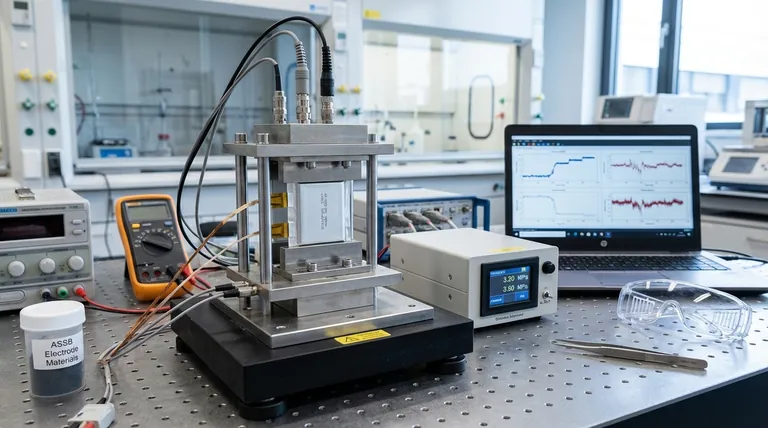
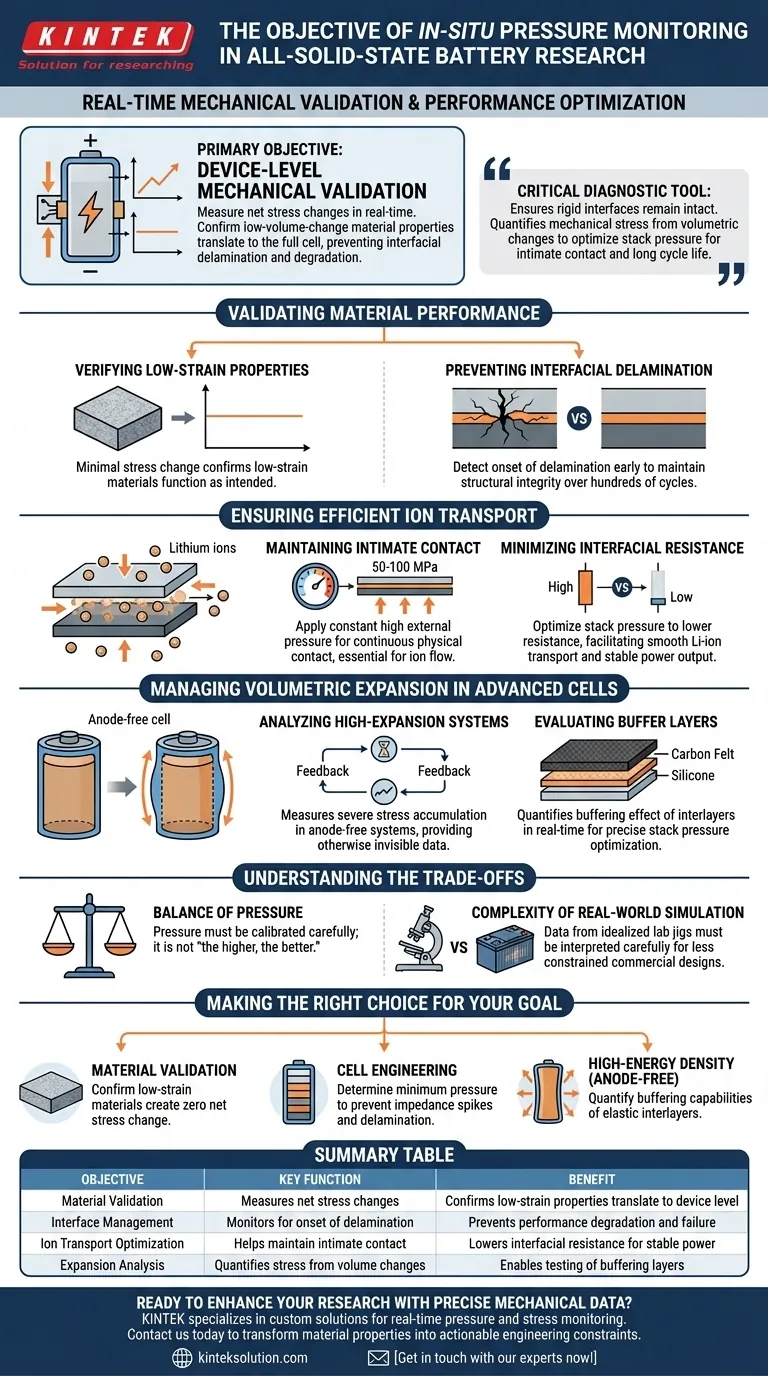
The primary objective of using a customized in-situ pressure and stress monitoring device is to macroscopically validate the mechanical stability of electrode materials in real-time. By measuring net stress changes across the cell during operational cycles, researchers can confirm whether a material's inherent low-volume-change properties successfully translate to the device level, thereby preventing interfacial delamination and performance degradation.
Real-time pressure monitoring serves as a critical diagnostic tool to ensure that the rigid solid-solid interfaces within the battery remain intact during cycling. It quantifies the mechanical stress caused by volumetric changes, allowing researchers to optimize the stack pressure required to maintain the intimate contact essential for efficient ion transport and long cycle life.
Validating Material Performance at the Device Level
Verifying Low-Strain Properties
In materials science, intrinsic properties do not always guarantee device-level success. The monitoring device provides direct evidence of how electrode materials behave macroscopically.
If the device records minimal or no stress changes during cycling, it confirms that the low-strain material is functioning as intended. This validation is the first step in proving a new material is viable for practical application.
Preventing Interfacial Delamination
All-solid-state batteries rely on rigid interfaces that are prone to separating. Even minor volume changes can cause these layers to de-bond.
By monitoring stress, researchers can detect the onset of delamination before the battery fails completely. This data is vital for engineering cells that maintain structural integrity over hundreds of cycles.
Ensuring Efficient Ion Transport
Maintaining Intimate Contact
For a solid-state battery to function, the cathode, solid electrolyte, and anode must maintain continuous physical contact. Without this, lithium ions cannot traverse the internal layers.
The monitoring device helps researchers apply and maintain a constant, high external pressure (often between 50 and 100 MPa). This pressure forces particles together, ensuring the "intimate" contact necessary for operation.
Minimizing Interfacial Resistance
Physical gaps at the interface act as barriers to energy flow, manifesting as high impedance. High impedance leads to poor performance and rapid degradation.
By using the device to optimize stack pressure, researchers can significantly lower this interfacial resistance. This facilitates smooth lithium-ion transport and stabilizes the battery's power output.
Managing Volumetric Expansion in Advanced Cells
Analyzing High-Expansion Systems
Anode-free solid-state batteries represent a high-reward, high-risk architecture due to significant volume changes caused by lithium stripping and deposition.
In these scenarios, the monitoring device acts as a feedback loop. It measures the severe stress accumulation and release that occurs during these aggressive cycles, providing data that is otherwise invisible to the researcher.
Evaluating Buffer Layers
To mitigate expansion, researchers often introduce elastic interlayers, such as carbon felt or silicone. The monitoring device is the only way to objectively test their effectiveness.
It quantifies the "buffering effect" of these layers in real-time. This allows for the precise optimization of stack pressure parameters to accommodate expansion without crushing the active materials.
Understanding the Trade-offs
The Balance of Pressure
While applying external pressure is necessary, it is not a cure-all. The monitoring device reveals that pressure must be calibrated carefully; it is not simply "the higher, the better."
Complexity of Real-World Simulation
Testing specifically at pressures like 100 MPa is intended to simulate the constraints of an actual battery package. However, one must recognize that laboratory jigs are often more rigid than commercial packaging.
Data derived from these devices represents an idealized mechanical environment. Researchers must interpret stress data carefully when extrapolating these results to flexible or less constrained commercial cell designs.
Making the Right Choice for Your Goal
The utility of a pressure monitoring device depends heavily on the specific barrier you are trying to overcome in your research.
- If your primary focus is Material Validation: Use the device to confirm that your specific low-strain electrode material creates zero or minimal net stress change at the full-cell level.
- If your primary focus is Cell Engineering: Use the device to determine the minimum external stack pressure required to prevent impedance spikes and delamination.
- If your primary focus is High-Energy Density (Anode-Free): Use the device to quantify the mechanical buffering capabilities of various elastic interlayers to manage extreme volume expansion.
By correlating mechanical stress data with electrochemical performance, you transform abstract material properties into actionable engineering constraints.
Summary Table:
| Objective | Key Function | Benefit |
|---|---|---|
| Material Validation | Measures net stress changes during cycling | Confirms low-strain properties translate to device level |
| Interface Management | Monitors for onset of delamination | Prevents performance degradation and failure |
| Ion Transport Optimization | Helps maintain intimate contact under pressure | Lowers interfacial resistance for stable power output |
| Expansion Analysis | Quantifies stress from volume changes in high-energy systems | Enables testing of buffering layers for anode-free designs |
Ready to enhance your all-solid-state battery research with precise mechanical data?
At KINTEK, we specialize in advanced laboratory equipment, including custom solutions for real-time pressure and stress monitoring. Our expertise helps researchers like you validate material performance, optimize stack pressure, and engineer longer-lasting, high-energy-density batteries.
Contact us today to discuss how we can support your specific research goals with tailored equipment and insights. Let's transform your material properties into actionable engineering constraints.
Get in touch with our experts now!
Visual Guide
Related Products
- Lab Infrared Press Mold for No Demolding
- Lab Infrared Press Mold for Laboratory Applications
- Laboratory Hydraulic Pellet Press for XRF KBR FTIR Lab Press
- Laboratory Hydraulic Press Lab Pellet Press Machine for Glove Box
- Special Shape Lab Press Mold for Laboratory Applications
People Also Ask
- What is the purpose of incorporating cartridge heaters into a lab press mold for MLCC block compression? Optimize Results
- What is the function of a pressing tool in thermoplastic panels? Master Precision Shaping & Fusion Bonding
- Why is precise cooling management of the lab press mold necessary? Protect Core Integrity in Thermoforming
- What role do precision positioning and pressure molds play in single-lap joints? Ensure 100% Data Integrity
- Why is a lab press used for KBr pellet preparation in polyurethane FTIR? Achieve High-Resolution Spectral Data



















