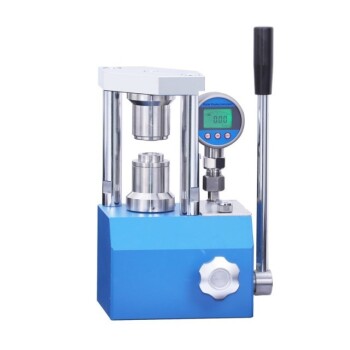
The practical value of assembling laboratory-grade sodium-ion full cells and pouch cells lies in validating the transition of Lead-based Prussian Blue Analogue (PbHCF) materials from theoretical components to functional energy storage systems. By pairing PbHCF/Carbon Nanotube (CNT) composites with hard carbon anodes, researchers can confirm the material's ability to operate within a realistic battery architecture and deliver the energy output necessary for commercial applications.
Core Takeaway While material synthesis proves chemical structure, assembling full cells and pouch cells provides the definitive proof of commercial feasibility. Successful operation in these formats demonstrates that PbHCF composites possess the actual energy output capability required to power electronic devices, such as LED displays.
Validating Real-World Feasibility
Moving Beyond Component Testing
Isolating a cathode material in a half-cell is useful for initial data, but it does not represent a real-world scenario.
By assembling sodium-ion full cells, researchers test the PbHCF material against a realistic anode, specifically hard carbon.
This validates that the cathode material acts as a stable sodium host when paired with commercially viable counter-electrodes.
The Role of Lab-Scale Equipment
The use of standard laboratory equipment, such as a lab press and sealing machines, is critical to this validation process.
It proves that the PbHCF/CNTs composites can withstand the mechanical pressures and packaging constraints required for battery assembly.
This establishes that the material is robust enough for standard manufacturing processes, not just delicate laboratory experiments.
Demonstrating Energy Output Capability
The "LED Test" as a Benchmark
The primary reference highlights a specific, tangible outcome of this assembly process: lighting an LED display.
While this may seem simple, it acts as a critical binary test for voltage and current stability.
It confirms that the pouch cell is not merely storing charge, but is capable of discharging it at a rate sufficient to do useful work.
Confirming Commercial Potential
Success in these formats positions PbHCF materials as legitimate candidates for commercial sodium-ion battery cathodes.
It moves the research from "promising material" to "viable technology."
Without this step, the material remains a theoretical possibility rather than a practical solution.
Understanding the Trade-offs
Manual Assembly Variables
When using laboratory equipment like manual sealing machines, consistency can be a challenge.
Human error during the sealing or pressing process can introduce variables that affect performance, independent of the material's quality.
The Scale-up Gap
Successfully creating a pouch cell in a lab validates feasibility, but it does not guarantee mass-manufacturability.
Lab-scale assembly proves the chemistry works, but it does not account for the complexities of high-speed, automated production lines.
Making the Right Choice for Your Goal
To effectively utilize PbHCF materials in your research, consider the specific level of validation required:
- If your primary focus is Material Compatibility: Assemble full cells with hard carbon anodes to verify that your PbHCF composite functions correctly within a complete electrochemical system.
- If your primary focus is Application Proof: Construct pouch cells and utilize a functional load, such as an LED display, to demonstrate tangible energy output and commercial readiness.
Ultimately, moving from powder synthesis to pouch cell assembly is the definitive step that transforms a chemical compound into a battery technology.
Summary Table:
| Research Phase | Testing Format | Key Objective | Performance Indicator |
|---|---|---|---|
| Component Validation | Half-Cell | Initial chemical structure & capacity | Theoretical electrochemical data |
| System Validation | Full-Cell | Cathode/Anode compatibility (Hard Carbon) | Stable sodium hosting in a complete system |
| Commercial Proof | Pouch Cell | Real-world power delivery & durability | Capability to power devices (e.g., LED displays) |
| Process Readiness | Lab-Scale Assembly | Mechanical robustness & manufacturability | Resistance to press and sealing pressures |
Elevate Your Battery Research with KINTEK Precision
From powder synthesis to functional pouch cells, KINTEK specializes in comprehensive laboratory pressing solutions designed for rigorous battery research. Whether you are validating PbHCF materials or optimizing sodium-ion battery architectures, our extensive range of manual, automatic, heated, and glovebox-compatible lab presses, along with cold and warm isostatic presses (CIP/WIP), provides the reliability you need for high-performance cell assembly.
Ready to bridge the gap from material science to commercial technology? Contact KINTEK today for a customized equipment solution!
References
- Na Liu, Liubin Wang. Synergistic intercalation–conversion reaction mechanism in Prussian blue analogue materials toward enhanced Na-storage. DOI: 10.1039/d5sc03041b
This article is also based on technical information from Kintek Solution Knowledge Base .
Related Products
- Lab Button Battery Disassembly and Sealing Mold
- Manual Button Battery Sealing Machine for Battery Sealing
- Button Battery Sealing Machine for Button Batteries
- Lab Button Battery Tablet Press Sealing Mold
- Button Battery Sealing Press Machine for Lab
People Also Ask
- How does a sealed battery mold facilitate the assembly and testing of asymmetric supercapacitors using VO2?
- What is the function of specialized battery molds and sealing consumables? Optimize Your In-situ XRD Testing Today
- How does the geometry of laboratory molds influence mycelium-based composites? Optimize Density and Strength
- Why are specialized battery test molds used? Ensure Peak Performance for All-Solid-State Sodium Batteries (ASSIBs)
- What role do battery testing molds play in electrolyte performance? Exploring Pressure vs. Viscoelasticity