
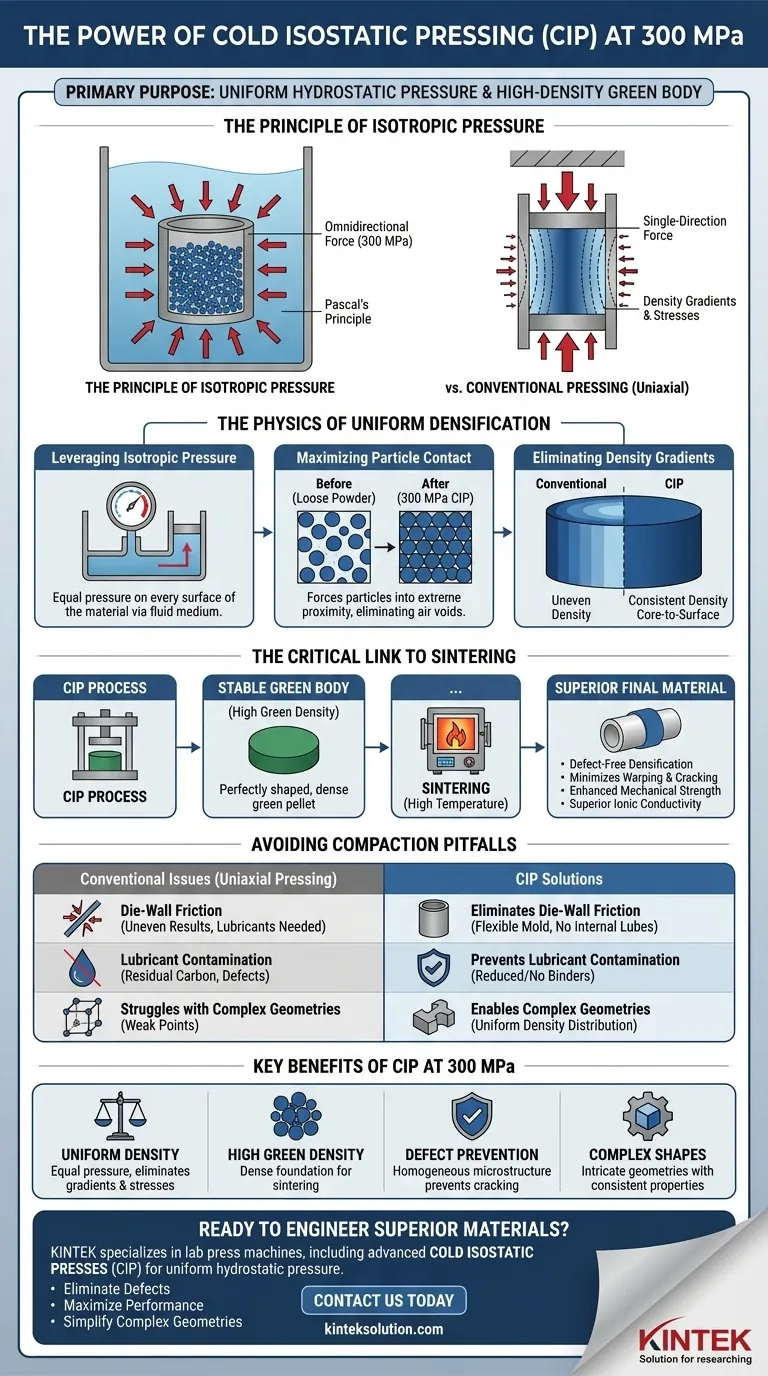
The primary purpose of using a cold isostatic press (CIP) at a high pressure of 300 MPa is to leverage Pascal's principle to apply uniform hydrostatic pressure, creating a high-density "green body." Unlike conventional pressing methods that apply force from a single direction, CIP exerts equal pressure from all directions via a liquid medium. This omnidirectional approach maximizes particle-to-particle contact and eliminates internal voids, establishing the essential structural foundation required for high-performance sintering.
Core Takeaway While standard pressing often creates internal stresses and uneven density due to friction, Cold Isostatic Pressing ensures a completely homogeneous microstructure. This uniformity is the decisive factor in preventing defects like cracking during the sintering phase, ultimately yielding materials with superior mechanical strength and ionic conductivity.

The Physics of Uniform Densification
Leveraging Isotropic Pressure
The defining characteristic of a cold isostatic press is the application of isotropic pressure. By submerging the powder mold in a fluid medium, pressure is transmitted equally to every surface of the material.
Maximizing Particle Contact
At high pressures like 300 MPa, the process forces powder particles into extremely close contact. This physical proximity significantly reduces initial porosity by eliminating air voids that naturally occur between loose particles.
Eliminating Density Gradients
Conventional single-axis pressing often results in density variations within a sample. CIP effectively removes these gradients, ensuring that the density at the core of the material is consistent with the density at the surface.
The Critical Link to Sintering
Creating a Stable Green Body
The immediate output of the CIP process is a "green body"—a compacted pellet or shape held together by mechanical interlocking. Achieving a high green density is vital because it sets the limit for the final density achievable after firing.
Facilitating Defect-Free Densification
A uniform green body is less likely to warp or crack during the high-temperature sintering process. By minimizing internal stress concentrations early on, CIP provides an ideal foundation for successful densification.
Enhancing Final Material Properties
The uniformity achieved during compaction directly correlates to the performance of the final product. For specialized materials like ceramic electrolytes (e.g., LLZT or LAGP), this process creates the low porosity and high relative density required for superior ionic conductivity and mechanical strength.
Avoiding Common Compaction Pitfalls
The Risk of Die-Wall Friction
In uniaxial pressing, friction between the powder and the metal die can inhibit densification, leading to uneven results. CIP eliminates this issue entirely by using a flexible mold and fluid pressure, removing the need for internal lubricants.
Preventing Lubricant Contamination
Because CIP reduces or eliminates the need for binders and lubricants, it mitigates the challenges associated with lubricant removal. This prevents the formation of residual carbon or defects that can occur when burning off additives during sintering.
Managing Complex Geometries
Standard presses struggle with intricate shapes, often leaving weak points in complex designs. CIP’s omnidirectional pressure allows for the compaction of complex shapes with high material utilization efficiency and uniform density distribution.
Making the Right Choice for Your Goal
To maximize the efficacy of your powder compaction process, align your method with your specific material requirements:
- If your primary focus is internal structural integrity: Use CIP to eliminate the stress concentrations and micro-cracks that inevitably occur with uniaxial pressing.
- If your primary focus is high-performance electrochemistry: Prioritize CIP to achieve the extreme microstructural uniformity required for high ionic conductivity in solid-state electrolytes.
Ultimately, high-pressure isostatic pressing is not just about shaping powder; it is about engineering the internal microstructure to guarantee the reliability of the final sintered material.
Summary Table:
| Key Benefit | How CIP at 300 MPa Achieves It |
|---|---|
| Uniform Density | Applies equal pressure from all directions, eliminating density gradients and internal stresses. |
| High Green Density | Maximizes particle-to-particle contact, creating a dense foundation for sintering. |
| Defect Prevention | Homogeneous microstructure prevents cracking and warping during the sintering phase. |
| Complex Shapes | Enables compaction of intricate geometries with consistent material properties. |
Ready to engineer superior materials with perfectly uniform density?
For researchers and laboratories focused on developing high-performance ceramics, solid-state electrolytes, or complex-shaped components, the right compaction equipment is critical. KINTEK specializes in lab press machines, including advanced cold isostatic presses (CIP) designed to deliver the uniform hydrostatic pressure essential for your success.
Our solutions help you:
- Eliminate Defects: Achieve a homogeneous green body to prevent cracking during sintering.
- Maximize Performance: Create the high-density, low-porosity microstructures required for superior ionic conductivity and mechanical strength.
- Simplify Complex Geometries: Compact intricate shapes with ease and high material utilization.
Contact us today to discuss how a KINTEK isostatic press can enhance your R&D and production outcomes. Let's build the foundation for your next breakthrough.
Visual Guide
Related Products
- Electric Lab Cold Isostatic Press CIP Machine
- Electric Split Lab Cold Isostatic Pressing CIP Machine
- Automatic Lab Cold Isostatic Pressing CIP Machine
- Manual Cold Isostatic Pressing CIP Machine Pellet Press
- Lab Isostatic Pressing Molds for Isostatic Molding
People Also Ask
- What are the applications of electric lab cold isostatic presses in research settings? Advance Material R&D with High-Pressure CIPs
- What role do electric lab cold isostatic presses play in industrial contexts? Bridge R&D and Manufacturing with Precision
- How does electrical Cold Isostatic Pressing (CIP) contribute to cost savings? Unlock Efficiency and Reduce Expenses
- What are some research applications of electric lab CIPs? Unlock Uniform Powder Densification for Advanced Materials
- What are the characteristics of standard off-the-shelf electric lab CIP solutions? Achieve Immediate, Cost-Effective Processing
















