
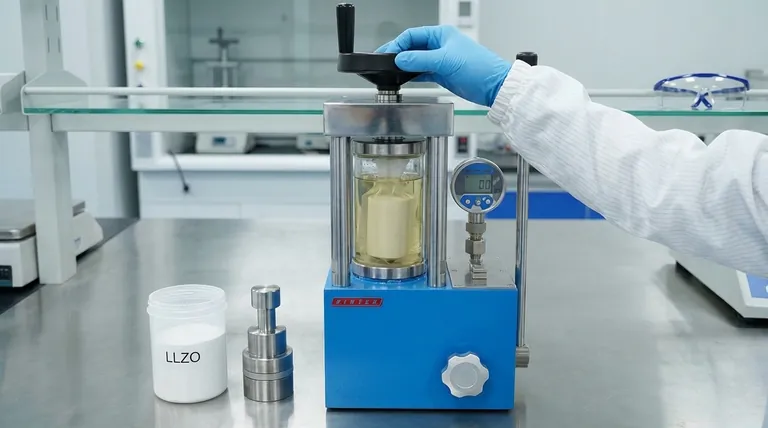
The primary purpose of Cold Isostatic Pressing (CIP) is to eliminate the internal density gradients and stress concentrations inherent in uniaxial pressing, thereby creating a highly uniform Li₇La₃Zr₂O₁₂ (LLZO) green body.
While the initial uniaxial pressing step is necessary to compact loose powder into a specific shape (a "pre-form"), it applies pressure along a single axis. CIP follows this by applying hydrostatic pressure from all directions, significantly increasing the green body's density and homogeneity to prepare it for successful high-temperature sintering.
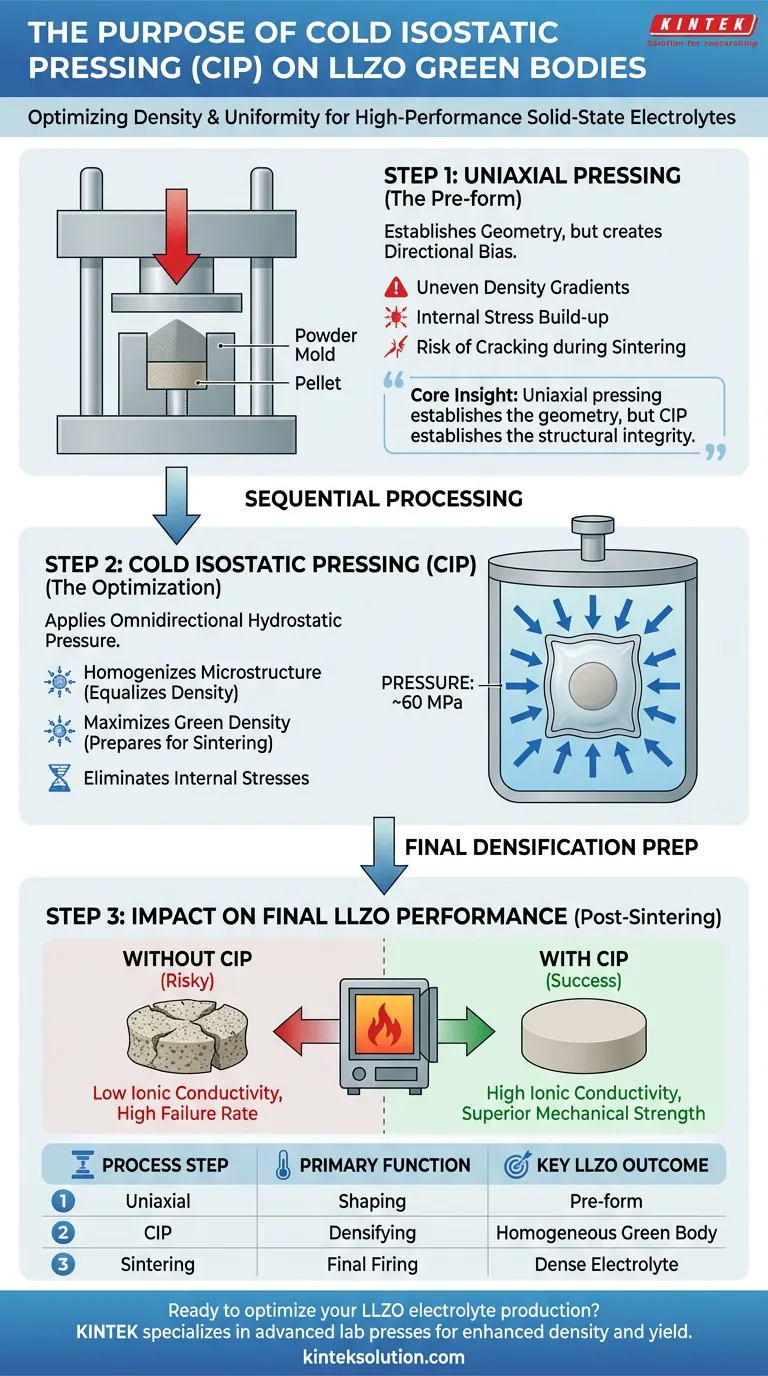
Core Insight: Uniaxial pressing establishes the geometry, but CIP establishes the structural integrity. Without CIP, the density variations within the pre-form would likely lead to cracking, warping, or low ionic conductivity in the final sintered electrolyte.
The Limitations of Uniaxial Pressing
Directional Bias
Uniaxial pressing applies force along a single vertical axis.
Resulting Density Gradients
This unidirectional force often creates uneven density distributions. The edges or surfaces in direct contact with the punch may be dense, while the center remains looser.
internal Stress Build-up
These density variations introduce internal stress concentrations. If left unresolved, these stresses can cause the pellet to crack or deform during the shrinking phase of sintering.
How CIP Optimizes the Green Body
Omnidirectional Hydrostatic Pressure
CIP subjects the pre-formed pellet to fluid pressure (e.g., 60 MPa) from every direction simultaneously.
Homogenization of Microstructure
This "all-around" pressure redistributes the particles within the green body. It effectively equalizes the density, removing the gradients left behind by the uniaxial press.
Maximizing Green Density
The process significantly increases the overall "green density" (density before firing). A higher starting density is critical for achieving high relative densities (up to 90.5%) in the final ceramic.
Impact on Final LLZO Performance
Enabling Successful Sintering
A homogeneous green body is the foundation for successful sintering. It allows the material to densify evenly at high temperatures without warping.
Reducing Final Porosity
By maximizing particle packing during the CIP stage, the final ceramic contains fewer pores.
Enhancing Ionic Conductivity
Low porosity and high density are directly linked to performance. A dense, crack-free microstructure maximizes the electrolyte’s ability to conduct lithium ions and improves its mechanical strength.
Understanding the Process Dependencies
The Requirement for a "Pre-form"
CIP is rarely used on loose powder alone for pellet fabrication. It requires a solid shape to act upon.
The Role of the Uniaxial Step
Therefore, the uniaxial press is not replaced by CIP; it is a prerequisite. It provides the initial shape and sufficient mechanical strength for the sample to be handled and loaded into the isostatic press.
Sequential Processing
The two techniques function as a complementary sequence: Uniaxial for shaping, followed by CIP for densifying.
Making the Right Choice for Your Goal
To achieve high-performance solid-state electrolytes, you must optimize each stage of the forming process.
- If your primary focus is Geometric Definition: Rely on the uniaxial press to establish the pellet's diameter and initial thickness.
- If your primary focus is Ionic Conductivity: You must employ CIP to maximize density and eliminate the porosity that blocks ion transport.
- If your primary focus is Mechanical Yield: Use CIP to remove internal stresses, significantly reducing the rejection rate due to cracking during sintering.
Mastering the transition from uniaxial shaping to isostatic densification is the key to producing robust, high-conductivity LLZO electrolytes.
Summary Table:
| Process Step | Primary Function | Key Outcome for LLZO |
|---|---|---|
| Uniaxial Pressing | Establishes geometry and shape | Creates a pre-form with initial compaction |
| Cold Isostatic Pressing (CIP) | Applies hydrostatic pressure from all directions | Eliminates density gradients, increases green density, and reduces internal stress |
| High-Temperature Sintering | Final densification of the ceramic | Produces a dense, crack-free electrolyte with high ionic conductivity |
Ready to optimize your LLZO electrolyte production? KINTEK specializes in advanced lab press machines, including automatic lab presses and isostatic presses, designed to enhance the density and homogeneity of your ceramic materials. Our equipment ensures higher mechanical yield, superior ionic conductivity, and reduced sintering failures. Contact us today to discuss how our solutions can improve your solid-state battery research and development!
Visual Guide
Related Products
- Electric Lab Cold Isostatic Press CIP Machine
- Electric Split Lab Cold Isostatic Pressing CIP Machine
- Automatic Lab Cold Isostatic Pressing CIP Machine
- Manual Cold Isostatic Pressing CIP Machine Pellet Press
- Lab Isostatic Pressing Molds for Isostatic Molding
People Also Ask
- What are the applications of electric lab cold isostatic presses in research settings? Advance Material R&D with High-Pressure CIPs
- What role do electric lab cold isostatic presses play in industrial contexts? Bridge R&D and Manufacturing with Precision
- How does electrical Cold Isostatic Pressing (CIP) contribute to cost savings? Unlock Efficiency and Reduce Expenses
- What are some research applications of electric lab CIPs? Unlock Uniform Powder Densification for Advanced Materials
- What are the characteristics of standard off-the-shelf electric lab CIP solutions? Achieve Immediate, Cost-Effective Processing
















