
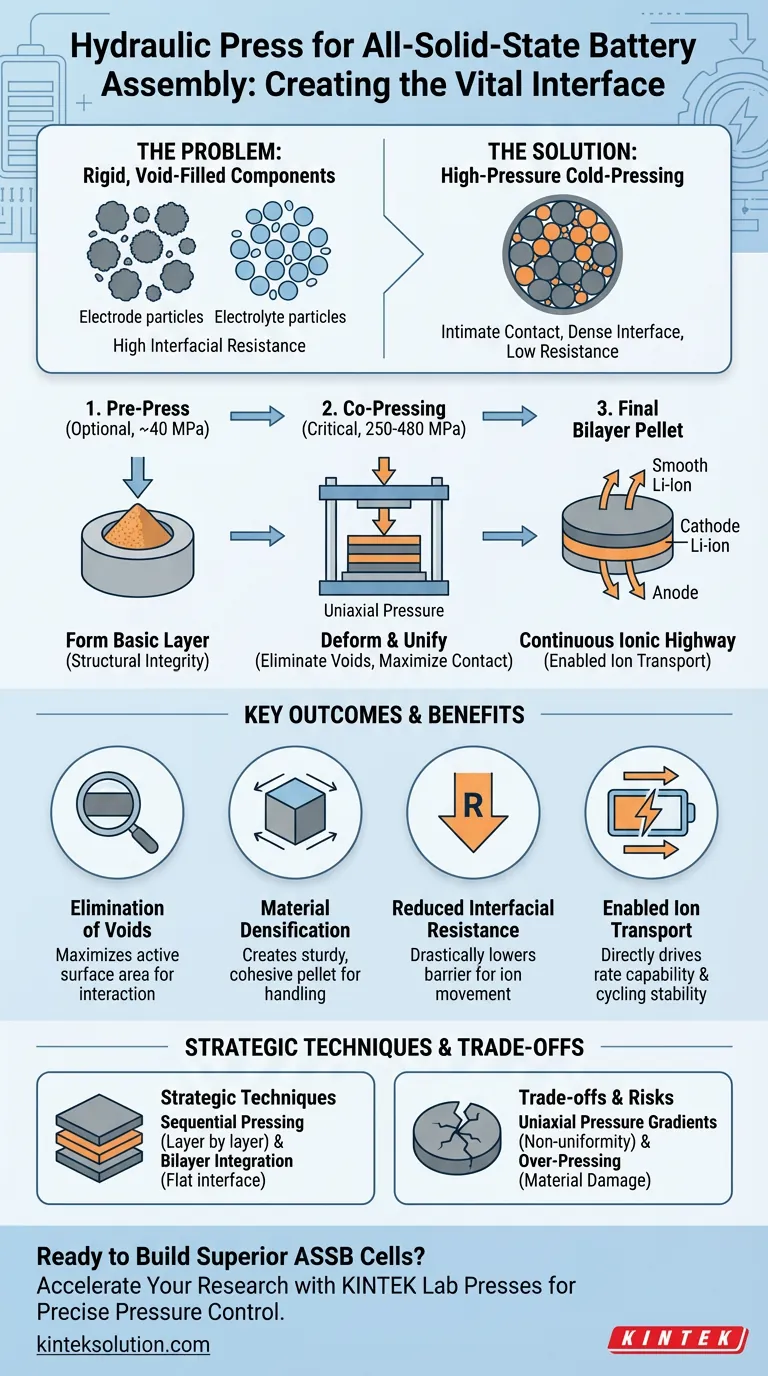
The primary purpose of using a hydraulic press during all-solid-state battery (ASSB) assembly is to mechanically force the electrode and electrolyte materials into intimate physical contact. Because solid electrolytes cannot flow into pores like liquid electrolytes, this high-pressure "cold-pressing" step is the only way to eliminate microscopic air gaps and create a continuous, dense interface required for the battery to operate.
Core Takeaway: In solid-state batteries, physical contact equals electrochemical performance. The hydraulic press serves to eliminate voids and densify the material layers, directly lowering interfacial resistance to ensure efficient lithium-ion transport.
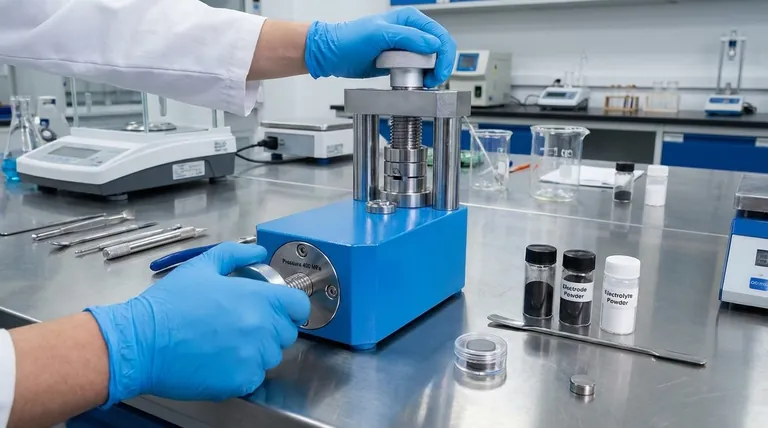
The Physical Challenge: Creating the Interface
Overcoming Material Rigidity
Unlike traditional batteries where a liquid electrolyte creates instant contact by wetting the electrode, solid-state batteries consist of rigid components.
Without external force, these solid particles merely touch at rough points, leaving vast gaps between them. The hydraulic press applies massive force (often between 250 MPa and 480 MPa) to physically deform these materials into a unified structure.
Elimination of Voids
The most immediate physical outcome of cold-pressing is the removal of voids.
Air gaps between the electrode sheet and the electrolyte pellet act as insulators, blocking the flow of current. High pressure collapses these voids, maximizing the active surface area where the materials interact.
Material Densification
Beyond the interface, the pressure compacts the bulk materials themselves.
This process densifies the electrode and electrolyte powders, reducing the overall volume and creating a sturdy, cohesive pellet. This structural integrity is vital for handling the cell during subsequent testing stages.
Electrochemical Implications
Reducing Interfacial Resistance
The success of an ASSB is often measured by its interfacial resistance—the barrier ions face when moving from one material to another.
A "large-area, void-free" interface created by the press drastically lowers this resistance. If the press pressure is insufficient, resistance spikes, rendering the battery inefficient or non-functional.
Enabling Ion Transport
Lithium ions require a continuous material pathway to migrate between the cathode and anode.
By pressing the particles into "intimate contact," you establish the necessary ionic highways. This smooth transport is the direct driver of the battery's rate capability (how fast it can charge/discharge) and its long-term cycling stability.
Strategic Pressing Techniques
Sequential Pressing
Assembly often involves a multi-step strategy rather than a single crush.
A common technique involves "pre-pressing" the cathode material at a lower pressure (e.g., 40 MPa) to form a basic layer. This is followed by "co-pressing" it with the electrolyte at significantly higher pressure (e.g., 250 MPa) to lock the interface together without damaging the individual layers.
Bilayer Integration
For many cell designs, the press is used to integrate the cathode composite and solid electrolyte into a single bilayer structure.
This ensures the boundary between the two different materials is physically flat and chemically intimate, further minimizing impedance.
Understanding the Trade-offs
Uniaxial Pressure Gradients
Standard hydraulic presses typically apply uniaxial pressure (pressure from one direction).
This can sometimes create pressure gradients, where the center of the pellet is densified differently than the edges. While effective for general assembly, this lack of total uniformity can occasionally lead to localized performance variations within the cell.
The Risk of Over-Pressing
While high pressure is necessary, it must be controlled.
Excessive pressure can crush brittle active materials or damage the crystal structure of certain solid electrolytes. The goal is plastic deformation and contact, not the destruction of the particle morphology.
Making the Right Choice for Your Goal
How to Apply This to Your Project
- If your primary focus is reducing internal resistance: Prioritize a "co-pressing" strategy where the electrode and electrolyte are pressed simultaneously at high pressure (250+ MPa) to maximize surface contact.
- If your primary focus is structural integrity: Utilize a lower-pressure "pre-press" step for individual layers before the final assembly to ensure the materials hold their shape without cracking.
- If your primary focus is perfect uniformity: Acknowledge the limits of a standard hydraulic press and consider isostatic pressing (omnidirectional pressure) for validation phases where edge-to-center consistency is critical.
Ultimately, the hydraulic press acts as the bridge between raw powder and a functional electrochemical system.
Summary Table:
| Purpose | Key Outcome | Typical Pressure Range |
|---|---|---|
| Eliminate Voids | Creates continuous, dense interface for ion transport | 250 - 480 MPa |
| Reduce Interfacial Resistance | Lowers barrier for lithium-ion movement | 250 - 480 MPa |
| Densify Materials | Improves structural integrity for handling | 250 - 480 MPa |
| Pre-Press for Integrity | Forms basic layers without damage | ~40 MPa |
Ready to Build Superior All-Solid-State Battery Cells?
The precise pressure control of a hydraulic press is critical for creating the high-quality, low-resistance interfaces your research demands. KINTEK specializes in laboratory press machines, including automatic and heated lab presses, designed to meet the exacting needs of battery development.
Let our expertise help you achieve perfect material densification and interfacial contact. Contact our team today to discuss how a KINTEK lab press can accelerate your ASSB assembly and testing.
Visual Guide
References
- Jaecheol Choi, Young-Gi Lee. Enhancing electrochemo-mechanical properties of graphite-silicon anode in all-solid-state batteries via solvent-induced polar interactions in nitrile binders. DOI: 10.1016/j.jechem.2025.02.012
This article is also based on technical information from Kintek Solution Knowledge Base .
Related Products
- Automatic Laboratory Hydraulic Press for XRF and KBR Pellet Pressing
- Automatic Laboratory Hydraulic Press Lab Pellet Press Machine
- Laboratory Hydraulic Split Electric Lab Pellet Press
- Manual Laboratory Hydraulic Pellet Press Lab Hydraulic Press
- Laboratory Hydraulic Pellet Press for XRF KBR FTIR Lab Press
People Also Ask
- Why is pressing powder into a pellet critical before sintering? Ensure Dense, Conductive Solid-State Electrolytes
- What is the role of a laboratory pressure machine and KBr in FTIR? Master Sample Preparation for Flame Retardants
- What are the advantages of using a laboratory automatic hydraulic press for HEA green compact forming?
- What are the advantages of using a lab automatic hydraulic press for HEA green body molding? Ensure Material Integrity
- What are the advantages of using an automatic laboratory hydraulic press? Enhance Precision in Sample Preparation



















