
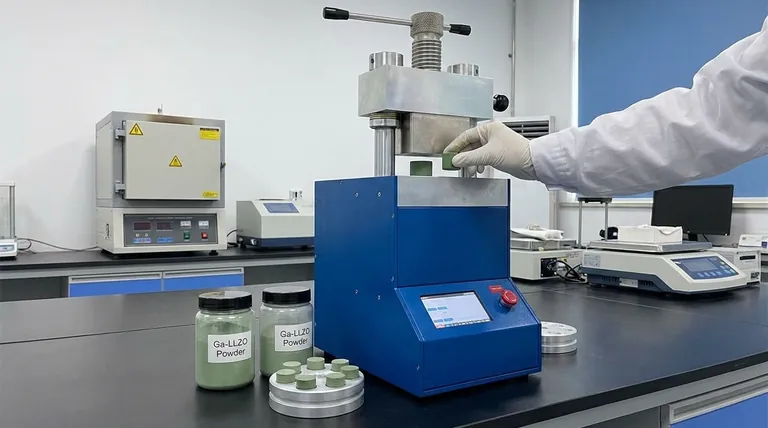
The primary purpose of using a lab press to cold-press Ga-LLZO powder is to transform loose particulate into a cohesive, semi-dense "green body" capable of withstanding the rigors of high-temperature sintering. This mechanical compaction closes the distance between particles, creating the intimate physical contact required to initiate solid-state diffusion and densification during the subsequent heating stages.
Core Insight Sintering efficiency is determined before the heat is ever applied. Cold-pressing establishes the necessary "structural foundation"—specifically adequate mechanical strength and high initial density—which allows the material to shrink uniformly and achieve near-theoretical density in the final ceramic product.
The Mechanics of Pre-Sintering Compaction
Creating the Green Body
The immediate goal of a lab press is to consolidate loose Ga-LLZO powder into a self-supporting shape, known as a "green body."
Using pressures such as 30 MPa to 100 MPa, the press forces the powder particles to interlock. This creates a pellet with sufficient mechanical strength to be handled and transferred to a furnace without crumbling.
Maximizing Particle Contact
Successful solid-state reactions rely heavily on proximity. Cold-pressing significantly increases the number of contact points between individual powder particles.
By eliminating large air gaps and ensuring intimate physical contact, the process establishes a pathway for atomic diffusion. This "material transport" is the fundamental mechanism that drives densification once high heat is applied.
Increasing Initial Density
A lab press reduces internal porosity before sintering begins, raising the initial relative density of the material.
A higher starting density reduces the amount of shrinkage the material must undergo during sintering. This head start is critical for achieving a final ceramic product with high relative density (e.g., up to 95% or higher) and optimal electrochemical properties.
Impact on Sintering Dynamics
Enabling Uniform Shrinkage
A well-compacted green body promotes uniform shrinkage during the heating phase.
When the initial density is consistent, the ceramic contracts evenly as grains fuse. This reduces the likelihood of warping or deformation, which is common when sintering loosely packed or unevenly distributed powders.
Enhancing Reaction Rates
For complex oxides like Ga-LLZO, the chemical reaction between precursor particles must be efficient.
Compaction ensures that reactant particles are physically touching, which improves the reaction conversion rate. A dense, well-pressed pellet facilitates a more homogeneous solid-state reaction, leading to a purer final phase.
Understanding the Trade-offs: Uniaxial vs. Isostatic
The Risk of Density Gradients
A standard laboratory hydraulic press typically applies uniaxial pressure (pressure from one direction).
While effective for simple pellets, this can create density gradients where the edges are denser than the center. These gradients can lead to internal stress concentrations, which may cause the ceramic to crack during the intense heat of sintering.
The Advantage of Isostatic Pressing (CIP)
To mitigate gradients, a Cold Isostatic Press (CIP) applies uniform hydrostatic pressure (e.g., 60 MPa) from all directions.
References indicate that CIP produces a green body with exceptional uniformity compared to uniaxial pressing. This effectively eliminates stress concentrations, significantly reducing the risk of cracking and ensuring a more consistent density distribution throughout the electrolyte.
Making the Right Choice for Your Goal
Whether you use a standard hydraulic press or an isostatic press depends on your specific requirements for density and structural integrity.
- If your primary focus is rapid prototyping or material screening: Use a standard uniaxial hydraulic press (30–100 MPa) to quickly generate pellets with sufficient strength for basic sintering and conductivity testing.
- If your primary focus is maximizing uniformity and preventing cracks: Employ a Cold Isostatic Press (CIP) to apply uniform pressure, ensuring the green body has no density gradients that could lead to failure during high-temperature processing.
- If your primary focus is pushing density to the theoretical limit: Consider following cold pressing with Hot Isostatic Pressing (HIP), which applies pressure and heat simultaneously to close residual microscopic pores that cold pressing alone cannot resolve.
The quality of your final electrolyte is effectively set by the quality of the green body you create before the furnace is ever turned on.
Summary Table:
| Purpose of Cold-Pressing | Key Benefit | Typical Pressure Range |
|---|---|---|
| Create a Cohesive Green Body | Enables handling and transfer to furnace without crumbling | 30 - 100 MPa |
| Maximize Particle Contact | Initiates atomic diffusion pathways for efficient sintering | 30 - 100 MPa |
| Increase Initial Density | Reduces required shrinkage, leading to higher final density | 30 - 100 MPa |
| Ensure Uniform Shrinkage | Prevents warping and deformation during sintering | Varies by press type |
| Mitigate Cracking (with CIP) | Applies uniform pressure to eliminate density gradients and stress | ~60 MPa (Isostatic) |
Achieve Superior Sintering Results with the Right Lab Press
The quality of your final Ga-LLZO ceramic electrolyte is determined by the initial compaction step. Using the correct lab press is critical for creating a uniform, high-density green body that sinters successfully without cracking.
KINTEK specializes in lab press machines designed specifically for these advanced material processing challenges. Whether you need a standard uniaxial hydraulic press for rapid prototyping or a Cold Isostatic Press (CIP) to eliminate density gradients and prevent sintering failures, we have the solution.
Our lab presses help you:
- Accelerate R&D: Quickly produce consistent pellets for material screening and conductivity testing.
- Maximize Yield: Achieve uniform density and minimize cracking for higher-quality final products.
- Push Performance Limits: Reach near-theoretical density for optimal electrochemical properties.
Ready to optimize your Ga-LLZO sintering process? Let our experts help you select the ideal press for your specific goals.
Contact KINTELK today for a consultation and discover how our automatic lab presses, isostatic presses, and heated lab presses can serve your laboratory's needs.
Visual Guide

Related Products
- Electric Lab Cold Isostatic Press CIP Machine
- Automatic Lab Cold Isostatic Pressing CIP Machine
- Manual Cold Isostatic Pressing CIP Machine Pellet Press
- Electric Split Lab Cold Isostatic Pressing CIP Machine
- Automatic Laboratory Hydraulic Press Lab Pellet Press Machine
People Also Ask
- What role do electric lab cold isostatic presses play in industrial contexts? Bridge R&D and Manufacturing with Precision
- What are the applications of electric lab cold isostatic presses in research settings? Advance Material R&D with High-Pressure CIPs
- How does electrical Cold Isostatic Pressing (CIP) contribute to cost savings? Unlock Efficiency and Reduce Expenses
- What are some research applications of electric lab CIPs? Unlock Uniform Powder Densification for Advanced Materials
- What are the characteristics of standard off-the-shelf electric lab CIP solutions? Achieve Immediate, Cost-Effective Processing




