To create a KBr pellet for FTIR analysis, you must grind approximately 1–2 mg of your sample with 200–250 mg of Potassium Bromide (KBr) powder to form a uniform mixture. This mixture is then loaded into a die set and compressed under 8,000–10,000 psi of pressure to produce a transparent disc suitable for spectroscopic analysis.
Core Takeaway: The success of a KBr pellet relies on diluting the sample within an infrared-transparent medium (KBr) at a ratio of approximately 1:100. A high-quality pellet must be mechanically stable and optically clear; a cloudy or opaque pellet will scatter light and degrade signal quality.
Phase 1: Preparation and Cleaning
Equipment Decontamination
Before handling any chemicals, thoroughly clean the die set, pestle, and mortar. Use a suitable solvent followed by deionized water to remove any previous residues.
Drying the Tools
After cleaning, ensure all tools are completely dry. Place the equipment in a warm oven to evaporate residual moisture. This is critical because moisture is the primary contaminant in KBr analysis.
Selecting the Mortar
An agate pestle and mortar is highly recommended. Its hardness prevents contamination from the mortar material itself, and its smooth surface minimizes sample loss during the grinding process.
Phase 2: Grinding and Mixing
Grinding the Sample
Begin by grinding a small amount of the sample powder (typically 1–2 mg for a standard 1/2 inch pellet) in the mortar. The sample must be reduced to a fine particle size to prevent light scattering.
Adding the Matrix (KBr)
Add approximately 200–250 mg of KBr powder to the mortar. This achieves the ideal dilution ratio of roughly 1 part sample to 100 parts KBr.
Creating the Mixture
Briefly grind the KBr and sample together to ensure they are uniformly mixed. Do not over-grind at this stage; excessive grinding increases the surface area of the KBr, which accelerates moisture absorption from the air.
Environmental Control
Because KBr is hygroscopic (absorbs water), this mixing process should ideally be performed in a glove box. This minimizes background noise caused by atmospheric water vapor in your final spectrum.
Phase 3: Pressing the Pellet
Loading the Die
Assemble the die by placing the sleeve onto the base plate. Transfer the KBr/sample mixture into the die cavity and insert the plunger on top of the powder.
Applying Pressure
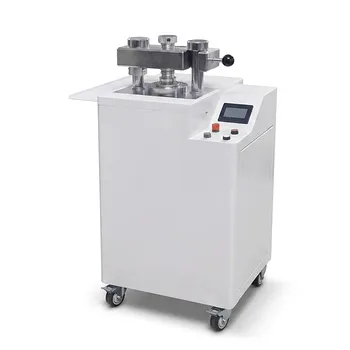
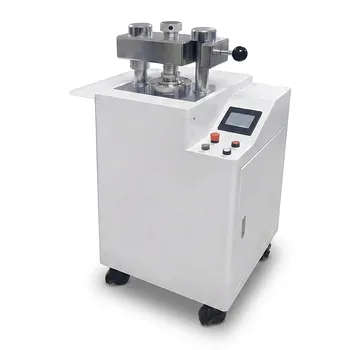
Place the die assembly into the hydraulic press. Apply a force that results in a pressure of approximately 8,000 to 10,000 psi (55–69 MPa).
Forming the Disc
Hold the pressure to allow the KBr to flow and fuse into a solid disc. The uniform force creates a pellet that is approximately 2 mm thick and transparent to infrared light.
Ejecting the Pellet
Release the pressure and remove the base plate. Invert the die sleeve, place the release ring on top, and use the press to gently push the finished pellet out of the sleeve.
Common Pitfalls to Avoid
The Moisture Issue
KBr readily absorbs moisture from the air, which creates broad water peaks in your FTIR spectrum. A vacuum die can help, but preparing the sample in a controlled atmosphere (glovebox) is far more effective than vacuum pressing alone.
Pellet Opacity
The final pellet should appear clear. If the pellet is opaque or cloudy, it typically indicates that the particle size was not ground finely enough, the sample is too concentrated, or the pellet is too thick.
Comparison to ATR
While Attenuated Total Reflectance (ATR) is a more modern and dominant technique, KBr pellets are a classic method that provides excellent transmission data. However, KBr preparation is more labor-intensive and sensitive to operator technique compared to ATR.
Making the Right Choice for Your Goal
To ensure the best spectral data, adjust your approach based on your specific requirements:
- If your primary focus is spectral purity: Use a glovebox for all mixing and loading steps to eliminate interference from atmospheric moisture.
- If your primary focus is pellet clarity: Ensure you adhere strictly to the 1:100 ratio; if the pellet is cloudy, reduce the sample amount or regrind the mixture to reduce particle size.
Mastering the KBr pellet technique requires balancing thorough mixing with speed to minimize moisture uptake.
Summary Table:
| Stage | Key Step | Parameters/Requirements |
|---|---|---|
| 1. Preparation | Tool Cleaning | Use agate mortar/pestle; dry in a warm oven |
| 2. Mixing | Sample to KBr Ratio | 1-2 mg sample : 200-250 mg KBr (approx. 1:100) |
| 3. Grinding | Particle Size | Grind to fine powder; avoid over-grinding to prevent moisture |
| 4. Pressing | Applied Pressure | 8,000 – 10,000 psi (55–69 MPa) |
| 5. Quality | Optical Clarity | Disc should be transparent; avoid cloudy/opaque pellets |
Achieve Flawless Spectroscopic Results with KINTEK
Consistency is the hallmark of high-quality research. At KINTEK, we specialize in comprehensive laboratory pressing solutions designed to eliminate variables like moisture contamination and uneven pressure. From manual and automatic presses to heated and glovebox-compatible models, our equipment empowers battery researchers and material scientists to produce perfect KBr pellets every time.
Ready to upgrade your lab's precision with our cold and warm isostatic presses? Contact us today to find your ideal pressing solution!
Related Products
- Laboratory Hydraulic Press 2T Lab Pellet Press for KBR FTIR
- XRF KBR Plastic Ring Lab Powder Pellet Pressing Mold for FTIR
- Laboratory Hydraulic Pellet Press for XRF KBR FTIR Lab Press
- Automatic Laboratory Hydraulic Press for XRF and KBR Pellet Pressing
- Lab Infrared Press Mold for No Demolding
People Also Ask
- What is the role of a laboratory pressure machine and KBr in FTIR? Master Sample Preparation for Flame Retardants
- What is the role of a laboratory hydraulic press in high-loading NCM811 cathode prep for solid-state batteries?
- What role does a laboratory hydraulic press play in reaction pellets? Optimizing Lunar Soil and Metal Fuel Density
- Why is a laboratory hydraulic press necessary for sample preparation? Precise Pelleting for Spiro Heterocyclic Analysis
- Why is a laboratory hydraulic press used with a mold for FTIR of shellac nanofibers? Achieve High-Fidelity Spectra