
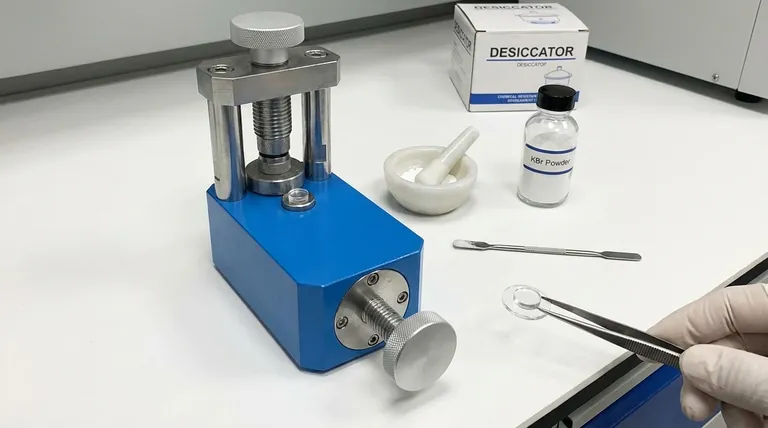
Preparing a KBr pellet is a foundational technique in spectroscopy used to turn solid samples into a transparent medium suitable for infrared analysis. The process requires grinding a minute quantity of your sample with potassium bromide (KBr) powder—typically at a 1% to 2% concentration by weight—and compressing the mixture under significant hydraulic pressure until it fuses into a clear, glass-like disc.
The Key to Quality Data While the mechanics of pressing a pellet are straightforward, the quality of your spectral data depends entirely on moisture control and particle size. A successful pellet is not just a solid disc; it is a transparent matrix where the KBr has become plastic and flowed around the sample particles without introducing water bands to the spectrum.
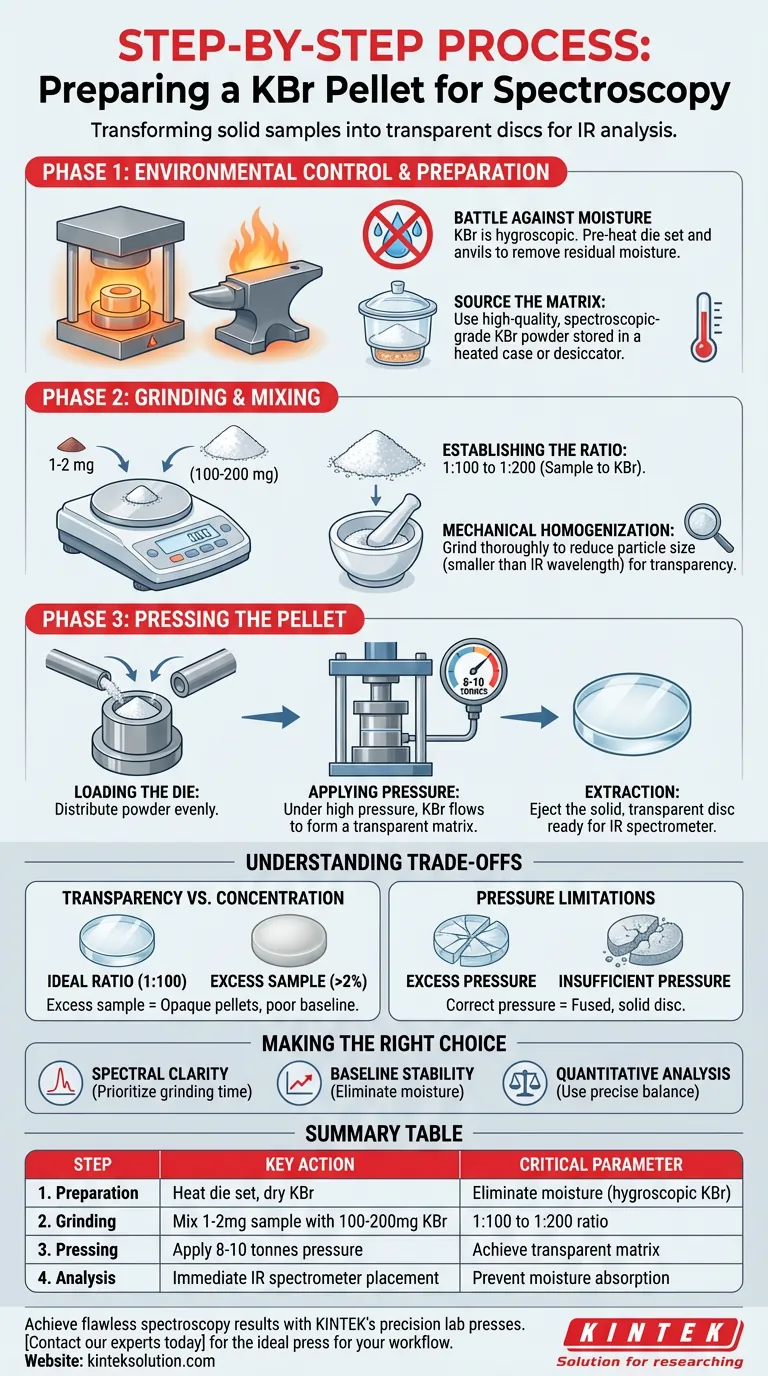
Phase 1: Environmental Control and Preparation
The Battle Against Moisture
The most critical variable in KBr pellet preparation is water. Potassium bromide is hygroscopic, meaning it aggressively absorbs moisture from the air.
Moisture contamination leads to cloudy pellets and introduces broad interference bands (around 3400 cm⁻¹) in your final spectrum, obscuring sample data.
Pre-heating Equipment
To prevent this, you must heat the anvils and the body of the die set prior to use. This removes residual surface moisture.
Ensure the die set, anvils, and powder are all at the same temperature before pressing to prevent condensation or thermal shock.
Sourcing the Matrix
Always use high-quality, spectroscopic-grade KBr powder.
This powder must be stored in a heated case or desiccator. Never leave the KBr container open to the laboratory atmosphere longer than absolutely necessary.
Phase 2: Grinding and Mixing
Establishing the Ratio
Precision is vital here. You generally need a ratio of 1:100 to 1:200 (sample to KBr).
Practically, this translates to mixing approximately 1–2 mg of sample with 100–200 mg of KBr.
Mechanical Homogenization
Place the measured sample and KBr into an agate mortar and pestle.
Grind the mixture thoroughly. The goal is to reduce the particle size of the sample until it is smaller than the wavelength of the infrared radiation.
This fine consistency is crucial for pellet transparency; large particles will scatter light and result in poor spectral quality.
Phase 3: Pressing the Pellet
Loading the Die
Transfer the finely ground powder mixture into the pellet die assembly.
Ensure the powder is distributed evenly across the internal plunger or anvil surface to create a disc of uniform thickness.
Applying Pressure
Place the die assembly into a hydraulic press. Apply a load of approximately 8 to 10 tonnes (for a standard 13 mm die).
Under this high pressure, the KBr powder loses its granular structure and becomes plastic, flowing to form a continuous, transparent matrix.
Extraction
Release the pressure and carefully eject the pellet from the die set.
The result should be a solid, transparent disc ready for immediate placement in the IR spectrometer for analysis.
Understanding the Trade-offs
Transparency vs. Concentration
There is a distinct trade-off between signal strength and pellet clarity. Adding more sample (above 2%) might seem like it would provide a stronger signal, but it often leads to opaque pellets that scatter the beam, ruining the baseline of your spectrum.
Pressure Limitations
While pressure is necessary, excessive pressure (beyond the standard 10 tonnes for KBr) or pressure applied too quickly can cause the pellet to fracture or result in "white spots" due to uneven crystallization.
Conversely, insufficient pressure will fail to fuse the KBr, leaving you with a fragile, opaque disc that crumbles upon handling.
Making the Right Choice for Your Goal
Achieving a perfect spectrum requires balancing the physical preparation with the chemical nature of your sample.
- If your primary focus is Spectral Clarity: Prioritize grinding time; the finer the powder, the lower the light scattering and the sharper the peaks.
- If your primary focus is Baseline Stability: Focus on moisture elimination by heating the die set and working quickly to minimize atmospheric exposure.
- If your primary focus is Quantitative Analysis: Use a precise balance to weigh both the sample and the KBr to ensure the 1:100 ratio is exact, rather than estimated.
The difference between a usable spectrum and a flawless one is usually the dryness of your KBr.
Summary Table:
| Step | Key Action | Critical Parameter |
|---|---|---|
| 1. Preparation | Heat die set & use dry KBr | Eliminate moisture (hygroscopic KBr) |
| 2. Grinding | Mix 1-2 mg sample with 100-200 mg KBr | 1:100 to 1:200 sample-to-KBr ratio |
| 3. Pressing | Apply 8-10 tonnes pressure in hydraulic press | Achieve transparent, plastic KBr matrix |
| 4. Analysis | Immediately place pellet in IR spectrometer | Prevent moisture absorption for clear baseline |
Achieve flawless spectroscopy results with KINTEK's precision lab presses.
Our automatic lab presses, including heated models ideal for moisture-sensitive applications like KBr pellet preparation, deliver the consistent, high-pressure performance your laboratory needs for perfect sample transparency and spectral clarity.
Ready to enhance your sample preparation? Contact our experts today to find the ideal press for your spectroscopy workflow.
Visual Guide
Related Products
- Laboratory Hydraulic Press 2T Lab Pellet Press for KBR FTIR
- XRF KBR Plastic Ring Lab Powder Pellet Pressing Mold for FTIR
- XRF KBR Steel Ring Lab Powder Pellet Pressing Mold for FTIR
- Laboratory Hydraulic Pellet Press for XRF KBR FTIR Lab Press
- Automatic Laboratory Hydraulic Press for XRF and KBR Pellet Pressing
People Also Ask
- What is the role of a laboratory pressure machine and KBr in FTIR? Master Sample Preparation for Flame Retardants
- What is the role of a laboratory hydraulic press in high-loading NCM811 cathode prep for solid-state batteries?
- Why is a laboratory hydraulic press necessary for sample preparation? Precise Pelleting for Spiro Heterocyclic Analysis
- What role does a laboratory hydraulic press play in reaction pellets? Optimizing Lunar Soil and Metal Fuel Density
- What is the role of a laboratory hydraulic press in denture preparation? Achieve High-Density Dental Prosthetics



















