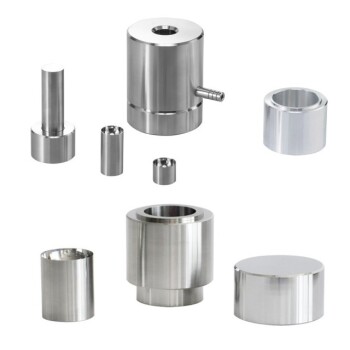
High-purity graphite components serve as both the structural vessel and the active heating engine in the Spark Plasma Sintering (SPS) process. For materials like Polytetrafluoroethylene (PTFE), these components—specifically the anodes, cathodes, punches, and molds—perform the dual function of containing the powder under high axial pressure while acting as resistive heating elements to generate thermal energy.
Core Takeaway: By passing pulsed electrical current directly through conductive graphite components, the SPS process achieves rapid, uniform heating that transfers immediately to the internal PTFE powder. This direct heating method, combined with simultaneous pressure, drastically reduces processing time and minimizes thermal degradation compared to conventional molding.
The Dual-Mechanism of Graphite Components
The efficiency of SPS relies on the unique ability of graphite to handle mechanical stress and electrical current simultaneously.
Resistive Heating Generation
In traditional sintering, heat is applied externally and slowly penetrates the mold. In SPS, the graphite mold and punches act as resistive heating elements.
When pulsed direct current passes through these conductive components, heat is generated internally and transferred directly to the PTFE powder.
Axial Pressure Transmission
While generating heat, the graphite assembly functions as a robust containment vessel.
The punches and dies transmit significant axial pressure to the PTFE powder. High-purity graphite is selected for its ability to maintain structural integrity and transmit this pressure accurately even at elevated sintering temperatures.
Impact on PTFE Processing Efficiency
The configuration of the graphite mold directly influences the quality and speed of the PTFE consolidation.
Achieving High Heating Rates
The direct heating nature of the graphite components allows for extremely rapid temperature increases, reaching rates as high as 400 °C/min.
This concentrates energy at the contact points of the PTFE particles, significantly shortening the overall processing time to just a few minutes.
Precise Temperature Control
Because the graphite components heat up rapidly and uniformly, they allow for tight control over temperature gradients.
This precision is critical for PTFE, as it enables solid-state consolidation at temperatures below the melting point.
Preserving Material Integrity
The speed and lower temperature requirements offered by this setup effectively suppress grain growth.
Furthermore, the reduced exposure time to high heat minimizes thermal oxidative degradation, preserving the chemical and physical properties of the PTFE.
The Role of Graphite Foil Liners
While the primary mold provides structure and heat, high-purity graphite foil is often employed as a critical interface layer.
Lubrication and Release
Graphite foil acts as a lubricant and release agent between the PTFE powder and the rigid die walls.
This ensures that the sintered sample can be removed smoothly without sticking to the mold, which is essential for maintaining the surface finish of the component.
Electrical and Chemical Isolation
The foil serves as a protective barrier that prevents chemical reactions between the powder and the mold.
It also ensures uniform current distribution within the die cavity, preventing "hot spots" that could lead to uneven sintering or microstructural defects.
Understanding the Trade-offs
While high-purity graphite is the standard for SPS, it is important to recognize the operational constraints of these components.
Mechanical Wear and Creep
Despite its strength, graphite is subject to wear and high-temperature creep over repeated cycles.
Over time, this can degrade the molding precision, requiring regular inspection and replacement of the dies to maintain dimensional tolerances.
Oxidation Risks
Graphite is susceptible to oxidation at high temperatures if the vacuum or inert atmosphere is compromised.
Maintaining a strictly controlled environment is necessary to prevent the erosion of the mold components, which would alter the electrical resistance and pressure distribution.
Making the Right Choice for Your Project
To maximize the benefits of SPS for PTFE, align your tooling strategy with your specific material goals.
- If your primary focus is Speed: Leverage the high conductivity of the graphite components to utilize rapid heating rates (up to 400 °C/min), drastically reducing cycle times.
- If your primary focus is Material Purity: Utilize high-quality graphite foil liners to prevent carbon diffusion or chemical reactions between the mold walls and the PTFE.
- If your primary focus is Microstructural Control: Rely on the simultaneous application of pressure and current to consolidate the material below its melting point, preventing grain coarsening.
The strategic use of high-purity graphite transforms the mold from a passive container into an active, high-precision processing tool.
Summary Table:
| Feature | Function in SPS Process | Benefit for PTFE |
|---|---|---|
| Graphite Mold/Die | Containment & Resistive Heating | Rapid, uniform heating (up to 400°C/min) |
| Punches/Anodes | Axial Pressure Transmission | High-density consolidation below melting point |
| Graphite Foil | Lubrication & Interface Layer | Easy release and prevention of chemical reactions |
| Direct Pulsed Current | Internal Heat Generation | Shortened cycle times and suppressed grain growth |
Maximize Your Material Research with KINTEK Precision Solutions
Elevate your laboratory's capabilities with KINTEK’s industry-leading expertise in high-performance pressing and sintering. As specialists in comprehensive laboratory pressing solutions, we provide a versatile range of equipment including manual, automatic, heated, multifunctional, and glovebox-compatible models, as well as advanced cold and warm isostatic presses specifically designed for demanding applications like battery research and advanced polymer processing.
Whether you are refining PTFE consolidation or developing next-generation ceramics, our tools ensure the precision and reliability your research deserves. Contact KINTEK today to discover how our tailored solutions can optimize your SPS workflows and material integrity.
References
- Ilham Elaboudi, Laurent Servant. Comparing the sorption kinetics of poly-tetrafluoroethylene processed either by extrusion or spark plasma sintering. DOI: 10.1016/j.polymer.2020.122192
This article is also based on technical information from Kintek Solution Knowledge Base .
Related Products
- Square Lab Press Mold for Laboratory Use
- Lab Round Bidirectional Press Mold
- Special Shape Lab Press Mold for Laboratory Applications
- Lab Isostatic Pressing Molds for Isostatic Molding
- Lab Heat Press Special Mold
People Also Ask
- What is the purpose of incorporating cartridge heaters into a lab press mold for MLCC block compression? Optimize Results
- Why is precise cooling management of the lab press mold necessary? Protect Core Integrity in Thermoforming
- What is the function of a pressing tool in thermoplastic panels? Master Precision Shaping & Fusion Bonding
- Why is a high-performance laboratory molding press critical for in-situ electrolyte formation? Unlock Battery Success
- Why are precision laboratory molds essential for forming basalt-reinforced lightweight concrete specimens?