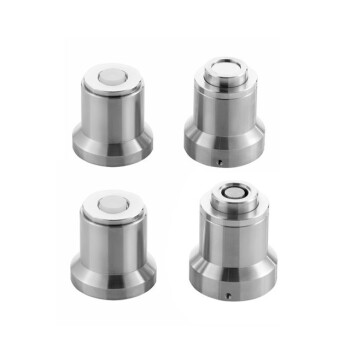
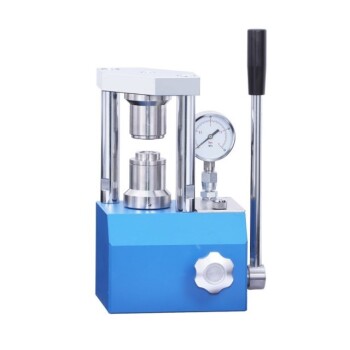
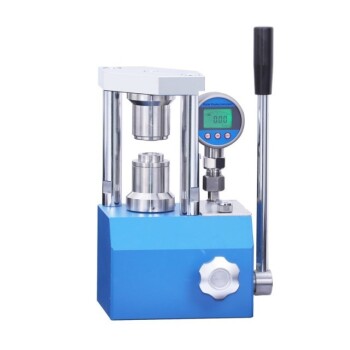
The compression-type battery test cell serves as the foundational hardware for accurate electrolyte characterization. It functions by creating a standardized, airtight environment while applying continuous mechanical pressure to the battery assembly. This mechanical force ensures intimate physical contact between the lithium foil anode, the composite cathode, and the PS-b-POEGMA electrolyte membrane, which is a prerequisite for valid data collection.
Core Takeaway: The primary value of this test cell is the elimination of physical gaps at the material interfaces. By maintaining consistent mechanical pressure, it minimizes interfacial resistance, ensuring that electrochemical measurements reflect the intrinsic properties of the PS-b-POEGMA electrolyte rather than assembly defects.
The Critical Role of Mechanical Pressure
Bridging the Solid-Solid Interface
Unlike liquid electrolytes that naturally wet electrode surfaces, solid electrolytes like PS-b-POEGMA require external force to establish connectivity. The test cell applies continuous mechanical pressure to force the electrolyte membrane against the electrodes.
Minimizing Interfacial Resistance
Without significant pressure, microscopic gaps remain between the layers. These gaps create high impedance that distorts performance data. The test cell ensures tight physical contact to drastically reduce this interfacial resistance.
Ensuring Data Integrity and Standardization
Creating an Airtight Environment
The test cell seals the components in a standardized, airtight environment. This protects the sensitive lithium foil anode and the electrolyte from environmental contaminants like moisture or oxygen, which could skew results.
Achieving Reproducibility
Reliability in scientific testing comes from controlling variables. By applying a fixed, consistent pressure, the test cell removes variability in how the layers touch. This leads to reliable, reproducible electrochemical measurement data across multiple test runs.
Understanding the Trade-offs
Sensitivity to Assembly Quality
While the cell standardizes pressure, it relies heavily on the precision of the initial assembly. If the components are not aligned perfectly before compression, the pressure may be applied unevenly.
The Risk of "False" Resistance
If the mechanical pressure is insufficient or relaxes over time, the interfacial resistance will artificially rise. This can lead to a mischaracterization of the PS-b-POEGMA material as having lower conductivity than it actually possesses.
Making the Right Choice for Your Goal
If your primary focus is material benchmarking:
- Ensure the test cell pressure is calibrated to be identical across all samples to isolate the PS-b-POEGMA performance from assembly variables.
If your primary focus is prototype viability:
- Prioritize the airtight integrity of the cell to simulate the longevity and stability required in a real-world battery architecture.
Precision in compression is the difference between measuring the material and measuring the gap.
Summary Table:
| Feature | Function in PS-b-POEGMA Characterization | Impact on Data Quality |
|---|---|---|
| Mechanical Pressure | Forces contact between membrane, anode, and cathode | Minimizes interfacial resistance; prevents false readings |
| Airtight Sealing | Isolates components from moisture and oxygen | Protects lithium foil and maintains chemical integrity |
| Structural Rigidity | Maintains fixed positioning of assembly layers | Ensures reproducibility and standardization across tests |
| Direct Interface | Bridges the solid-solid gap between materials | Enables measurement of intrinsic electrolyte conductivity |
Elevate Your Battery Research with KINTEK Precision
Precise characterization of solid-state electrolytes like PS-b-POEGMA requires more than just high-quality materials—it demands specialized hardware. KINTEK specializes in comprehensive laboratory pressing solutions designed for the rigorous demands of battery research.
Whether you need manual, automatic, heated, or glovebox-compatible models, our range of laboratory presses and isostatic systems ensures you achieve the exact mechanical pressure required to eliminate interfacial resistance and secure reproducible data.
Ready to optimize your solid-state assembly? Contact us today to discover how KINTEK's pressing solutions can bring industry-leading accuracy to your laboratory.
Related Products
- Lab Button Battery Tablet Press Sealing Mold
- Button Battery Sealing Press Machine for Lab
- Carbide Lab Press Mold for Laboratory Sample Preparation
- Lab Button Battery Disassembly and Sealing Mold
- Manual Button Battery Sealing Machine for Battery Sealing
People Also Ask
- How does a sealed battery mold facilitate the assembly and testing of asymmetric supercapacitors using VO2?
- Why use standardized CR2032 components & high-precision presses? Ensure reliability in lithium metal battery research.
- Why is a laboratory battery sealing press essential for desolvation energy testing? Ensure Reliable Kinetic Data
- What is the function of specialized battery molds and sealing consumables? Optimize Your In-situ XRD Testing Today
- What role does a laboratory sealing press play in thermal analysis of solid dispersion films? Ensure Data Integrity