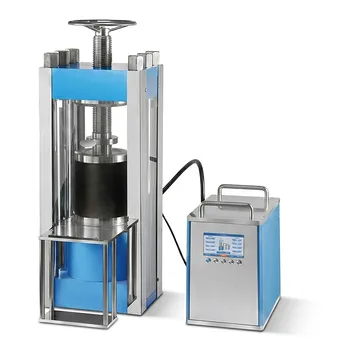
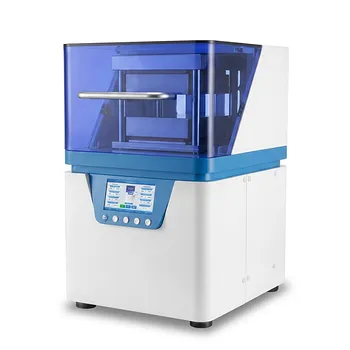
The heated laboratory press acts as the critical catalyst for consolidating loose wood strands into a high-performance structural composite. By simultaneously applying precise temperatures—typically around 180°C—and stable mechanical pressure, the press triggers the chemical cross-linking and curing of phenolic resins. This synchronized process transforms a loose mat of oriented strands into a solid, standardized lumber product with specific geometric dimensions and uniform density.
Core Takeaway: A heated laboratory press is the essential tool for synchronized thermomechanical processing, where heat activates chemical bonding and pressure ensures physical density, resulting in the structural integrity and dimensional stability required for Oriented Strand Lumber (OSL).
Engineering the Chemical and Physical Bond
The molding of OSL is not merely a shaping process; it is a fundamental transformation of material properties through controlled energy application.
Triggering the Phenolic Resin Reaction
The primary role of the heated press is to provide the thermal energy necessary to initiate the curing reaction of the adhesive. In OSL production, phenolic resins require a specific temperature threshold to undergo cross-linking, which creates a permanent, rigid bond between the wood strands.
Facilitating Molecular Flow and Packing
As the press heats the material, the resin reaches a state of flow that allows it to coat the wood fibers thoroughly. This high-pressure environment ensures the tight packing of the polymer melt into the microscopic textures of the wood, eliminating the internal air bubbles and voids that would otherwise weaken the lumber.
Precision Control of Structural Morphology
Beyond the chemical bond, the laboratory press dictates the physical architecture of the OSL sample.
Achieving Uniform Density Profiles
A key challenge in composite manufacturing is avoiding "soft spots" or inconsistent thickness. The press maintains a stable pressure (often reaching 10 MPa or 700 kPa depending on the resin type) to compress the wood mat into a solid composite structure with a uniform density profile from the surface to the core.
Determining Final Geometric Dimensions
The mechanical stops and precision platens of a laboratory press allow researchers to control the sample thickness with extreme accuracy. This precision is vital for creating standardized materials that can undergo reliable mechanical testing for shear strength, elasticity, and internal bond strength.
Enhancing Material Stability and Performance
The specialized environment within the press directly influences how the OSL will behave in real-world applications.
Maximizing Internal Bond Strength
By ensuring that the wood strands and the resin matrix are tightly bonded, the press maximizes the internal bond strength of the composite. This bond is what allows OSL to resist delamination and carry heavy structural loads in construction environments.
Ensuring Dimensional Stability
OSL must resist warping and swelling when exposed to moisture. The high-temperature environment in the press helps "set" the wood fibers, reducing internal stresses and creating a product with high dimensional stability that maintains its shape over time.
Understanding the Trade-offs and Limitations
While the heated laboratory press is indispensable, it requires careful calibration to avoid compromising the material.
Thermal Degradation Risks
Excessive heat or prolonged dwell times can lead to the thermal degradation of the wood fibers themselves. If the temperature exceeds the stable limit for the wood species being used, the lumber may become brittle, losing its intended structural ductility.
Pressure-Induced Micro-Damage
Applying pressure too rapidly can cause "blowouts" where trapped steam or air ruptures the internal structure of the mat. Conversely, insufficient pressure leads to high porosity and low interlaminar strength, making the OSL unsuitable for structural use.
How to Apply These Insights to Your Project
When utilizing a heated laboratory press for OSL development, your settings should be dictated by your specific performance requirements.
- If your primary focus is Maximum Load-Bearing Capacity: Prioritize higher unit pressure and precise temperature dwell times to maximize resin flow and eliminate all internal voids for a dense, void-free structure.
- If your primary focus is Moisture Resistance and Stability: Focus on the cooling rate and the precision of the cross-linking temperature to ensure the chemical bonds are fully matured and internal stresses are minimized.
- If your primary focus is Rapid Prototyping/R&D: Utilize the press to simulate industrial cycle times, focusing on the minimum temperature required to achieve a full cure without degrading the wood fibers.
The heated laboratory press is the bridge between raw biological materials and engineered structural components, providing the controlled environment necessary to achieve predictable mechanical performance.
Summary Table:
| Key Function | Mechanism | Impact on OSL |
|---|---|---|
| Resin Curing | ~180°C Applied Heat | Initiates chemical cross-linking and bonding |
| Densification | ~10 MPa Pressure | Ensures uniform density and eliminates internal voids |
| Dimension Control | Precision Platens | Maintains exact thickness for mechanical testing |
| Material Stability | Controlled Environment | Reduces internal stress and enhances moisture resistance |
Experience Precision Compaction with KINTEK
Achieve industry-leading standards for your Oriented Strand Lumber development or advanced material research. KINTEK specializes in comprehensive laboratory pressing solutions, offering a versatile range of manual, automatic, heated, multifunctional, and glovebox-compatible models, as well as cold and warm isostatic presses.
Whether you are refining structural composites or conducting cutting-edge battery research, our equipment provides the exact temperature and pressure control required for superior material morphology.
Ready to enhance your lab's efficiency? Contact KINTEK Experts Today for a Custom Quote!
References
- Yong Sik Kim, John F. Kadla. Investigation of the Effect of Organoclay Additives on Mechanical Properties of PF resin and MPB-OSL using Creep Behavior Analysis and IB Test. DOI: 10.5658/wood.2011.39.5.381
This article is also based on technical information from Kintek Solution Knowledge Base .
Related Products
- 24T 30T 60T Heated Hydraulic Lab Press Machine with Hot Plates for Laboratory
- Automatic Heated Hydraulic Press Machine with Hot Plates for Laboratory
- Automatic Hydraulic Hot Press with Large Plate and Precision Temperature Control for Advanced Material Sample Preparation and Industrial Research
- Automatic Heated Hydraulic Press Machine with Heated Plates for Laboratory
- Automatic High Temperature Heated Hydraulic Press Machine with Heated Plates for Lab
People Also Ask
- Function of a Laboratory Hydraulic Press with Heated Platens in SSE? Enhance Battery Density & Conductivity
- Why is a laboratory hydraulic press with heating plates required for PLA/TEC films? Achieve Precise Sample Integrity
- What role does a laboratory heated hydraulic press play in LTCC? Essential for High-Density Ceramic Lamination
- What is the primary function of a laboratory heated hydraulic press? Mastering Thermoplastic Carbon Fiber Composites
- Why is a laboratory heated hydraulic press utilized during the lamination stage of NASICON green tapes?