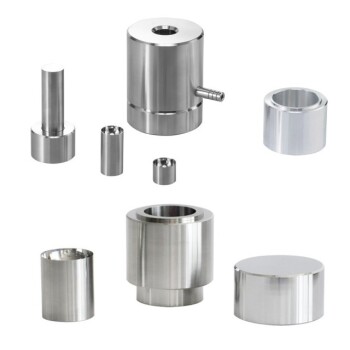
High-precision split cylindrical molds are essential in the preparation of alkali-activated iron ore tailings samples to guarantee strict geometric accuracy and prevent structural damage during removal. By allowing the mold to be taken apart laterally rather than forcing the sample out, researchers prevent mechanical disturbances that would otherwise invalidate subsequent performance tests.
Core Takeaway The reliability of mechanical testing relies heavily on the physical condition of the specimen before the test begins. The split mold design eliminates demolding stress, ensuring that data regarding unconfined compressive strength and shear reflects the material's true properties, not damage incurred during preparation.
Achieving Structural Uniformity
To obtain reliable scientific data, every variable outside of the material composition must be controlled.
Strict Dimensional Control
High-precision molds ensure that every test specimen has identical dimensions. This consistency is vital when comparing the performance of different alkali-activated mixtures.
Uniform Material Structure
The rigidity and precision of these molds allow for the creation of a uniform structure during the laboratory pressing process. This prevents density gradients within the sample that could lead to premature failure under load.
Preserving Sample Integrity
The most critical phase in sample preparation is often the removal of the specimen from the mold.
Facilitating Easy Demolding
The split design allows the operator to disassemble the mold around the sample. This "peel-away" method removes the need to push or extrude the sample, which is a common source of friction-based damage.
Avoiding Mechanical Disturbances
Alkali-activated iron ore tailings samples can be sensitive to handling immediately after pressing. Split molds effectively avoid disturbances or mechanical damage such as micro-cracking, which often occurs when using standard solid molds.
Ensuring Data Repeatability
By protecting the sample during demolding, researchers ensure the accuracy and repeatability of data. This allows for confident analysis of mechanical properties like unconfined compressive strength and simple shear behavior.
Understanding the Operational Trade-offs
While split molds offer superior sample quality, there are operational considerations to keep in mind.
Increased Preparation Time
Using split molds typically requires more time per sample than simple extrusion molds. The assembly and disassembly process adds steps to the workflow, potentially reducing daily throughput in high-volume testing scenarios.
Maintenance Sensitivity
To maintain "high precision," the connecting interfaces of the split mold must be kept perfectly clean. Debris or residue in the joints can compromise the geometric alignment, requiring diligent maintenance.
Ensuring Data Reliability in Your Experiments
Choosing the right mold is a decision that directly impacts the validity of your mechanical testing.
- If your primary focus is precise mechanical characterization: Prioritize split molds to ensure that any failure observed during testing is due to the material's limit, not pre-existing damage from extraction.
- If your primary focus is rapid, rough prototyping: You may consider standard molds, but you must accept a higher margin of error and potential structural inconsistencies.
The use of high-precision split molds is an investment in the scientific integrity of your iron ore tailings research.
Summary Table:
| Feature | High-Precision Split Molds | Standard Solid Molds |
|---|---|---|
| Demolding Method | Lateral disassembly (peel-away) | Forced extrusion/pushing |
| Sample Integrity | Prevents micro-cracks and friction damage | High risk of mechanical disturbance |
| Geometric Accuracy | High dimensional consistency | Variable based on extrusion force |
| Primary Benefit | Ensures data repeatability and reliability | Higher throughput for rough prototypes |
| Ideal Application | Mechanical performance testing (UCS, Shear) | Preliminary material screening |
Elevate Your Laboratory Pressing Accuracy with KINTEK
Precise mechanical characterization begins with flawless sample preparation. At KINTEK, we specialize in comprehensive laboratory pressing solutions designed to meet the rigorous demands of material science. Whether you are conducting battery research or stabilizing industrial tailings, our range of manual, automatic, heated, and multifunctional presses, alongside cold and warm isostatic models, ensures your specimens maintain perfect structural uniformity.
Don't let demolding stress compromise your research data. Contact KINTEK today to discover how our high-precision molds and pressing equipment can enhance your lab's efficiency and ensure the scientific integrity of every test.
References
- Helena Portela Farenzena, Nilo César Consoli. Iron ore tailings stabilization with alternative alkali-activated cement for dry stacking: mechanical and microstructural insights. DOI: 10.1139/cgj-2023-0125
This article is also based on technical information from Kintek Solution Knowledge Base .
Related Products
- Lab Cylindrical Press Mold with Scale
- Lab Cylindrical Press Mold for Laboratory Use
- Cylindrical Lab Electric Heating Press Mold for Laboratory Use
- Assemble Lab Cylindrical Press Mold for Laboratory Use
- Square Bidirectional Pressure Mold for Lab
People Also Ask
- What is the purpose of incorporating cartridge heaters into a lab press mold for MLCC block compression? Optimize Results
- Why is precise cooling management of the lab press mold necessary? Protect Core Integrity in Thermoforming
- What is the function of a pressing tool in thermoplastic panels? Master Precision Shaping & Fusion Bonding
- Why is a standardized cylindrical mold necessary when testing electrode materials? Ensure Data Precision & Consistency
- What is the technical significance of specific cylindrical molds in aluminum foaming? Achieve Near-Net-Shape Precision