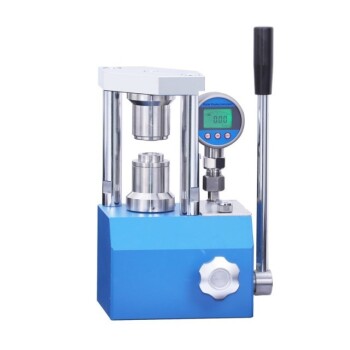
PEEK (polyether ether ketone) cells are the standard solution for testing solid electrolyte pellets because they solve the dual challenge of electrical isolation and mechanical durability. These cells allow researchers to apply the necessary pressure for testing without short-circuiting the system or degrading under chemical exposure.
PEEK cells ensure data integrity by forcing electrical current strictly through the electrolyte sample while withstanding the high pressures required for pellet densification. This material choice eliminates parasitic currents and protects testing equipment from corrosive byproducts.
Ensuring Measurement Accuracy
Complete Electrical Isolation
The primary function of the sample holder is to act as an electrical insulator. By using PEEK, you ensure that the test current flows strictly through the solid electrolyte pellet.
Preventing Measurement Errors
If a holder has any conductive properties, the current may bypass the sample entirely. PEEK prevents these short circuits, ensuring that the conductivity data collected reflects the actual performance of the electrolyte, not the mold.
Withstanding Mechanical Demands
Resistance to High Pressure
Testing solid electrolytes often requires compacting the powder into a pellet using a lab press. PEEK cells are mechanically robust and can withstand these high pressures without undergoing permanent deformation.
Maintaining Geometric Integrity
Because the material does not warp under pressure, the dimensions of the sample cell remain constant. This stability is vital for calculating accurate conductivity values based on the pellet's thickness and area.
Protection Against Chemical Hazards
Resistance to Corrosive Agents
Solid electrolytes frequently contain corrosive halide salts. PEEK offers excellent chemical resistance, ensuring the holder does not degrade or react with the sample during the test.
Equipment Preservation
By containing these corrosive elements effectively, PEEK cells protect the surrounding testing apparatus. This extends the lifespan of expensive equipment that might otherwise be damaged by chemical exposure.
Common Pitfalls in Material Selection
The Risk of Deformation
Choosing a material that lacks PEEK's mechanical rigidity often leads to permanent deformation under load. A deformed cell alters the contact area and pressure applied to the pellet, leading to inconsistent and unreliable test results.
The Danger of Conductive Components
Using mold parts that are not fully insulating is a critical error in conductivity testing. Any conductivity in the holder introduces a parallel circuit, rendering the impedance spectroscopy data invalid.
Making the Right Choice for Your Goal
To ensure your solid electrolyte testing yields valid, reproducible results, consider the specific demands of your experiment:
- If your primary focus is accurate conductivity data: Use PEEK to eliminate parasitic currents and ensure the measured resistance comes solely from the electrolyte.
- If your primary focus is testing under high pressure: Rely on PEEK to maintain structural integrity and prevent cell deformation during the densification process via lab press.
- If your primary focus is equipment longevity: Select PEEK to shield your instrumentation from the corrosive effects of halide salts often present in electrolyte samples.
By utilizing PEEK cells, you establish a stable, inert, and electrically isolated environment that is essential for high-fidelity electrochemical analysis.
Summary Table:
| Feature | Benefit for Solid Electrolyte Testing |
|---|---|
| Electrical Insulation | Prevents short circuits; ensures current flows only through the pellet for accurate data. |
| Mechanical Strength | Withstands high compaction pressure from lab presses without deformation or warping. |
| Chemical Resistance | Protects the cell and equipment from corrosive halide salts and reactive electrolyte samples. |
| Dimensional Stability | Maintains constant sample geometry for precise conductivity and impedance calculations. |
Elevate Your Battery Research with KINTEK Precision
Don't let parasitic currents or cell deformation compromise your solid-state battery data. KINTEK specializes in comprehensive laboratory pressing solutions designed for the rigors of modern materials science. Whether you need manual, automatic, heated, or glovebox-compatible models, our equipment—paired with high-performance PEEK sample holders—ensures your solid electrolyte pellets are tested under optimal conditions.
Ready to achieve high-fidelity electrochemical analysis? Contact KINTEK today to discover how our cold and warm isostatic presses and specialized tooling can enhance your lab's research efficiency and equipment longevity.
References
- Hui Wang, Ying Shirley Meng. Highly Conductive Halide Na-ion Conductor Boosted by Low-cost Aliovalent Polyanion Substitution for All-Solid-State Sodium Batteries. DOI: 10.21203/rs.3.rs-7754741/v1
This article is also based on technical information from Kintek Solution Knowledge Base .
Related Products
- Laboratory Hydraulic Split Electric Lab Pellet Press
- Lab Cylindrical Press Mold for Laboratory Use
- Lab Button Battery Disassembly and Sealing Mold
- Automatic Laboratory Hydraulic Press for XRF and KBR Pellet Pressing
- Manual Laboratory Hydraulic Press Lab Pellet Press
People Also Ask
- What are the emerging trends in the design and materials of lab pellet presses? Modernize Your Lab Efficiency
- How do lab pellet presses support customization and flexibility? Optimize Your Sample Prep for Any Material
- What are common lab pellet press issues? Expert Troubleshooting Guide for Reliable Material Research
- What are the common operational types of lab pellet presses? Choosing the Right Manual, Automatic, or Hydraulic System
- Why use a laboratory pellet press for solid-state battery evaluation? Ensure Accuracy in Interface Stability Testing