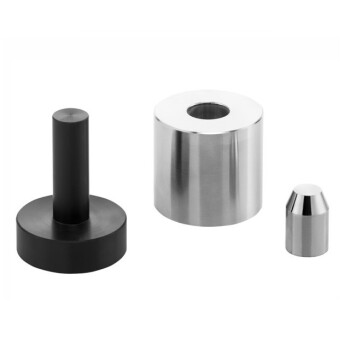
Precision molds are utilized in magnesium slag cementitious activity experiments to guarantee that every test specimen maintains identical geometric dimensions and compression areas. This uniformity is a non-negotiable prerequisite for accurate compressive strength testing, ensuring that observed differences in performance are caused strictly by the material composition—specifically the magnesium slag dosage—rather than physical inconsistencies.
The use of standard-sized precision molds transforms the specimen's geometry from a chaotic variable into a reliable constant, securing the scientific validity and repeatability of comparative data.
The Necessity of Geometric Standardization
Eliminating Variables in Comparative Analysis
In magnesium slag activity assessments, the primary variable being tested is the dosage level of the slag.
To measure the effect of this dosage accurately, all other factors must remain constant. Precision molds ensure that every 20 x 20 x 20 mm specimen is physically identical to the next.
Ensuring Accurate Force Calculation
Compressive strength is a calculation of force applied over a specific area.
If the mold dimensions fluctuate, the compression area changes. Even minor deviations in the 20 x 20 mm face can significantly skew the resulting strength data, rendering the experiment mathematically flawed.
Operational and Scientific Rigor
Integrity During Demolding
The quality of the mold directly impacts the physical state of the specimen after it hardens.
Using precision molds helps ensure the production of well-formed hardened bodies. This minimizes the risk of structural defects or surface irregularities occurring when the specimen is removed from the mold.
Scientific Repeatability
Valid scientific research relies on the ability to repeat an experiment and achieve similar results.
Precision molds provide the consistency required for repeatability. They allow researchers to confidently compare data across different batches and dosage levels, knowing that the physical testing conditions were uniform throughout the study.
The Risks of Compromising on Precision
The "False Signal" of Dimensional Variance
If non-precision molds are used, physical irregularities can create "noise" in the data.
A specimen might fail early not because the magnesium slag mixture was weak, but because an uneven surface created a stress concentration. This leads to false conclusions about the cementitious activity of the slag.
Specimen Damage Risks
Lower-quality molds often lack the exacting tolerances required for smooth release.
This increases the likelihood of damaging the specimen during the demolding process, resulting in micro-cracks or chipped edges that invalidate the sample before testing even begins.
Ensuring Valid Experimental Results
To ensure your magnesium slag assessment produces defensible data, prioritize the physical quality of your testing equipment.
- If your primary focus is Comparative Accuracy: Ensure all molds are calibrated to identical standards so that dosage is the only variable influencing strength.
- If your primary focus is Process Efficiency: Invest in high-quality precision molds to reduce the rate of specimen rejection caused by demolding damage.
Precision in preparation is the foundation of accuracy in analysis.
Summary Table:
| Factor | Impact of Precision Molds | Risk of Low-Quality Molds |
|---|---|---|
| Dimensional Tolerance | Ensures identical 20x20x20 mm geometry | Fluctuating compression areas skew data |
| Stress Distribution | Uniform loading across the specimen face | Stress concentrations cause premature failure |
| Demolding Quality | Smooth release with zero structural damage | Micro-cracks and chipped edges during removal |
| Data Validity | Isolates material dosage as the sole variable | Physical inconsistencies create experimental "noise" |
Optimize Your Specimen Preparation with KINTEK
Achieve uncompromising accuracy in your magnesium slag research with KINTEK’s precision laboratory pressing solutions. We specialize in providing high-performance equipment—including manual, automatic, and multifunctional presses—designed to work seamlessly with precision molds for battery research and material science.
Our solutions ensure that every 20 x 20 x 20 mm specimen is a reliable constant, protecting your data from physical variables. Ready to enhance your lab’s scientific rigor? Contact us today to find the perfect press for your research!
References
- Ping Lu, Xiaoming Liu. Structural Characteristics and Cementitious Behavior of Magnesium Slag in Comparison with Granulated Blast Furnace Slag. DOI: 10.3390/ma17020360
This article is also based on technical information from Kintek Solution Knowledge Base .
Related Products
- Lab Polygon Press Mold
- Infrared Heating Quantitative Flat Plate Mold for Precise Temperature Control
- Lab Button Battery Tablet Press Sealing Mold
- Special Shape Lab Press Mold for Laboratory Applications
- Square Lab Press Mold for Laboratory Use
People Also Ask
- What is the purpose of incorporating cartridge heaters into a lab press mold for MLCC block compression? Optimize Results
- How do the design and geometric precision of pressing molds and mandrels affect the quality of PTFE composite samples?
- What role do precision positioning and pressure molds play in single-lap joints? Ensure 100% Data Integrity
- What are the requirements for pressing molds when using SSCG? Key Materials for Complex Single Crystal Production
- How do industrial-grade pressure molds affect zinc metal pouch cells? Maximize Energy Density & Performance