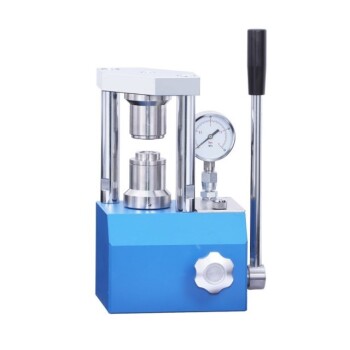
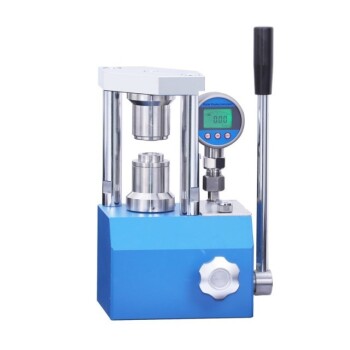
Precision pressure control is strictly necessary because solid-state batteries face a fundamental mechanical challenge: their solid electrolytes lack the fluidity to self-repair physical gaps. As cathode particles undergo inevitable volume expansion and contraction during cycling, precision devices are required to apply constant stack pressure, forcing tight physical contact to inhibit interface detachment and prevent a rapid, debilitating rise in interfacial impedance.
Core Insight: Unlike liquid electrolytes, solid components cannot flow to fill the voids created by electrode breathing. Precision pressure devices act as a mechanical stabilizer, ensuring continuous solid-solid contact to prevent delamination and structural failure during charge and discharge cycles.
The Fundamental Challenge: Lack of Self-Repair
Addressing Volume Fluctuations
Cathode particles in solid-state batteries are not static; they physically expand and contract during operation.
In a liquid battery, the electrolyte flows to accommodate these changes. In a solid-state system, this "breathing" creates physical gaps between the active materials and the electrolyte.
Compensating for Rigid Electrolytes
Solid electrolytes possess no inherent fluidity. They cannot naturally flow into voids created by the contraction of electrode materials.
Without external intervention, these voids lead to a loss of contact. Precision pressure devices bridge this gap by applying a constant external force that compensates for the electrolyte's rigidity.
How Pressure Enhances Electrochemical Performance
Reducing Interfacial Impedance
The primary goal of stack pressure is to maximize the active contact area between layers.
Devices like hydraulic presses or aluminum pressure frames force the cathode, solid electrolyte (such as SPE or LLZO), and anode into intimate contact.
This mechanical bonding significantly reduces interfacial impedance, allowing for efficient ion transfer and high utilization of active materials.
Managing Lithium Metal Dynamics
Lithium metal anodes present unique challenges during the stripping and plating processes.
As lithium is stripped away, it can leave behind voids at the interface. Constant stack pressure (e.g., 50 MPa) suppresses these voids, maintaining the conductive pathway necessary for long-term cycling.
Mitigating Dendrite Formation
Uncontrolled lithium growth poses a severe safety risk.
Precision pressure applies a mechanical constraint that helps inhibit lithium dendrites from penetrating vertically through the solid electrolyte.
Instead, the pressure guides lithium growth into a safer, lateral expansion mode. This prevents internal short circuits and significantly extends the battery's lifespan.
The Role of Precision in Data Validity
Simulating Real-World Conditions
Laboratory testing must mimic the pressurized state of a battery in its actual working environment to be valid.
Precision hydraulic presses allow researchers to simulate these specific mechanical conditions. This ensures that the performance data collected is relevant to real-world applications.
Ensuring Sealing and Consistency
A properly calibrated press does more than just push layers together; it ensures a high-quality seal.
This isolation protects internal components from air and moisture. Furthermore, uniform pressure distribution is critical for obtaining consistent, reproducible test results across different samples.
Understanding the Trade-offs
Mechanical Complexity vs. Performance
While pressure is vital, implementing it adds complexity. High-precision equipment is required to maintain stability, as simple mechanical clamping often relaxes over time.
The Risk of Non-Uniformity
Applying pressure is not enough; it must be uniform.
If the testing device applies uneven force, it can lead to localized "hot spots" of impedance or physical stress. This can skew test data, making the battery appear less stable than it actually is.
Making the Right Choice for Your Goal
To optimize your solid-state battery assembly and testing, align your pressure strategy with your specific objectives:
- If your primary focus is Cycle Life: Prioritize equipment that maintains constant stack pressure during stripping to prevent void formation and delamination.
- If your primary focus is Safety: Ensure your setup applies sufficient mechanical constraint to force lateral lithium expansion and block vertical dendrite penetration.
- If your primary focus is Data Integrity: Use high-precision, calibrated hydraulic presses to eliminate variables caused by electrolyte leakage or environmental contamination.
Success in solid-state battery development relies not just on chemistry, but on the precise mechanical management of the interfaces.
Summary Table:
| Challenge | Role of Precision Pressure Device | Impact on Performance |
|---|---|---|
| Electrode Breathing | Compensates for volume expansion/contraction | Maintains solid-solid contact |
| Interfacial Impedance | Maximizes active contact area | Enhances ion transfer & utilization |
| Lithium Dynamics | Suppresses voids during stripping/plating | Ensures continuous conductive pathways |
| Dendrite Growth | Applies vertical mechanical constraint | Prevents shorts & extends lifespan |
| Data Integrity | Simulates real-world stack pressure | Ensures consistent & reproducible results |
Optimize Your Solid-State Battery Research with KINTEK
Precise mechanical management is the key to overcoming interfacial impedance and dendrite formation. KINTEK specializes in comprehensive laboratory pressing solutions designed specifically for the rigorous demands of battery research.
Our extensive range includes manual, automatic, heated, and multifunctional presses, as well as glovebox-compatible models and isostatic presses (CIP/WIP) to ensure uniform pressure distribution and structural integrity.
Whether you are focusing on cycle life stability or safety validation, our high-precision equipment provides the constant stack pressure necessary for valid, real-world data.
Ready to elevate your lab's performance? Contact KINTEK today to find the perfect pressing solution.
References
- Xinchao Hu, Qingshui Xie. Review on Cathode‐Electrolyte Interphase for Stabilizing Interfaces in Solid‐State Lithium Batteries. DOI: 10.1002/advs.202517032
This article is also based on technical information from Kintek Solution Knowledge Base .
Related Products
- Warm Isostatic Press for Solid State Battery Research Warm Isostatic Press
- Lab Button Battery Tablet Press Sealing Mold
- Laboratory Hydraulic Press Lab Pellet Press Button Battery Press
- Lab Infrared Press Mold for Laboratory Applications
- Button Battery Sealing Press Machine for Lab
People Also Ask
- Why must composite cathodes be sealed in vacuum lamination bags for WIP? Ensure Battery Stability and Density
- How do sacrificial volume materials (SVM) maintain microchannels in isostatic pressing? Ensure Structural Integrity
- What is the function of elastic molds in warm isostatic pressing? Achieve Uniform Density in Composite Particles
- What are the advantages of using a Warm Isostatic Press (WIP) for batteries? Achieve Superior Interface Contact
- What is the mechanism of a Warm Isostatic Press (WIP) on cheese? Master Cold Pasteurization for Superior Safety