
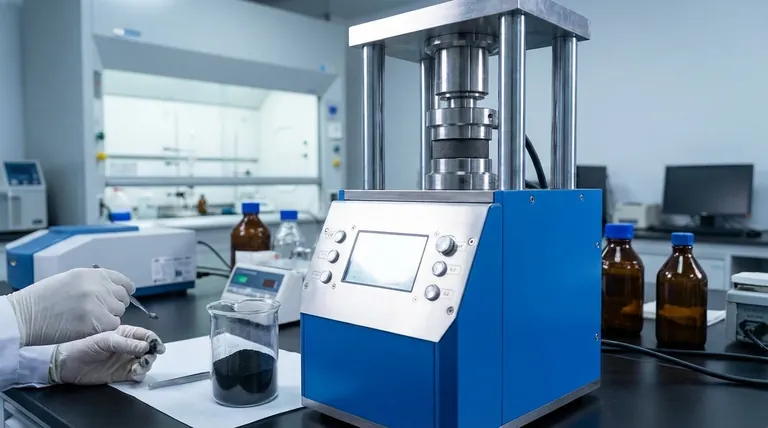
Sulfide solid electrolyte powders are cold-pressed primarily because they possess exceptional mechanical plasticity, allowing them to be compacted into high-density pellets at room temperature. A laboratory press machine applies high pressure (often exceeding 360 MPa) to mechanically deform the particles, effectively eliminating porosity and creating a solid, cohesive membrane without the need for high-temperature sintering.
Core Takeaway The cold pressing process leverages the inherent ductility of sulfide materials to transform loose powder into a dense, continuous solid. This mechanical densification is the fundamental requirement for establishing efficient ionic transport pathways and minimizing interfacial impedance in all-solid-state batteries.
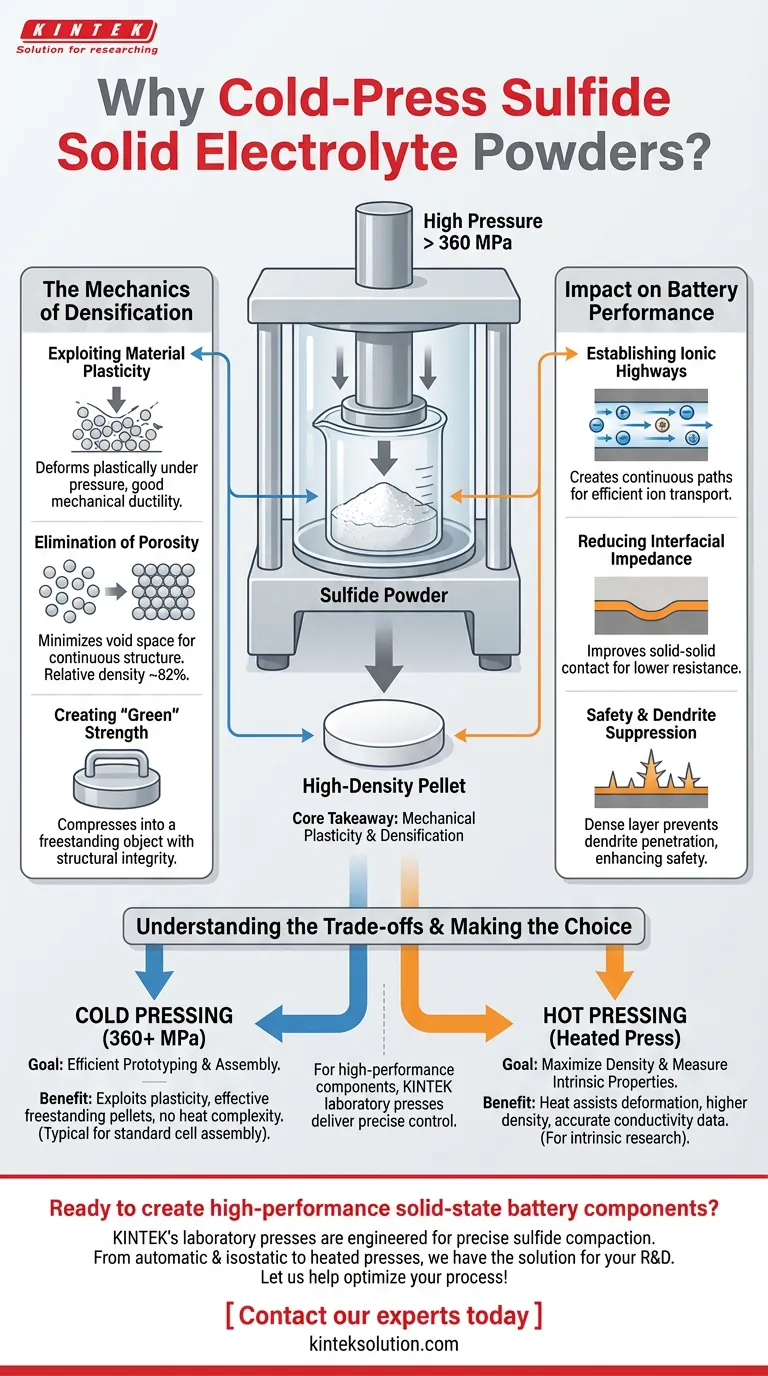
The Mechanics of Densification
Exploiting Material Plasticity
Unlike oxide-based electrolytes which are often brittle and require heat to bond, sulfide electrolytes exhibit good mechanical ductility. This unique property means that when subjected to the uniaxial force of a laboratory press, the particles do not shatter; instead, they deform plastically.
Elimination of Porosity
The primary goal of using a laboratory press is to minimize void space between particles. Loose powder creates air gaps that block ion movement. By applying pressures such as 360–370 MPa, the process forces particles together, significantly reducing these interstitial voids and increasing the relative density of the pellet (often reaching targets around 82% or higher).
Creating "Green" Strength
Even before a battery is assembled, the electrolyte must exist as a freestanding object. Cold pressing compresses the powder into a pellet with sufficient mechanical strength to be handled. This structural integrity is vital for the subsequent layering of electrodes or assembly into test cells.
Impact on Battery Performance
Establishing Ionic Highways
For a solid-state battery to function, lithium ions must travel through the electrolyte. The high-pressure compaction creates continuous channels for ion transport. If the pellet remains porous, ions face "dead ends," drastically lowering the material's overall ionic conductivity.
Reducing Interfacial Impedance
Performance is often limited by resistance where materials meet. Cold pressing improves the solid-solid interfacial contact between the electrolyte and electrode materials. A denser, well-compacted pellet ensures that ions can cross these boundaries with minimal resistance (impedance).
Safety and Dendrite Suppression
A critical function of the electrolyte is acting as a physical barrier. A dense, low-porosity layer formed by high pressure is essential for preventing lithium dendrite penetration. If the pellet is porous, lithium dendrites can grow through the voids, causing short circuits and safety hazards.
Understanding the Trade-offs
Cold Pressing vs. Hot Pressing
While cold pressing is efficient and straightforward, it has limitations regarding maximum density. As noted in comparative studies, utilizing a heated press (hot pressing) can leverage the material's plastic deformation capabilities even further.
The Density Ceiling
Cold pressing typically achieves a relative density of roughly 82% for certain sulfides (like Li6PS5Cl). While this is sufficient for many high-performance applications, it may not completely eliminate all microscopic voids.
Measurement Accuracy
For research focusing on the intrinsic ionic conductivity of a material, cold pressing alone might yield slightly lower values than the material's theoretical maximum. If the pellet retains porosity, the measured conductivity is a combination of the material and the air gaps, potentially skewing data.
Making the Right Choice for Your Goal
When determining the specific parameters for your pressing process, consider your primary objective:
- If your primary focus is efficient prototyping and standard cell assembly: Utilize cold pressing at high pressures (360+ MPa). This exploits the sulfide's plasticity to create effective, freestanding pellets without the complexity of thermal cycling.
- If your primary focus is measuring intrinsic material properties or maximizing density: Consider hot pressing. Adding heat assists the plastic deformation, allowing for higher density and more accurate conductivity readings by further eliminating voids.
Summary: The laboratory press acts as the critical bridge between loose chemical powder and a functional battery component, translating mechanical force into the dense, conductive microstructure required for energy storage.
Summary Table:
| Process Goal | Key Benefit | Typical Parameter |
|---|---|---|
| Densification | Eliminates porosity, creates continuous ion pathways | Pressure > 360 MPa |
| Structural Integrity | Forms a freestanding "green" pellet for handling | Room Temperature |
| Performance | Maximizes ionic conductivity, reduces interfacial resistance | Relative Density ~82% |
Ready to create high-performance solid-state battery components?
KINTEK's laboratory presses are engineered to deliver the precise, high-pressure compaction required for sulfide solid electrolytes. Whether you are prototyping with cold pressing or pursuing maximum density with hot pressing, our automatic lab presses, isostatic presses, and heated lab presses provide the reliability and control essential for your research and development.
Let us help you optimize your process and accelerate your battery development. Contact our experts today to discuss your specific lab press needs!
Visual Guide
Related Products
- Manual Cold Isostatic Pressing CIP Machine Pellet Press
- XRF KBR Plastic Ring Lab Powder Pellet Pressing Mold for FTIR
- XRF KBR Steel Ring Lab Powder Pellet Pressing Mold for FTIR
- Automatic Laboratory Hydraulic Press for XRF and KBR Pellet Pressing
- Lab XRF Boric Acid Powder Pellet Pressing Mold for Laboratory Use
People Also Ask
- Why is Cold Isostatic Pressing (CIP) necessary for SBN ceramics? Achieve High-Density and Crack-Free Sintering
- Why is Cold Isostatic Pressing (CIP) applied after uniaxial pressing? Optimize Superconductor Precursor Density
- What are the process advantages of using Cold Isostatic Pressing (CIP) for LSMO? Achieve Defect-Free Density
- What types of equipment are available for cold isostatic pressing? Explore CIP Solutions for Labs and Production
- What are the technical advantages of cold isostatic pressing equipment compared to uniaxial compression equipment? Learn More!


















