Cold Isostatic Pressing (CIP) is essential for Cu-SWCNT composites because it applies uniform, omnidirectional pressure to eliminate the density gradients and internal microporosity inherent in uniaxial pressing. By using a fluid medium to transmit pressure equally from all directions, CIP ensures that the high-density copper powder and low-density, high-aspect-ratio carbon nanotubes are packed into a homogenous green body. This uniformity is critical for preventing cracks, warping, and structural failure during subsequent high-temperature sintering or extrusion processes.
Core Takeaway: For metal-matrix composites like Cu-SWCNT, CIP is the only way to achieve the isotropic density and structural integrity required to overcome the physical differences between metal powders and nanotubes, effectively eliminating the friction-induced defects of traditional die pressing.
Overcoming the Limitations of Uniaxial Pressing
The Friction Problem and Density Gradients
In uniaxial pressing, pressure is applied from a single direction, causing significant friction between the composite powder and the mold walls. This friction results in an uneven distribution of force, creating internal density gradients where the center or bottom of the compact is less dense than the top.
Managing Disparate Material Properties
Copper powders and single-walled carbon nanotubes (SWCNTs) differ significantly in density, shape, and mechanical behavior. Uniaxial pressing often fails to bridge these differences, leading to localized clusters and structural "dead zones" that weaken the final composite.
The Risk of Elastic Recovery
When pressure is released in a uniaxial die, the material may experience non-uniform elastic recovery. This often leads to "capping" or laminations, where the green body develops micro-cracks before it even reaches the furnace.
The Mechanics of Isostatic Compression
Omnidirectional Fluid Pressure
CIP utilizes a high-pressure liquid medium to apply equal force (e.g., 150 MPa to 300 MPa) to every surface of the mold simultaneously. This omnidirectional application ensures that the pressure reaches the core of the Cu-SWCNT mixture without being absorbed by mold-wall friction.
Elimination of Internal Microporosity
The uniform pressure effectively collapses internal micropores that uniaxial pressing might miss. By forcing the copper particles into closer contact with the nanotubes, CIP creates a tighter microstructure with significantly reduced porosity.
Achieving Isotropic Uniformity
Because the pressure is perfectly balanced, the resulting green body is isotropic, meaning its physical properties are identical in all directions. This is vital for the thermal and electrical performance expected from advanced copper-nanotube materials.
Impact on Downstream Processing
Reducing Sintering and Extrusion Defects
Uniform density in the green body translates to uniform shrinkage during high-temperature sintering. Without the density gradients provided by CIP, the composite would be prone to warping, cracking, or non-uniform grain growth at temperatures exceeding 1000°C.
Improving Particle Interface Tightness
The high pressures (often reaching 2 ton/cm²) improve the mechanical interlocking between the copper matrix and the SWCNTs. This enhanced contact tightness ensures better load transfer and conductivity in the finished bulk material.
Understanding the Trade-offs
Equipment and Complexity
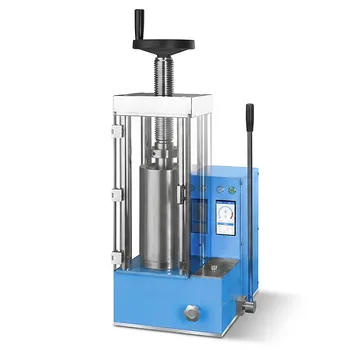
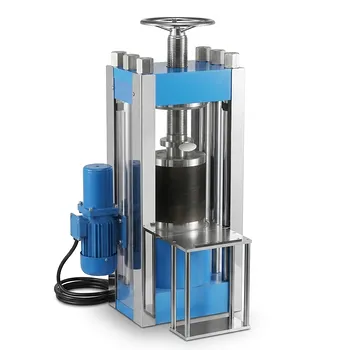
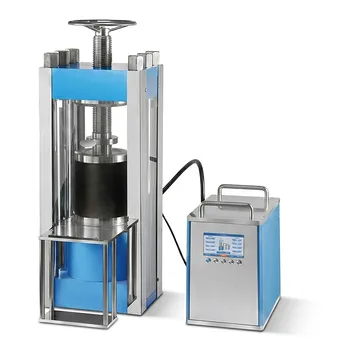
CIP requires specialized high-pressure vessels and flexible molds, making the initial setup more complex than simple die pressing. The process is typically slower because it involves sealing the sample, pressurizing the fluid, and decompressing.
Dimensional Precision
Unlike uniaxial pressing, which uses rigid steel dies to achieve exact dimensions, CIP uses elastomeric molds that deform under pressure. This may require the green body to undergo additional machining if high-precision final dimensions are required.
How to Apply This to Your Project
Making the Right Choice for Your Goal
- If your primary focus is maximum density and structural integrity: Use Cold Isostatic Pressing to eliminate internal stresses and ensure a defect-free microstructure.
- If your primary focus is high-volume, low-cost production of simple shapes: Uniaxial pressing may be sufficient if the density gradients do not compromise the specific application of the part.
- If your primary focus is subsequent hot extrusion: You must use CIP to create a high-quality initial billet that can withstand the intense shearing forces of the extrusion process.
By prioritizing uniform pressure distribution through CIP, you ensure that the unique properties of carbon nanotubes are fully realized within the copper matrix, resulting in a high-performance composite free from internal structural flaws.
Summary Table:
| Feature | Uniaxial Pressing | Cold Isostatic Pressing (CIP) |
|---|---|---|
| Pressure Direction | Single Direction (Unidirectional) | Omnidirectional (All directions) |
| Density Distribution | Uneven (Density Gradients) | Highly Uniform (Isotropic) |
| Friction Effects | High (Wall Friction) | Minimal/Eliminated |
| Microporosity | Risk of internal pockets | Effectively collapsed/eliminated |
| Ideal Application | Simple shapes, high volume | High-performance composites (Cu-SWCNT) |
Elevate Your Material Research with KINTEK Precision
Ready to eliminate structural defects and achieve perfect density in your composites? KINTEK specializes in comprehensive laboratory pressing solutions tailored for advanced material science. Our range includes:
- Manual & Automatic Presses for routine lab work.
- Heated & Multifunctional Models for specialized processing.
- Cold and Warm Isostatic Presses (CIP/WIP), essential for battery research and high-performance metal-matrix composites like Cu-SWCNT.
Don't let density gradients compromise your results. Contact KINTEK today to find the perfect pressing solution for your lab and ensure your materials meet the highest standards of structural integrity.
References
- Miguel Gomez‐Mendoza, Eduardo de Albuquerque Brocchi. Ni, Cu Nanoparticles Decorating CNT as Precursors for Metal-Matrix Nanocomposites. DOI: 10.1017/s1431927610059404
This article is also based on technical information from Kintek Solution Knowledge Base .
Related Products
- Electric Lab Cold Isostatic Press CIP Machine
- Electric Split Lab Cold Isostatic Pressing CIP Machine
- Automatic Lab Cold Isostatic Pressing CIP Machine
- Manual Cold Isostatic Pressing CIP Machine Pellet Press
- Electric Isostatic Pressing Machine 40 Tons Automatic Laboratory Powder Compacting Press
People Also Ask
- What role do electric lab cold isostatic presses play in industrial contexts? Bridge R&D and Manufacturing with Precision
- What are the applications of electric lab cold isostatic presses in research settings? Advance Material R&D with High-Pressure CIPs
- How does electrical Cold Isostatic Pressing (CIP) contribute to cost savings? Unlock Efficiency and Reduce Expenses
- What are some research applications of electric lab CIPs? Unlock Uniform Powder Densification for Advanced Materials
- What are the characteristics of standard off-the-shelf electric lab CIP solutions? Achieve Immediate, Cost-Effective Processing