
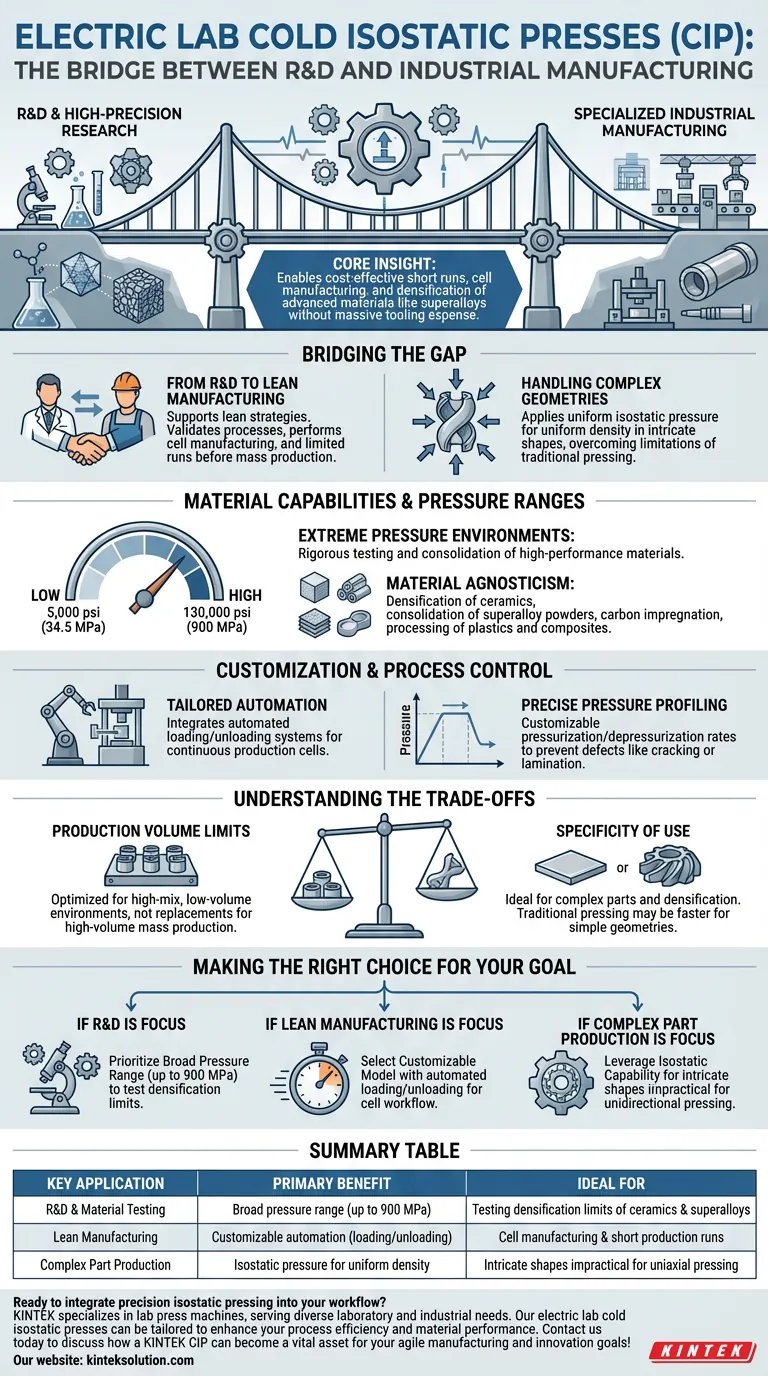
Electric lab cold isostatic presses (CIP) serve as a critical bridge between high-precision research and specialized industrial manufacturing. They facilitate the production of complex parts where traditional unidirectional pressing is either technically impractical or cost-prohibitive. By applying uniform pressure from all directions, these systems are essential for R&D, material testing, and limited production runs across industries ranging from pharmaceuticals to advanced ceramics.
Core Insight: While initially designed for laboratory precision, these presses drive industrial innovation by enabling cost-effective short runs, cell manufacturing, and the densification of advanced materials like superalloys without the expense of massive production tooling.
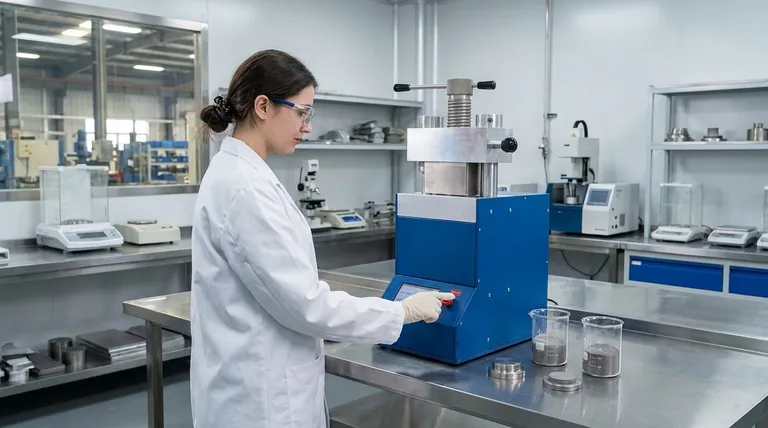
Bridging the Gap Between Concept and Production
From R&D to Lean Manufacturing
These units are not limited to experimental data gathering; they actively support lean manufacturing strategies. They allow engineers to validate processes and perform cell manufacturing or limited production runs before committing to capital-intensive mass production facilities.
Handling Complex Geometries
Traditional pressing methods often struggle with intricate shapes due to friction and uneven force distribution. Electric lab CIPs apply pressure isostatically (equally from all sides), ensuring uniform density for complex geometries that standard molds cannot handle effectively.
Diverse Industry Application
The versatility of these presses extends across multiple sectors. They are utilized for laminating, rubber and plastic molding, and pharmaceutical compression, proving their value beyond standard metallurgical applications.
Material Capabilities and Pressure Ranges
Extreme Pressure Environments
Achieving specific material properties often requires extreme force. These presses offer operational ranges from under 5,000 psi (34.5 MPa) up to 130,000 psi (900 MPa), allowing for the rigorous testing and consolidation of high-performance materials.
Material Agnosticism
The broad pressure range allows for the effective compaction of a wide variety of materials. This includes the densification of ceramics, consolidation of superalloy powders for aerospace, carbon impregnation, and the processing of plastics and composites.
Customization and Process Control
Tailored Automation
Modern electric lab presses can be customized to fit specific industrial workflows. This includes the integration of fully automated loading and unloading systems, which transforms a standalone lab unit into a component of a continuous production cell.
Precise Pressure Profiling
Control is paramount when dealing with sensitive materials. Users can customize pressurization rates and create specific depressurization profiles. This prevents defects, such as cracking or lamination, that can occur during the pressure release phase.
Understanding the Trade-offs
Production Volume Limits
While these presses are described as adaptable for "short and limited production runs," they are generally not replacements for high-volume mass production lines. Their value lies in high-mix, low-volume environments or the production of high-value complex parts.
Specificity of Use
These systems are optimized for "complex parts" and "densification." For simple, flat geometries where uniform density is less critical, traditional pressing methods may remain a faster and more economical option.
Making the Right Choice for Your Goal
To maximize the return on investment for a cold isostatic press, align the machine's capabilities with your immediate operational needs.
- If your primary focus is Research and Development: Prioritize a unit with a broad pressure range (up to 900 MPa) to test densification limits across various ceramics and superalloys.
- If your primary focus is Lean Manufacturing: Select a customizable model featuring automated loading and unloading systems to integrate seamlessly into a cell manufacturing workflow.
- If your primary focus is Complex Part Production: Leverage the isostatic capability to produce intricate shapes that are too costly or impossible to form with unidirectional pressing.
By selecting the right configuration, you transform this equipment from a simple testing tool into a vital asset for agile manufacturing.
Summary Table:
| Key Application | Primary Benefit | Ideal For |
|---|---|---|
| R&D & Material Testing | Broad pressure range (up to 900 MPa) | Testing densification limits of ceramics & superalloys |
| Lean Manufacturing | Customizable automation (loading/unloading) | Cell manufacturing & short production runs |
| Complex Part Production | Isostatic pressure for uniform density | Intricate shapes impractical for uniaxial pressing |
Ready to integrate precision isostatic pressing into your workflow?
KINTEK specializes in lab press machines, including automatic, isostatic, and heated lab presses, serving diverse laboratory and industrial needs. Whether you are in R&D, lean manufacturing, or producing complex parts, our electric lab cold isostatic presses can be tailored to enhance your process efficiency and material performance.
Contact us today to discuss how a KINTEK CIP can become a vital asset for your agile manufacturing and innovation goals!
Visual Guide
Related Products
- Electric Lab Cold Isostatic Press CIP Machine
- Electric Split Lab Cold Isostatic Pressing CIP Machine
- Automatic Lab Cold Isostatic Pressing CIP Machine
- Manual Cold Isostatic Pressing CIP Machine Pellet Press
- Lab Isostatic Pressing Molds for Isostatic Molding
People Also Ask
- What are the applications of electric lab cold isostatic presses in research settings? Advance Material R&D with High-Pressure CIPs
- How does electrical Cold Isostatic Pressing (CIP) contribute to cost savings? Unlock Efficiency and Reduce Expenses
- What are some research applications of electric lab CIPs? Unlock Uniform Powder Densification for Advanced Materials
- What are the characteristics of standard off-the-shelf electric lab CIP solutions? Achieve Immediate, Cost-Effective Processing
- What types of materials can be compacted using electric lab cold isostatic presses? Achieve Uniform Density for Metals, Ceramics & More



















