
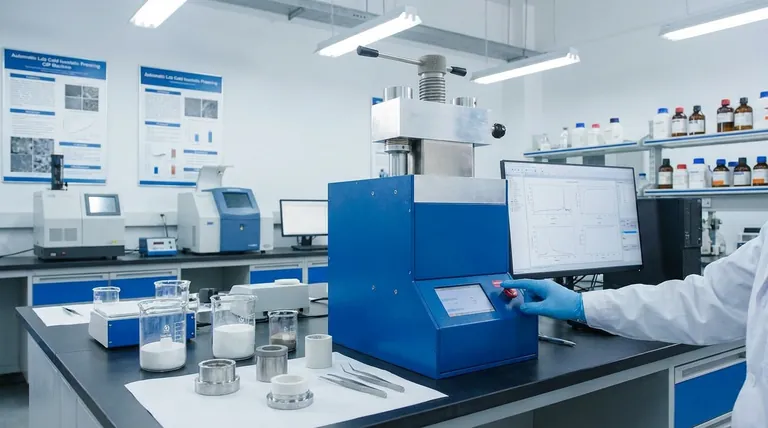
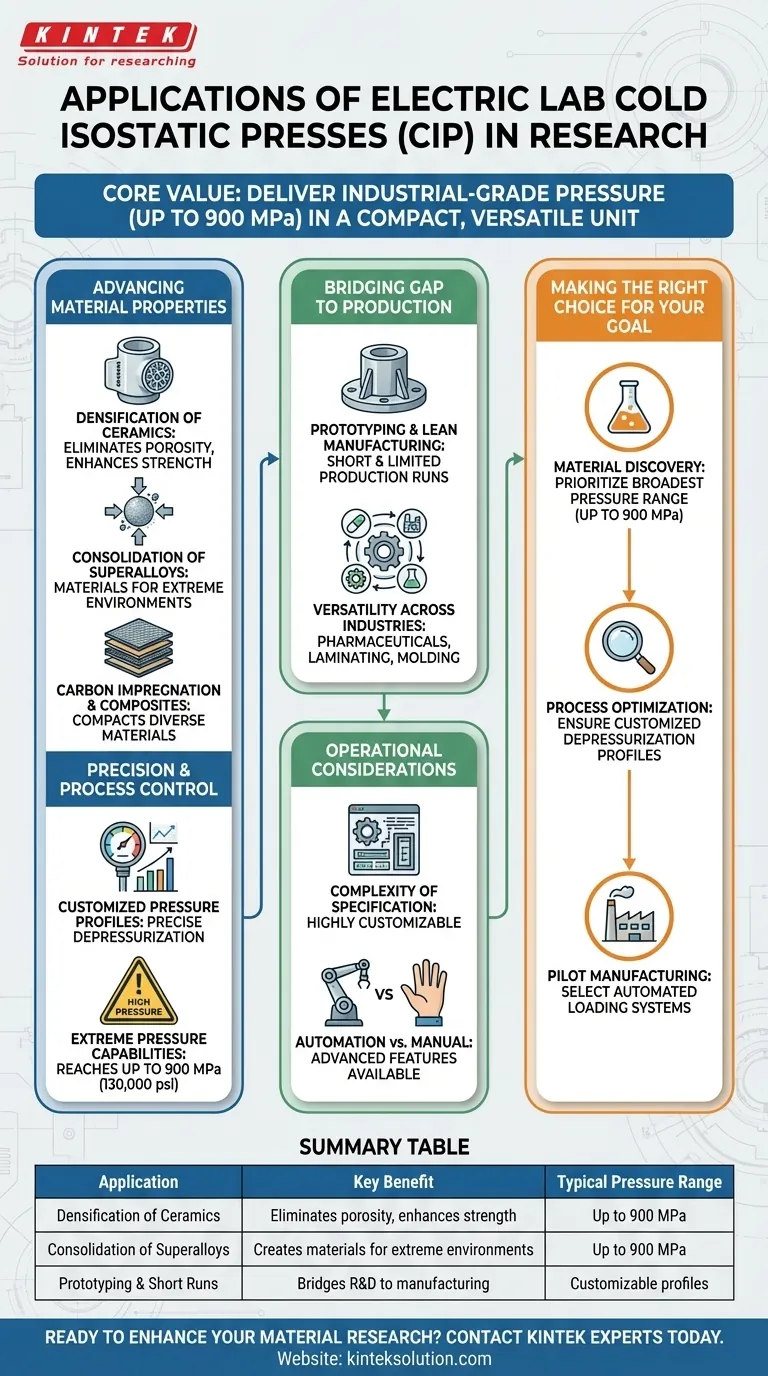
Electric lab cold isostatic presses (CIP) are primarily utilized in research settings for the densification of ceramics, the consolidation of superalloy powders, and carbon impregnation. Beyond these specific material treatments, these systems are integral to broader Research and Development (R&D) workflows, facilitating materials testing, prototyping, and the establishment of parameters for short or limited production runs.
The core value of an electric lab CIP lies in its ability to deliver industrial-grade pressure—up to 900 MPa—within a versatile, compact unit designed for the rigorous demands of experimental material science.
Advancing Material Properties
In the laboratory, the primary goal is often achieving specific material characteristics that cannot be realized through standard pressing methods.
Densification of Ceramics
Research often focuses on eliminating porosity to enhance strength. Electric CIPs are essential for the densification of ceramics, applying uniform pressure to achieve consistent structural integrity.
Consolidation of Superalloys
For high-performance applications, researchers use these presses for the consolidation of superalloy powders. This process is critical for creating materials capable of withstanding extreme environments.
Carbon Impregnation and Composites
The technology supports niche processes like carbon impregnation. Furthermore, the broad pressure range allows for the effective compaction of diverse materials, including metals, plastics, and complex composites.
Precision and Process Control
Successful research requires reproducibility and precise control over variables, which electric CIPs provide through advanced customization.
Customized Pressure Profiles
Standard pressing is often insufficient for sensitive materials. Electric lab CIPs allow for customized depressurization profiles and high pressurization rates.
This ensures that the internal structure of the material is not compromised during the pressure release phase.
Extreme Pressure Capabilities
Some research applications require extreme conditions to force phase changes or material bonding.
These units can reach pressures up to 900 MPa (130,000 psi). This capability is vital for industries where achieving specific, high-performance material properties is non-negotiable.
Bridging the Gap to Production
Research is rarely the end goal; it is usually a stepping stone to manufacturing. Electric CIPs are designed to bridge this divide.
Prototyping and Lean Manufacturing
These presses are used for short and limited production runs and cell manufacturing.
They allow researchers to produce small batches of complex parts, testing feasibility before scaling up to expensive mass production machinery.
Versatility Across Industries
The adaptability of these presses makes them valuable across various sectors.
References highlight their use in pharmaceuticals, laminating, and rubber or plastic molding, proving their utility extends well beyond metallurgy.
Understanding Operational Considerations
While highly capable, deploying an electric lab CIP requires careful consideration of configuration and intended use to ensure the equipment meets specific research goals.
Complexity of Specification
Because these units are highly customizable, selecting the standard model may not suffice.
Researchers must precisely define their requirements—such as dimension constraints and automation needs—to optimize the unit for their specific intended use.
Automation vs. Manual Operation
Advanced features like fully automated loading and unloading systems are available.
While these increase throughput for pilot manufacturing, they may add unnecessary complexity and cost for laboratories focused strictly on low-volume, early-stage material discovery.
Making the Right Choice for Your Goal
To maximize the utility of an electric lab cold isostatic press, you must align the machine's specific features with your primary research objective.
- If your primary focus is Material Discovery: Prioritize a unit with the broadest pressure range (up to 900 MPa) to test the widest variety of metals, ceramics, and composites.
- If your primary focus is Process Optimization: Ensure the system offers customized depressurization profiles to refine the structural integrity of sensitive parts.
- If your primary focus is Pilot Manufacturing: Select a unit featuring automated loading systems to simulate lean manufacturing workflows and increase cycle efficiency.
By matching the press's customization capabilities to your specific R&D requirements, you ensure a direct path from experimental concept to viable product.
Summary Table:
| Application | Key Benefit | Typical Pressure Range |
|---|---|---|
| Densification of Ceramics | Eliminates porosity, enhances strength | Up to 900 MPa |
| Consolidation of Superalloys | Creates materials for extreme environments | Up to 900 MPa |
| Carbon Impregnation & Composites | Compacts diverse materials effectively | Broadly customizable |
| Prototyping & Short Runs | Bridges R&D to manufacturing | Customizable profiles |
Ready to enhance your material research with precision pressure?
At KINTEK, we specialize in high-performance lab press machines, including automatic, isostatic, and heated lab presses. Our electric lab cold isostatic presses are engineered to deliver the industrial-grade pressure and control your R&D demands, helping you densify advanced ceramics, consolidate superalloy powders, and optimize processes for a seamless transition to pilot production.
Let us help you select the perfect press for your specific goals in material discovery, process optimization, or pilot manufacturing. Contact our experts today to discuss your application and request a quote!
Visual Guide
Related Products
- Electric Lab Cold Isostatic Press CIP Machine
- Electric Split Lab Cold Isostatic Pressing CIP Machine
- Automatic Lab Cold Isostatic Pressing CIP Machine
- Manual Cold Isostatic Pressing CIP Machine Pellet Press
- Lab Isostatic Pressing Molds for Isostatic Molding
People Also Ask
- What role do electric lab cold isostatic presses play in industrial contexts? Bridge R&D and Manufacturing with Precision
- How does electrical Cold Isostatic Pressing (CIP) contribute to cost savings? Unlock Efficiency and Reduce Expenses
- What are some research applications of electric lab CIPs? Unlock Uniform Powder Densification for Advanced Materials
- What are the characteristics of standard off-the-shelf electric lab CIP solutions? Achieve Immediate, Cost-Effective Processing
- What is the Electric Lab Cold Isostatic Press (CIP) and its primary function? Achieve Uniform High-Density Parts



















