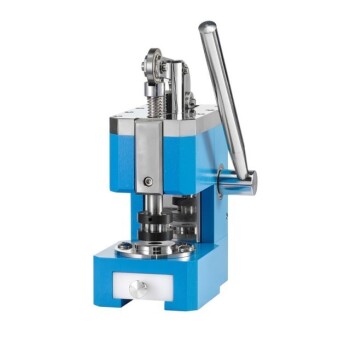
High-precision nanoindentation is required because isostatic-pressed thin films, such as Copper Phthalocyanine (CuPc), are often only hundreds of nanometers thick, rendering conventional testing methods ineffective. Standard hardness testers lack the necessary sensitivity and inevitably penetrate through the film, measuring the properties of the underlying substrate rather than the film itself. Only a high-precision tester offers the nanometer-scale depth control and micro-Newton resolution needed to isolate and quantify the film's intrinsic mechanical characteristics.
To validate the quality of a thin film, you must ensure your data reflects the material, not the substrate it sits on. High-precision nanoindentation utilizes continuous stiffness measurement to provide the granular data necessary to verify the densification and strength enhancements achieved by isostatic pressing.
The Challenge of Thin Film Characterization
The Limitations of Conventional Testing
Standard hardness testers are designed for bulk materials. When applied to films that are merely hundreds of nanometers thick, the force applied is disproportionately high.
This causes the indenter to punch through the film entirely. As a result, the data returned reflects the mechanical properties of the supporting substrate rather than the film you are trying to analyze.
Isolating the Film from the Substrate
To get accurate data, the indentation depth must be a fraction of the total film thickness.
High-precision testers solve the substrate problem by restricting the measurement to the topmost surface layer. This ensures the data collected—specifically hardness and modulus—is intrinsic to the isostatic-pressed film alone.
How Precision Technology Validates Isostatic Pressing
Micro-Newton Load Resolution
Isostatic pressing is used to enhance the density of materials like CuPc. Verifying this improvement requires detecting subtle changes in mechanical strength.
Nanoindentation testers apply forces in the micro-Newton range. This extreme sensitivity allows researchers to detect the specific increase in densification and mechanical strength that results from the pressing process.
Continuous Stiffness Measurement (CSM)
Advanced testers do not just take a single measurement after unloading; they use techniques like Continuous Stiffness Measurement (CSM).
CSM measures the material's response continuously as the indenter is pressed into the surface. This allows for the dynamic extraction of intrinsic hardness ($H_{IT}$) and elastic modulus ($E_{IT}$) at every point of the indentation depth.
Quantifying Structural Enhancement
The ultimate goal of using high-precision equipment is quantitative verification.
By accurately measuring $H_{IT}$ and $E_{IT}$ without substrate interference, you can mathematically prove that isostatic pressing has successfully improved the film's structural integrity.
Understanding the Trade-offs
Sensitivity to Surface Conditions
Because these instruments operate at the nanometer scale, they are unforgiving of surface imperfections.
While they provide high-accuracy data for thin films, the measurements can be easily skewed by surface roughness or contamination. The sample preparation must be meticulous compared to bulk testing.
Complexity of Data Analysis
Unlike standard testers that give a simple "hardness" number, nanoindentation provides complex load-displacement curves.
Interpreting this data requires a deeper understanding of material physics, particularly when distinguishing between plastic and elastic deformation in viscoelastic materials like CuPc.
Making the Right Choice for Your Goal
When characterizing isostatic-pressed thin films, your testing strategy should align with your specific data requirements:
- If your primary focus is process verification: Use Continuous Stiffness Measurement (CSM) to track how hardness changes with depth, confirming that densification is uniform throughout the film.
- If your primary focus is material properties: Prioritize indentation depth control to ensure all measurements remain within the top percentage of the film thickness, completely excluding substrate effects.
Precision measurement is the bridge between processing theory and verified material performance.
Summary Table:
| Feature | Conventional Hardness Testing | High-Precision Nanoindentation |
|---|---|---|
| Ideal Sample | Bulk materials (> 1mm) | Thin films (< 1µm) |
| Load Resolution | Newton scale | Micro-Newton scale |
| Depth Control | Coarse/Manual | Nanometer precision |
| Substrate Effect | High (frequently penetrates film) | Minimized (surface-specific) |
| Key Capabilities | Single point hardness | CSM (Hardness & Modulus vs. Depth) |
Elevate Your Material Research with KINTEK
Precision is the key to unlocking the potential of your thin film applications. KINTEK specializes in comprehensive laboratory pressing solutions, including manual, automatic, heated, and glovebox-compatible models, alongside advanced cold and warm isostatic presses used extensively in battery and semiconductor research.
Whether you are refining densification processes for CuPc or developing next-gen battery materials, our equipment provides the stability and control required for high-precision characterization. Contact KINTEK today to find the perfect pressing solution for your lab!
References
- Anno Ide, Moriyasu Kanari. Mechanical properties of copper phthalocyanine thin films densified by cold and warm isostatic press processes. DOI: 10.1080/15421406.2017.1352464
This article is also based on technical information from Kintek Solution Knowledge Base .
Related Products
- Lab Anti-Cracking Press Mold
- Lab Double Plate Heating Mold for Laboratory Use
- Laboratory Hydraulic Split Electric Lab Pellet Press
- Lab Cylindrical Press Mold for Laboratory Use
- Lab Infrared Press Mold for Laboratory Applications
People Also Ask
- What is the purpose of incorporating cartridge heaters into a lab press mold for MLCC block compression? Optimize Results
- What is the function of a pressing tool in thermoplastic panels? Master Precision Shaping & Fusion Bonding
- Why is precise cooling management of the lab press mold necessary? Protect Core Integrity in Thermoforming
- What are the requirements for pressing molds when using SSCG? Key Materials for Complex Single Crystal Production
- How do industrial-grade pressure molds affect zinc metal pouch cells? Maximize Energy Density & Performance