
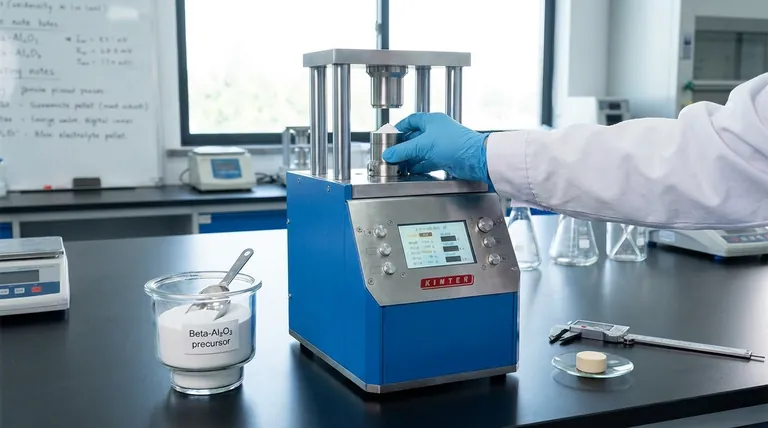
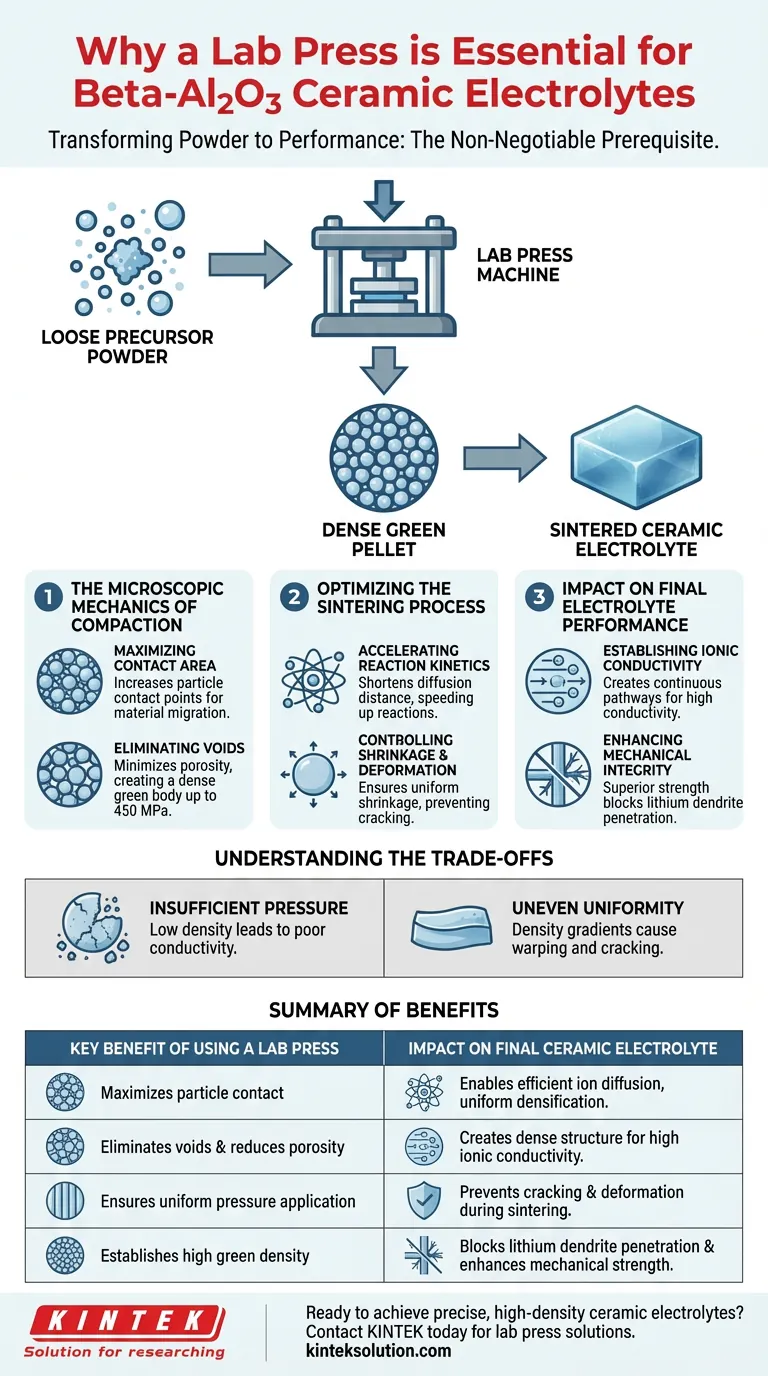
Using a laboratory press is a non-negotiable prerequisite for processing Beta-Al2O3 ceramic electrolytes. It serves to mechanically transform loose precursor powder into a cohesive "green pellet" with high initial density. By applying specific pressure, you minimize the voids between particles and maximize their physical contact points, establishing the necessary structural foundation for the subsequent sintering phase.
Core Insight: The quality of the final ceramic electrolyte is determined before heating ever begins. A lab press does not merely shape the powder; it creates the critical particle-to-particle proximity required for effective ion diffusion, uniform densification, and structural integrity.
The Microscopic Mechanics of Compaction
Maximizing Contact Area
Loose powder lacks the connectivity required for solid-state reactions. The lab press forces particles together, drastically increasing the points of contact among them.
This intimate physical contact is essential. It establishes a continuous network that serves as the bridge for material migration.
Eliminating Voids
Precursor powders naturally contain significant air gaps and pores. Applying pressure, often up to 450 MPa depending on the material, minimizes these inter-particle voids.
This reduction in porosity creates a dense green body. Without this step, the final material would remain porous, severely compromising its utility as an electrolyte.
Optimizing the Sintering Process
Accelerating Reaction Kinetics
Sintering relies on diffusion—the movement of atoms across particle boundaries. By increasing the packing density early on, you shorten the distance atoms must travel.
This proximity promotes rapid ion diffusion. It significantly accelerates reaction kinetics, particularly during rapid heating stages such as microwave synthesis.
Controlling Shrinkage and Deformation
Ceramics shrink as they densify under heat. A green pellet with high initial density ensures this shrinkage is uniform and controlled.
This stability is critical for preventing structural failures. Proper compaction effectively prevents cracking or deformation in the finished product that would otherwise occur due to uneven contraction.
Impact on Final Electrolyte Performance
Establishing Ionic Conductivity
The efficiency of an electrolyte is directly dependent on its density. Pores act as roadblocks to ion transport.
Compaction creates a continuous, robust pathway for ions. This is essential for achieving high ionic conductivity and ensuring reliable, repeatable measurement results.
Enhancing Mechanical Integrity
A dense green body leads to a final ceramic with high relative density. This directly translates to superior mechanical strength.
In the context of battery electrolytes, this density serves a secondary protective function. A highly dense structure is crucial for preventing the penetration of lithium dendrites, which can cause short circuits.
Understanding the Trade-offs
The Risk of Insufficient Pressure
While pressure is vital, consistency is equally important. If the "green pellet" lacks sufficient mechanical strength due to low pressure, the foundation for sintering collapses.
This results in a "garbage in, garbage out" scenario. A low-density green body invariably leads to a final product with low porosity and poor conductivity, rendering the synthesis effort wasted.
Uniformity vs. Deformation
The references highlight the need for uniform pressure. If pressure is applied unevenly, the green body will contain density gradients.
During sintering, these gradients cause differential shrinkage. This results in warped or cracked ceramics, destroying the geometric integrity needed for precise electrochemical testing.
Making the Right Choice for Your Goal
To achieve the best results with your Beta-Al2O3 electrolyte, align your processing parameters with your specific end-goals:
- If your primary focus is Ionic Conductivity: Prioritize maximizing pressure (within material limits) to eliminate porosity, as density creates the continuous pathways required for efficient ion transport.
- If your primary focus is Structural Integrity: Focus on the uniformity of the pressure application to ensure even shrinkage, which prevents cracking and blocks dendrite penetration.
Ultimately, the lab press is the tool that translates chemical potential into physical performance by defining the structural density of your material.
Summary Table:
| Key Benefit of Using a Lab Press | Impact on Final Ceramic Electrolyte |
|---|---|
| Maximizes particle contact area | Enables efficient ion diffusion and uniform densification |
| Eliminates voids and reduces porosity | Creates a dense structure for high ionic conductivity |
| Ensures uniform pressure application | Prevents cracking and deformation during sintering |
| Establishes high green density | Blocks lithium dendrite penetration and enhances mechanical strength |
Ready to achieve precise, high-density ceramic electrolytes?
KINTEK specializes in laboratory press machines, including automatic, isostatic, and heated lab presses, designed to meet the exacting demands of Beta-Al2O3 and other advanced ceramic processing. Our equipment ensures uniform compaction, critical for optimizing ionic conductivity and structural integrity in your final products.
Contact us today to discuss how our lab press solutions can enhance your research and development outcomes!
Visual Guide
Related Products
- Laboratory Hydraulic Press 2T Lab Pellet Press for KBR FTIR
- Automatic Laboratory Hydraulic Press Lab Pellet Press Machine
- Manual Laboratory Hydraulic Pellet Press Lab Hydraulic Press
- Manual Laboratory Hydraulic Press Lab Pellet Press
- Laboratory Hydraulic Press Lab Pellet Press Button Battery Press
People Also Ask
- What is the role of a laboratory pressure machine and KBr in FTIR? Master Sample Preparation for Flame Retardants
- What is the role of a laboratory hydraulic press in high-loading NCM811 cathode prep for solid-state batteries?
- Why is a laboratory hydraulic press necessary for sample preparation? Precise Pelleting for Spiro Heterocyclic Analysis
- What role does a laboratory hydraulic press play in reaction pellets? Optimizing Lunar Soil and Metal Fuel Density
- What is the typical pressure capacity of a laboratory hydraulic press and what materials can it process?



















