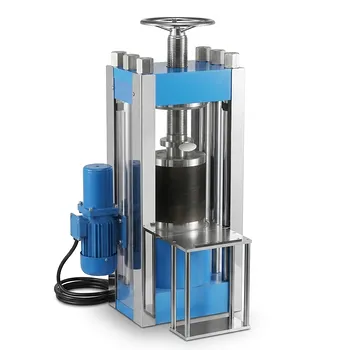
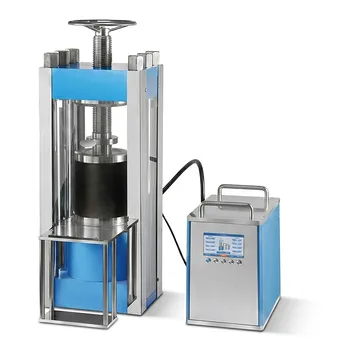
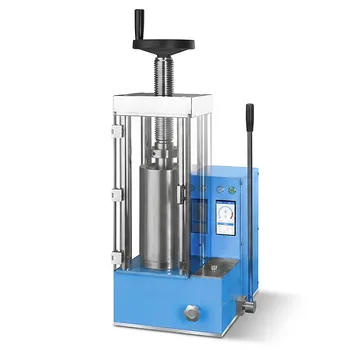
Warm Isostatic Pressing (WIP) succeeds where room-temperature methods fail by introducing a precisely heated liquid medium to the consolidation process. It is suitable for difficult-to-form materials because the application of controlled heat alongside pressure alters the physical properties of binders and powders—specifically reducing viscosity—allowing them to flow, densify, and mold effectively.
Core Takeaway Standard cold pressing cannot process materials with high yield strengths or rigid binders that require thermal softening to deform. WIP solves this by utilizing a heated liquid medium to apply ultra-high pressure (up to 2 GPa) at moderate temperatures, enabling densification without the negative side effects—such as grain growth—associated with the extreme heat of Hot Isostatic Pressing (HIP).
The Mechanics of Thermal Plasticity
Overcoming Material Rigidity
Many advanced powders and binders behave like rigid solids at room temperature. They resist compaction and will not bond cohesively under pressure alone.
WIP addresses this by heating the pressurizing fluid—usually water or oil—before and during injection into the sealed cylinder.
By raising the temperature, the process softens the material, significantly reducing its yield strength and allowing it to be shaped.
Viscosity Reduction for Pore Filling
For composite materials, such as Poly-L-lactic acid (PLLA) mixed with ceramics, room temperature processing leaves gaps and pores.
The heat applied in WIP reduces the viscosity of these polymers. This allows the binder to flow freely, infiltrating and filling the microscopic pores between nanoparticles to create a solid, dense structure.
Precise Temperature Regulation
Unlike processes that rely on ambient conditions, WIP employs a heating element directly within the pressing cylinder.
This ensures the material reaches the exact temperature required for molding, maintaining consistency throughout the production cycle.
Preserving Material Integrity
Achieving Density at Lower Temperatures
A distinct advantage of WIP is its ability to use liquid media to generate massive pressures, potentially reaching 2 GPa.
Because the pressure is so high, the temperature required to density the material is significantly lower than in gas-based Hot Isostatic Pressing (HIP).
Preventing Abnormal Grain Growth
High temperatures often degrade nanomaterials by causing the grain structure to grow abnormally large, ruining the material's unique properties.
WIP allows for densification at moderate temperatures (e.g., 500°C). This preserves the nanocrystalline characteristics of the material while still achieving high-density bulk formation.
Impurity Removal
The warm medium facilitates the evacuation of volatile components.
Trapped gases and impurities are more easily expelled from the powder matrix at elevated temperatures, leading to a higher purity final product.
Understanding the Trade-offs
Equipment Complexity
WIP systems are more complex than Cold Isostatic Pressing (CIP) units. They require specialized seals and pumping systems capable of handling hot liquids under extreme pressure.
Temperature Limitations of Liquid Media
While WIP offers heat, it is limited by the boiling point and stability of the liquid medium used.
It cannot reach the extreme temperatures (1000°C+) possible with gas-based HIP, making it unsuitable for materials requiring full high-temperature sintering.
Making the Right Choice for Your Goal
To determine if WIP is the correct solution for your manufacturing needs, consider your material's thermal sensitivity.
- If your primary focus is preserving nanostructures: WIP is ideal because it densifies materials at lower temperatures, preventing grain growth.
- If your primary focus is complex binders: WIP is necessary if your binder is too viscous or rigid to flow at room temperature.
- If your primary focus is extreme temperature sintering: You likely require Hot Isostatic Pressing (HIP) rather than WIP, as liquids cannot sustain the required temperatures.
WIP is the definitive solution when you need the flow characteristics of hot processing combined with the microstructural preservation of cold processing.
Summary Table:
| Feature | Cold Isostatic Pressing (CIP) | Warm Isostatic Pressing (WIP) | Hot Isostatic Pressing (HIP) |
|---|---|---|---|
| Medium | Liquid (Room Temp) | Heated Liquid | Inert Gas |
| Temperature | Ambient | Up to ~500°C | Up to 2000°C+ |
| Pressure Source | Hydraulic | Hydraulic | Gas Compressor |
| Best For | Simple powders, green parts | Thermal binders, nanomaterials | Metal casting, sintering |
| Key Benefit | Low cost, high speed | Density without grain growth | Full elimination of porosity |
Elevate Your Material Research with KINTEK Solutions
Are you struggling with rigid binders or delicate nanomaterials that fail during standard cold pressing? KINTEK specializes in comprehensive laboratory pressing solutions designed to overcome your most complex manufacturing challenges.
Our range includes manual, automatic, heated, and multifunctional models, along with advanced Cold and Warm Isostatic Presses specifically engineered for high-performance battery research and composite development. By choosing KINTEK, you benefit from:
- Precision Control: Achieve exact density targets while preserving nanocrystalline structures.
- Versatility: Solutions compatible with gloveboxes and specialized material requirements.
- Expertise: Industry-leading equipment tailored for both R&D and pilot production.
Ready to optimize your densification process? Contact us today to find the perfect pressing solution for your lab!
Related Products
- Warm Isostatic Press for Solid State Battery Research Warm Isostatic Press
- Split Warm Isostatic Lab Press 200 Ton Powder Compaction Chamber for Battery Research and Material Science
- Split Hot Isostatic Pressing Machine 150 Ton Laboratory Heated Isostatic Press
- Electric Isostatic Pressing Machine 40 Tons Automatic Laboratory Powder Compacting Press
- Electric Lab Cold Isostatic Press CIP Machine
People Also Ask
- Why must composite cathodes be sealed in vacuum lamination bags for WIP? Ensure Battery Stability and Density
- How do sacrificial volume materials (SVM) maintain microchannels in isostatic pressing? Ensure Structural Integrity
- What is the function of elastic molds in warm isostatic pressing? Achieve Uniform Density in Composite Particles
- What is the mechanism of a Warm Isostatic Press (WIP) on cheese? Master Cold Pasteurization for Superior Safety
- What is the significance of temperature control in Warm Isostatic Pressing? Unlock Uniform Densification and Process Stability