The Invisible Foundation
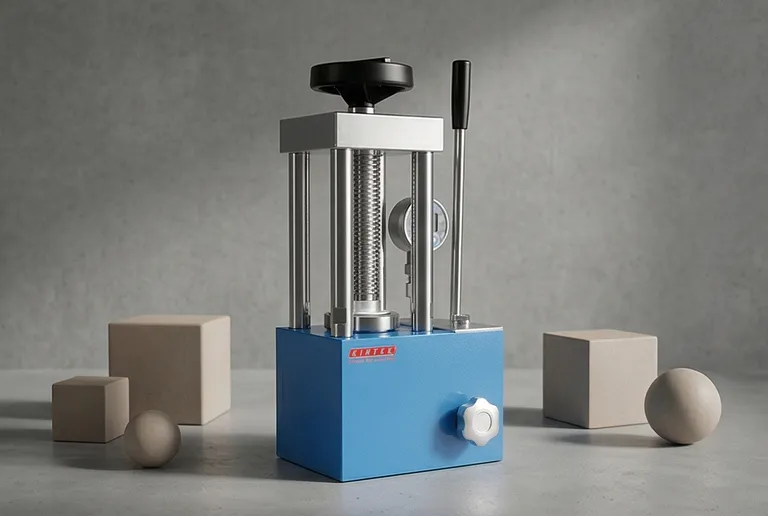
In advanced materials science, we often obsess over the "grand finale"—the high-temperature sintering or the microwave-induced transformation. But in the life of a SiC/YAG composite, the most critical moment happens in silence, under the steady descent of a manual laboratory press.
This is the creation of the "green body." It is the transition from a state of chaos—loose, independent particles—to a state of structural intent.
If this foundation is flawed, no amount of thermal energy can save the material. The laboratory press is not merely a tool; it is the architect of the material's internal landscape.
Phase I: Eliminating the Void
Loose SiC and YAG powders are separated by air. In the world of high-performance ceramics, air is a liability. It creates thermal insulators where you need conductors and weak points where you need strength.
The application of controlled axial pressure—roughly 100 MPa—performs three systemic functions:
- Particle Rearrangement: Forcing independent grains to pack into a cohesive network.
- Air Expulsion: Removing the internal pockets that cause structural "capping" or uneven heating.
- Mechanical Interlocking: Inducing slight plastic deformation at contact points to create "green strength."
Without this initial densification, the material remains a pile of dust. With it, it becomes a workpiece capable of surviving the violent stresses of a furnace.
The Geometry of Survival
Precision is not just about aesthetics; it is about compatibility. A SiC/YAG composite must fit the rigorous constraints of its next environment, whether that is a high-pressure container or a specialized sintering furnace.
Why Structural Integrity Matters
| Feature | Role in SiC/YAG Formation | Impact on Research Quality |
|---|---|---|
| Axial Force | Compacts powder into geometry | Creates a handleable "Green Body" |
| Void Removal | Expels trapped gas | Prevents cracking during thermal expansion |
| Mechanical Bond | Increases surface contact | Accelerates diffusion during sintering |
| Precision Dies | Defines exact dimensions | Ensures fit in subsequent processing |
A manual pellet press allows a researcher to feel the material’s resistance. It provides a tactile feedback loop that automated systems sometimes obscure, ensuring that the initial density is consistent across every sample.
The Struggle with Physics: Uniaxial Limits

Engineering is a series of trade-offs. Most manual laboratory presses apply uniaxial pressure—force from a single direction.
While efficient, this creates a "density gradient." The material is often denser near the plunger and more porous in the center. In the pursuit of perfection, this "green body" acts as the essential precursor. For the most demanding applications, this workpiece will later undergo Isostatic Pressing to harmonize those internal stresses.
To master the forming stage, one must account for:
- Wall Friction: The resistance between the powder and the carbon steel die.
- Pressure Ramping: Applying force slowly to allow air a path of escape.
- Die Precision: Using high-tolerance tooling to prevent material "flash" or edge crumbling.
The Psychology of Precision
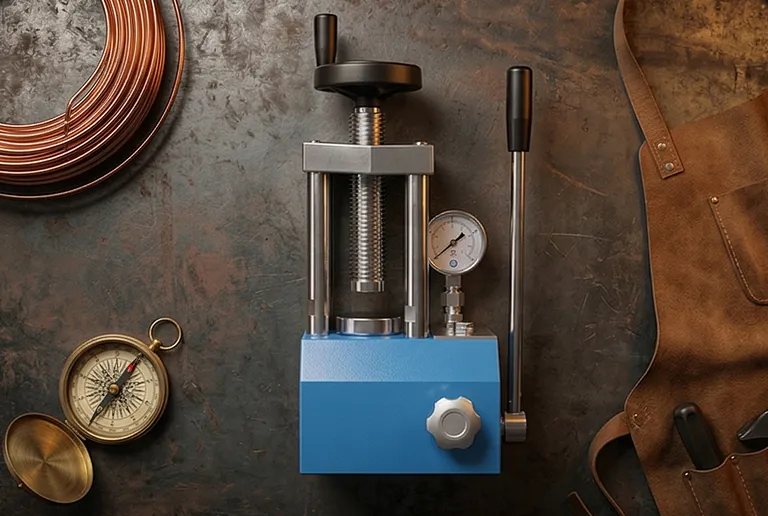
We often overlook the manual stage because it seems simple. However, the most sophisticated failures in material science are rarely caused by a lack of complexity; they are caused by a lack of consistency.
A precision manual press brings repeatability to the bench. It ensures that the SiC/YAG composite you test today is the same as the one you test tomorrow. It removes the variables of "form" so you can focus on the variables of "science."
Engineering the Perfect Start with KINTEK
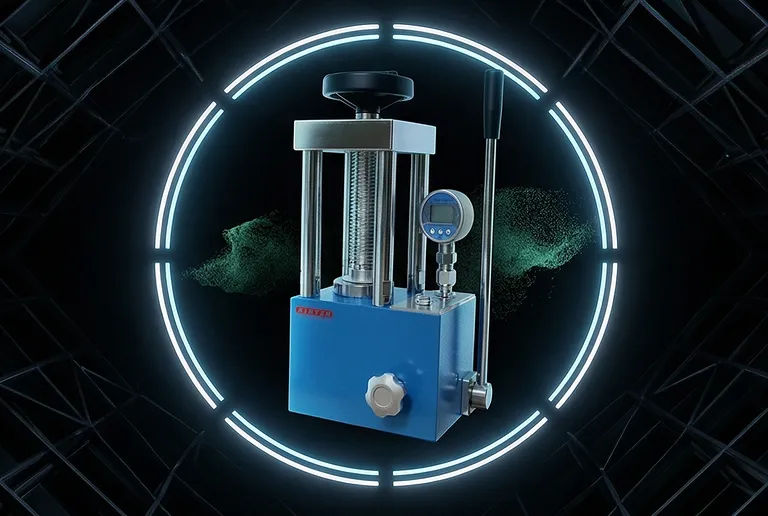
At KINTEK, we understand that the path to a breakthrough begins with a perfect green body. We design our laboratory pressing solutions to provide the stability, precision, and durability required for the most sensitive material research.
Our comprehensive catalog is built for the modern laboratory:
- Manual & Automatic Pellet Presses for controlled densification.
- Heated Models for advanced composite forming.
- Glovebox-Compatible Systems for air-sensitive battery and ceramic powders.
- CIP/WIP Solutions to eliminate density gradients and achieve theoretical limits.
The integrity of your final material is determined by the precision of your first step. Let us help you build a stronger foundation.
Related Products
- Lab Polygon Press Mold
- Lab Round Bidirectional Press Mold
- Lab XRF Boric Acid Powder Pellet Pressing Mold for Laboratory Use
- XRF KBR Plastic Ring Lab Powder Pellet Pressing Mold for FTIR
- Lab Cylindrical Press Mold for Laboratory Use
Related Articles
- Leverage in Miniature: The Physics and Psychology of the Compact Lab Press
- The Geometry of Energy: Why Graphite is the Soul of Advanced Sintering
- The Architecture of Pressure: Why Precision is the Only Truth in Material R&D
- The Last Millimeter: Why Physical Constraints Define Material Integrity
- The Glass Transition Ritual: Why Heat is the Secret Language of High-Density Materials
















