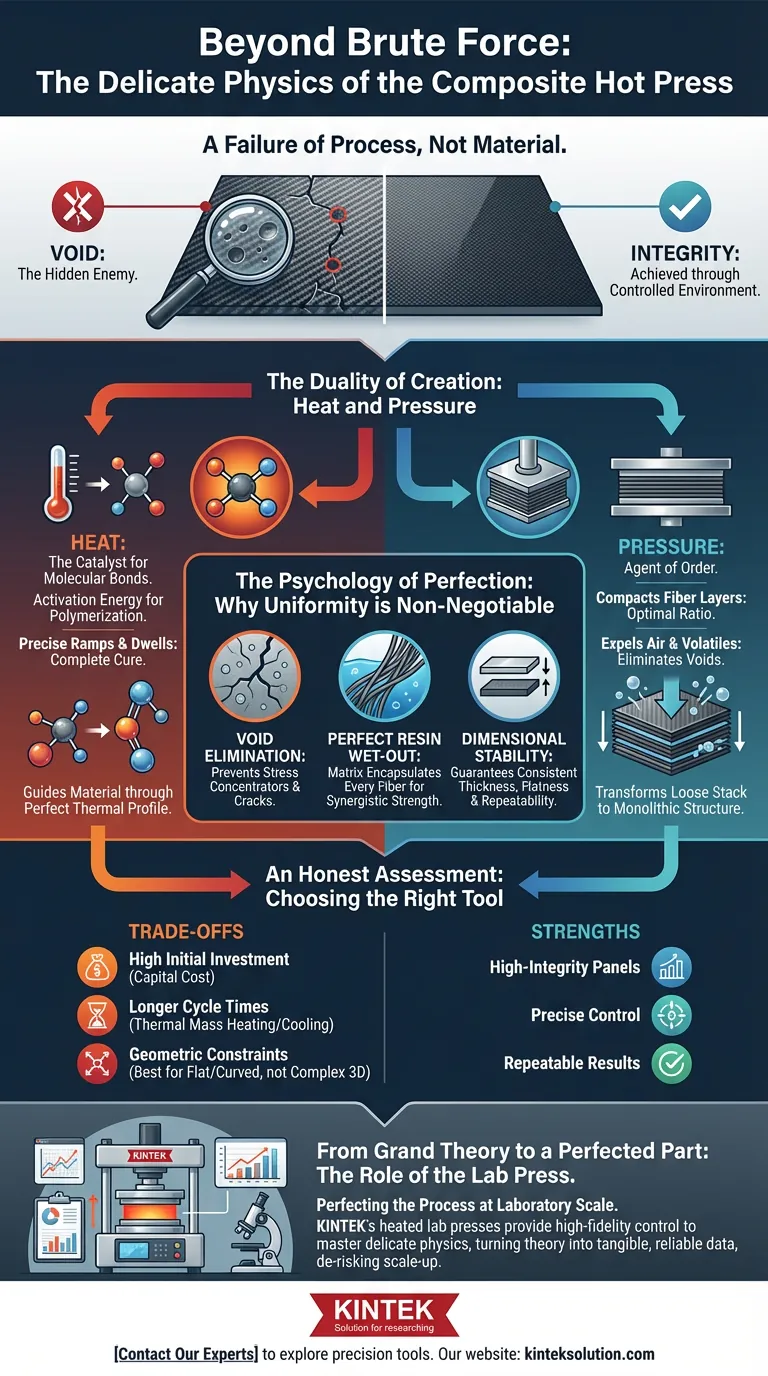
A Failure of Process, Not Material
Imagine a high-performance carbon fiber panel, designed for aerospace. It looks perfect. It feels impossibly strong. Yet, under stress, it delaminates and fails catastrophically. The culprit wasn't the advanced fiber or the engineered resin. It was a microscopic pocket of air—a void—trapped during manufacturing.
This scenario highlights a common psychological bias in engineering. We are captivated by novel materials but often overlook the mundane process that gives them their integrity.
The strength of a composite is not just born from its ingredients, but forged in the controlled environment of its creation. The hot press is that environment. It’s less a tool of brute force and more an instrument of delicate physics.
The Duality of Creation: Heat and Pressure
At its core, a hot press orchestrates a dance between two fundamental forces: thermal energy and mechanical pressure. Understanding their distinct roles reveals why precision is everything.
Heat: The Catalyst for Molecular Bonds
Heat is not merely about making the material hot. It is the activation energy required to initiate polymerization—the chemical reaction where individual resin molecules link together to form a rigid, cross-linked polymer network.
Without precise temperature ramps and dwells, this reaction can be incomplete, leaving the part weak and "green." Too much heat, too fast, can create internal stresses that become failure points later. The press acts as a conductor, guiding the material through a perfect thermal profile.
Pressure: The Sculptor of Density
Simultaneously, the press applies uniform pressure. This force is a powerful agent of order.
First, it compacts the layers of fiber, ensuring an optimal fiber-to-resin ratio. Then, as the heat lowers the resin's viscosity, pressure squeezes out any excess. Most critically, it expels trapped air and volatiles—the very culprits behind the voids that doom components. It transforms a loose stack of materials into a single, dense, monolithic structure.
The Psychology of Perfection: Why Uniformity is Non-Negotiable
A simple heater and a clamp can apply heat and pressure. But a high-quality composite demands absolute uniformity. Any deviation creates an invisible weakness, a flaw we can't see but that the laws of physics will surely find.
The Hidden Enemy: Voids
A void is a pocket of nothingness in a structure that demands absolute solidity. These tiny bubbles are stress concentrators, the starting points for cracks and delamination. Uniform pressure is the only reliable way to systematically eliminate them, ensuring the final part is as solid and reliable as its design intends.
The Art of Flow: Perfect Resin Wet-Out
For a composite to work, the resin matrix must fully encapsulate every single fiber. This "wet-out" is what allows stress to be transferred from the resin to the much stronger fibers. Pressure guides this resin flow into the tightest corners of the fiber bundles, ensuring the two components act as a synergistic whole, not just two materials coexisting.
The Mandate of Precision: Dimensional Stability
In industries like electronics or aerospace, a part that is almost the right thickness is completely wrong. The parallel platens of a hot press act as a high-precision mold, guaranteeing consistent thickness, flatness, and a predictable surface finish, part after part. It’s the guarantee of engineering repeatability.
An Honest Assessment: Choosing the Right Tool
The hot press is a master of creating high-integrity flat and gently-curved panels. However, it’s not a universal solution. Acknowledging its trade-offs is crucial for making smart manufacturing decisions.
- High Initial Investment: Precision industrial machinery represents a significant capital cost.
- Longer Cycle Times: Heating and cooling the large thermal mass of the platens takes time, making it less suitable for certain high-volume applications.
- Geometric Constraints: The process is fundamentally designed for parts with a consistent cross-section, not complex 3D shapes.
For intricate geometries, processes like autoclave or resin transfer molding (RTM) may be more appropriate. The choice depends entirely on the part's final requirements for performance, volume, and shape.
From Grand Theory to a Perfected Part
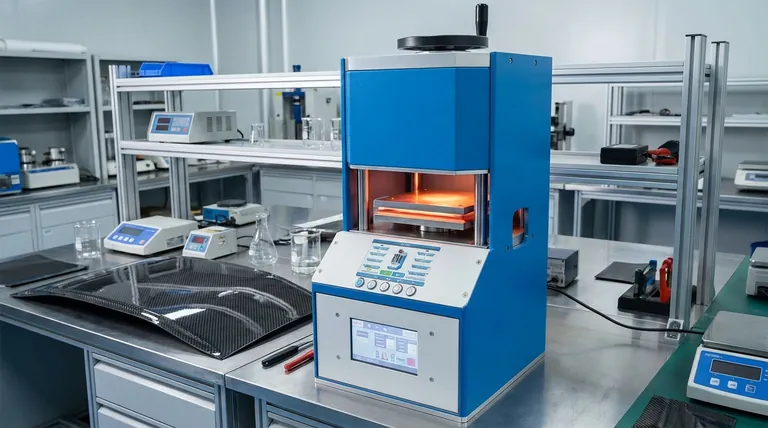
Before any composite part is mass-produced, its material and process are perfected on a smaller scale. This happens in the laboratory, where variables can be meticulously controlled and results carefully analyzed. Here, the principles of heat and pressure are tested and refined.
This is the essential role of a high-fidelity lab press. Instruments like KINTEK's heated lab presses are designed not just to mimic production, but to provide an even greater degree of control. They allow engineers and material scientists to master the delicate physics of composite curing, turning theoretical properties into tangible, reliable data. They are the tools used to de-risk a process before it ever scales.
Perfecting this process at the laboratory scale is the first and most critical step toward manufacturing excellence. Contact Our Experts to explore the precision tools your material development deserves.
Visual Guide
Related Products
- Manual Heated Hydraulic Lab Press with Integrated Hot Plates Hydraulic Press Machine
- Split Automatic Heated Hydraulic Press Machine with Heated Plates
- Heated Hydraulic Press Machine with Heated Plates for Vacuum Box Laboratory Hot Press
- Automatic High Temperature Heated Hydraulic Press Machine with Heated Plates for Lab
- Heated Hydraulic Press Machine With Heated Plates For Vacuum Box Laboratory Hot Press
Related Articles
- The Architecture of Slow: Why Physical Precision Dictates Chemical Destiny
- From Chaos to Control: The Unseen Power of a Heated Lab Press
- The Slow Creep of Inaccuracy: Mastering the Hidden Physics of Heated Lab Presses
- The Unseen Architecture of a Pill: Why Heat Engineers Pharmaceutical Trust
- Clarity from Chaos: Mastering Sample Preparation for FTIR Spectroscopy
















