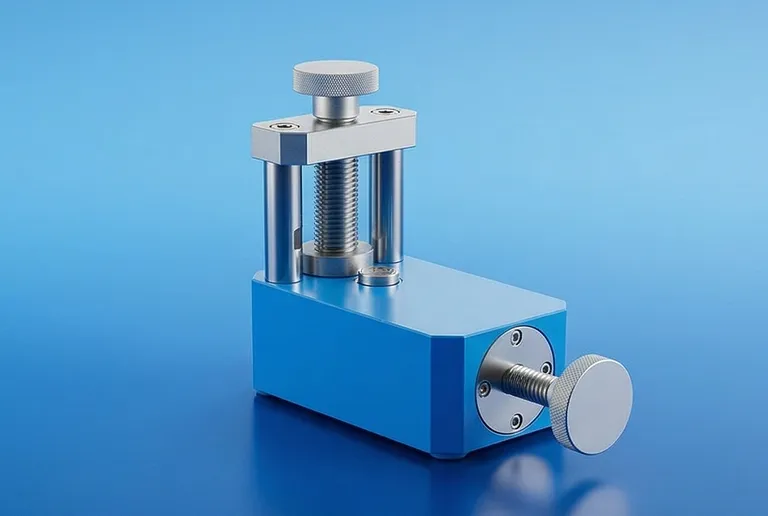
The Invisible Flaws
In materials science, as in life, the most catastrophic failures often begin where we cannot see.
A ceramic anode green body might look perfect to the naked eye. But inside, it often hides a chaotic landscape of density gradients and microscopic "fault lines." When these materials are placed in the furnace, heat does not forgive. It exposes every hidden inequality.
For 10NiO-NiFe2O4 composite ceramic anodes, the stakes are exceptionally high. These materials must survive the brutal, corrosive heart of aluminum electrolysis. To survive, they need more than just the right chemistry; they need a flawless internal architecture.
The Tyranny of the Single Axis
Most manufacturing relies on uniaxial pressing—pushing down from the top. It is simple, fast, and often effective. But it is fundamentally "unfair" to the particles.
- Pressure Shadows: In a rigid die, friction against the walls prevents force from reaching the center of the powder mass.
- The Layering Effect: You end up with a material that is dense at the surface but loose in the core.
- Stored Stress: These internal imbalances are like coiled springs, waiting to snap during the sintering process.
To build a ceramic capable of withstanding cryolite electrolytes, we must move beyond the single axis. We need the "liquid hug" of Cold Isostatic Pressing (CIP).
The Isotropic Embrace
Cold Isostatic Pressing operates on a different psychological principle: Equivalence.
By submerging a flexible mold in a liquid medium and applying pressures often reaching 200 MPa, the force is transmitted equally from every possible direction. There is no "top" or "bottom."
The Transformation of Matter
- Particle Rearrangement: Under isotropic pressure, 10NiO-NiFe2O4 particles are forced to find their most efficient configuration. Voids are filled; gaps are closed.
- Elimination of Gradients: Because the pressure is equal everywhere, the density becomes uniform across the entire volume.
- Healing Microcracks: The "omnidirectional squeeze" effectively heals the tiny structural rifts that occur during initial powder loading.
Sintering: The Moment of Truth
Sintering is the transition from a fragile "green" state to a hardened ceramic. It is a process of shrinkage.
If the density is non-uniform, the shrinkage is non-uniform. The material warps. It cracks. It fails.
By using CIP to create a perfectly uniform green body, we ensure that the material shrinks with mathematical consistency. This consistency is the only way to achieve the high relative density required to block the penetration of aggressive chemical agents.
Survival in the Electrolytic Cell
In the context of aluminum electrolysis, density is not a luxury—it is a shield.
The 10NiO-NiFe2O4 anode must face constant attacks from cryolite. Without the structural integrity provided by CIP, the electrolyte would find its way into the grain boundaries, causing rapid degradation.
When optimized with additives like BaO and densified via CIP, the annual wear rate can be brought down to a remarkable 3.66 cm per year.
The Precision Trade-off
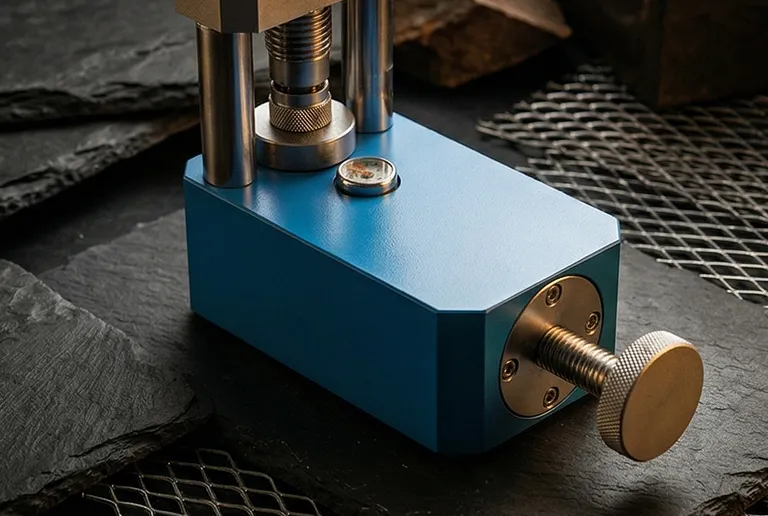
Nothing of value is free. CIP is a more complex discipline than standard pressing. It requires specialized equipment and a deeper understanding of flexible mold dynamics.
| Feature | Uniaxial Pressing | Cold Isostatic Pressing (CIP) |
|---|---|---|
| Pressure Direction | Single axis (Vertical) | Omnidirectional (Isotropic) |
| Density Uniformity | Low (Internal gradients) | High (Homogeneous) |
| Internal Stress | Significant | Minimal to None |
| Complexity | Low (Fast cycles) | High (Specialized setups) |
| Resulting Integrity | Prone to warping | Stable, high-density structure |
Engineering the Solution

At KINTEK, we understand that the future of battery research and high-performance ceramics depends on the precision of the initial form. We provide the tools that turn loose powders into the resilient architectures required by modern industry.
From manual lab presses to advanced cold and warm isostatic systems designed for battery research, our solutions are built to eliminate the invisible flaws that lead to material failure.
Precision is the bridge between a laboratory concept and an industrial reality. Ensure your materials are built on a foundation of total uniformity.
Related Products
- Electric Lab Cold Isostatic Press CIP Machine
- Electric Split Lab Cold Isostatic Pressing CIP Machine
- Automatic Lab Cold Isostatic Pressing CIP Machine
- Manual Cold Isostatic Pressing CIP Machine Pellet Press
- Lab Isostatic Pressing Molds for Isostatic Molding
Related Articles
- Shaping vs. Perfecting: The Strategic Divide Between Cold and Hot Isostatic Pressing
- Beyond Brute Force: The Elegant Physics of Cold Isostatic Pressing
- The Isotropic Imperative: Why Uniform Pressure Defines the Life of a Superconductor
- The Silent Geometry of Density: Why Isotropic Pressure is the Soul of Advanced Ceramics
- How Isostatic Pressing Delivers Superior Performance in Critical Industries
















