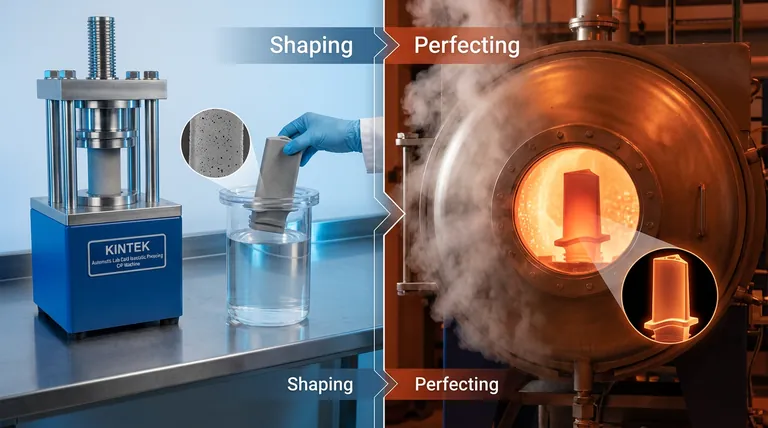
The Hidden Enemy in High-Performance Materials
In the world of advanced materials, the most dangerous enemy is often invisible: empty space. Microscopic voids and pores buried deep within a component are silent assassins. They are the starting points for cracks, the weak links that cause catastrophic failure in aerospace turbines, medical implants, and critical industrial parts.
The battle against these voids is not fought with a single weapon. It requires a strategic choice between two powerful processes: Cold Isostatic Pressing (CIP) and Hot Isostatic Pressing (HIP). Understanding their difference isn't just about temperature; it's about understanding the fundamental philosophy of shaping versus perfecting.
The Unifying Principle: The Certainty of Pressure
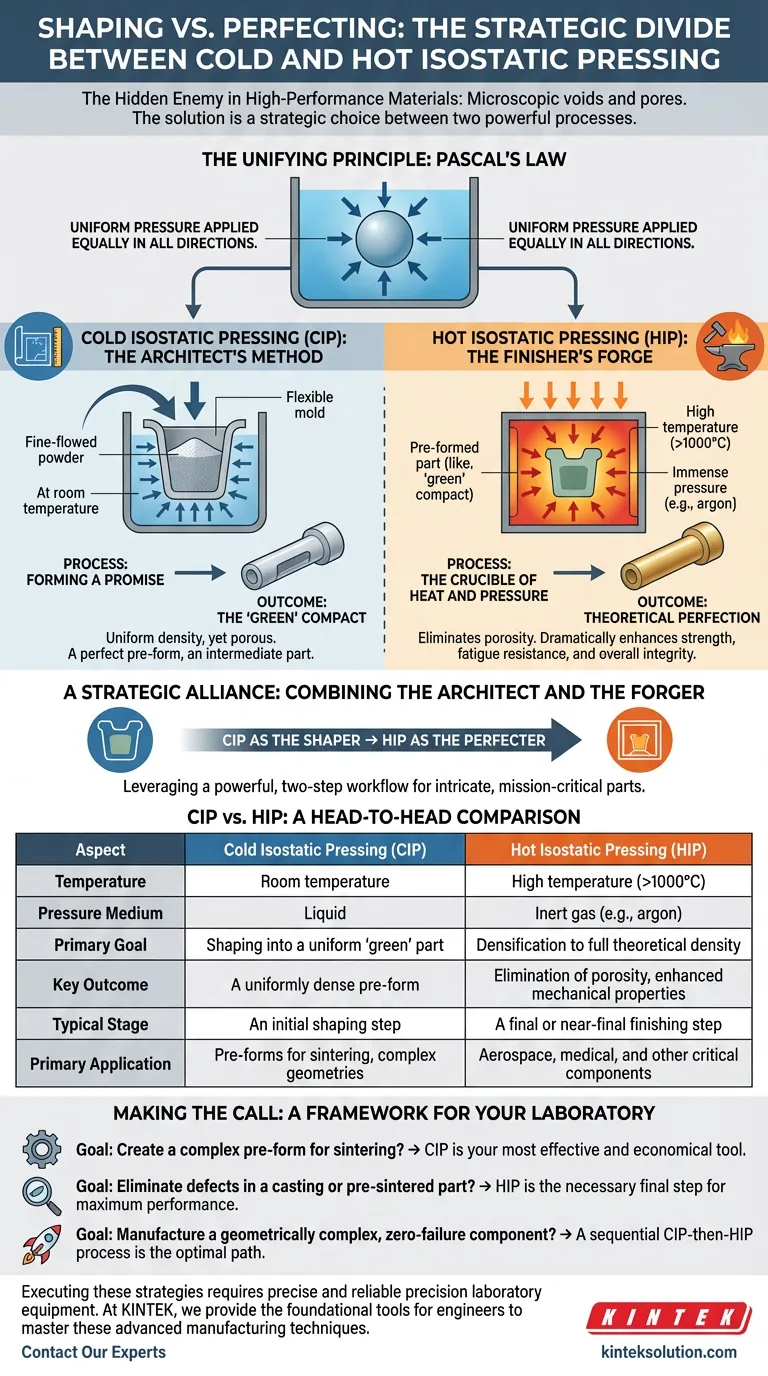
Both methods are built on a beautifully simple and elegant foundation: Pascal's Law. The law states that pressure applied to an enclosed fluid is transmitted equally in all directions.
This is a profound departure from conventional pressing, which applies force from one or two directions. That's a brute-force approach, often creating hidden inconsistencies and density gradients—the very flaws that lead to failure.
Isostatic pressing is different. By submerging a component in a fluid medium, it applies a perfectly uniform "squeeze" from all sides. It's a process of complete control, designed to create a predictable and homogenous foundation for a high-performance part.
Cold Isostatic Pressing: The Architect's Method
Imagine an architect creating a detailed blueprint. The vision is complete, but the structure has yet to be built. This is the role of Cold Isostatic Pressing (CIP).
The Process: Forming a Promise
In CIP, a fine powder is sealed inside a flexible, rubber-like mold. This mold is then placed in a vessel of liquid at room temperature. As the pressure in the vessel ramps up, the liquid compresses the mold with perfect uniformity.
The Outcome: The "Green" Compact
The result is not a finished part. It is a solid, handleable object known as a "green" compact. It has the exact shape desired, from simple rods to incredibly complex geometries. It is uniformly dense, yet still porous—a solid promise of the final component.
CIP is a shaping process. Its genius lies in creating a perfect pre-form, an intermediate part free of the density variations that would plague it during later heating stages. It is an act of preparation.
Hot Isostatic Pressing: The Finisher's Forge
If CIP is the architect, HIP is the master forger who turns a well-designed piece of metal into an unbreakable sword.
The Process: The crucible of heat and pressure
HIP takes a pre-formed part (like a green compact from CIP or a metal casting) and subjects it to a brutal, transformative environment. Inside a specialized furnace, the component is heated to temperatures often exceeding 1000°C, softening the material to a near-plastic state.
Simultaneously, an inert gas like argon is pumped in, creating immense pressure. This combination of heat and uniform pressure causes the material to collapse in on itself, squeezing every last internal void and pore out of existence.
The Outcome: Theoretical Perfection
The goal of HIP is not to shape, but to perfect. It aims for 100% theoretical density. By eliminating porosity, HIP dramatically enhances a material's mechanical properties: its strength, fatigue resistance, and overall integrity. This is the process reserved for components where failure is simply not an option.
A Strategic Alliance: Combining the Architect and the Forger
The choice isn't always one or the other. The most demanding applications often leverage a powerful, two-step workflow:
- CIP as the Shaper: First, CIP is used to create a complex component with highly uniform density. This ensures the part's geometry is sound before the final, intense densification step.
- HIP as the Perfecter: The green part from CIP is then placed into a HIP unit to remove all residual porosity, locking in its shape and elevating its material properties to their absolute peak.
This combination allows manufacturers to create intricate, mission-critical parts that are both geometrically complex and internally flawless.
Making the Call: A Framework for Your Laboratory
Choosing the right process depends entirely on your objective. This is where precision laboratory equipment becomes critical, allowing engineers to validate their material strategies.
- Goal: Create a complex pre-form for sintering? CIP is your most effective and economical tool.
- Goal: Eliminate defects in a casting or pre-sintered part? HIP is the necessary final step for maximum performance.
- Goal: Manufacture a geometrically complex, zero-failure component? A sequential CIP-then-HIP process is the optimal path to success.
Executing these strategies requires equipment that is both precise and reliable. High-quality laboratory presses are essential for developing and refining the processes that turn advanced materials from a concept into a reality. At KINTEK, we provide the foundational tools—from automatic lab presses and isostatic presses for shaping to heated presses for simulating densification—that empower engineers to master these advanced manufacturing techniques.
CIP vs. HIP: A Head-to-Head Comparison
| Aspect | Cold Isostatic Pressing (CIP) | Hot Isostatic Pressing (HIP) |
|---|---|---|
| Temperature | Room temperature | High temperature (>1000°C) |
| Pressure Medium | Liquid | Inert gas (e.g., argon) |
| Primary Goal | Shaping into a uniform 'green' part | Densification to full theoretical density |
| Key Outcome | A uniformly dense pre-form | Elimination of porosity, enhanced mechanical properties |
| Typical Stage | An initial shaping step | A final or near-final finishing step |
| Primary Application | Pre-forms for sintering, complex geometries | Aerospace, medical, and other critical components |
Ultimately, understanding the profound difference between shaping and perfecting is the first step. The next is having the right tools to execute your vision with confidence. Contact Our Experts
Visual Guide
Related Products
- Electric Lab Cold Isostatic Press CIP Machine
- Electric Split Lab Cold Isostatic Pressing CIP Machine
- Automatic Lab Cold Isostatic Pressing CIP Machine
- Manual Cold Isostatic Pressing CIP Machine Pellet Press
- Lab Isostatic Pressing Molds for Isostatic Molding
Related Articles
- Beyond Brute Force: The Elegant Physics of Cold Isostatic Pressing
- The Isotropic Imperative: Why Uniform Pressure Defines the Life of a Superconductor
- The Architecture of Uniformity: Why Omnidirectional Pressure Defines Ceramic Destiny
- The Silent Geometry of Density: Why Isotropic Pressure is the Soul of Advanced Ceramics
- How Isostatic Pressing Delivers Superior Performance in Critical Industries
















