The Heartbreak of the Kiln
In ceramic engineering, the most painful moment happens at the kiln door. You spend hours preparing a sample, only to find it warped, cracked, or microscopically compromised after sintering.
It looks like a material failure. It is actually a structural one.
The failure didn't happen in the heat. It happened in the press. When we treat powder as a solid before it is ready, we introduce "memory"—hidden gradients of density that haunt the material as it shrinks.
The Tyranny of the Die
Conventional dry pressing is a battle against friction. When a rigid steel die moves in one or two directions, the powder particles near the walls resist.
This friction creates a hierarchy of density. The center and the edges are never the same.
- Internal Stress: Different zones of the green body hold different "potential energy."
- Friction Losses: Mechanical force dissipates as it travels through the powder.
- The Sintering Tax: During heating, dense areas shrink less than porous ones. This differential leads to the macroscopic cracks that ruin high-performance alumina.
The Logic of the Fluid
Cold Isostatic Pressing (CIP) abandons the rigid die for a more elegant medium: liquid.
By submerging a flexible mold into a hydraulic fluid, we apply pressure from every direction simultaneously. This is Isotropic Pressure.
Because the fluid doesn't "care" about the shape of the part, the force is perfectly uniform. There are no wall effects. There is no friction-induced gradient. The powder is persuaded, rather than forced, into its new state.
The 68% Threshold
Density is the primary predictor of success. In the world of alumina, a green body’s relative density is its insurance policy.
High-pressure CIP systems, operating between 300 MPa and 500 MPa, can push alumina samples to a relative density of 68%.
Why does this matter?
- Air Elimination: It removes the microscopic pockets of gas that become explosive seeds of failure at 1500°C.
- Particle Contact: It maximizes the surface-to-surface contact required for phase transition kinetics.
- Green Strength: A 68% dense sample is physically robust, making it easier to handle and machine before it ever sees a flame.
Precision vs. Production
Engineering is the art of trade-offs. Choosing a pressing method is a choice between the economy of scale and the pursuit of perfection.
| Feature | Cold Isostatic Pressing (CIP) | Conventional Dry Pressing |
|---|---|---|
| Pressure Direction | Omnidirectional (Isotropic) | Unidirectional / Bidirectional |
| Density Uniformity | Absolute (No internal gradients) | Variable (Affected by wall friction) |
| Relative Green Density | Superior (~68%) | Moderate |
| Structural Integrity | High (Even shrinkage) | Risk of warping/cracking |
| Throughput | Lower (Batch-oriented) | High (Mass production) |
Designing for Reliability
If you are manufacturing simple, low-cost ceramic components in the millions, the speed of dry pressing is your ally.
But if you are chasing the Master Sintering Curve, or if you are developing transparent Yb:YAG ceramics or battery materials where microstructure is everything, CIP is the only path.
Isotropic pressure ensures that when the material shrinks, it shrinks into itself, maintaining its geometry and its soul. It is the difference between a component that merely exists and one that performs.
Engineering Excellence with KINTEK
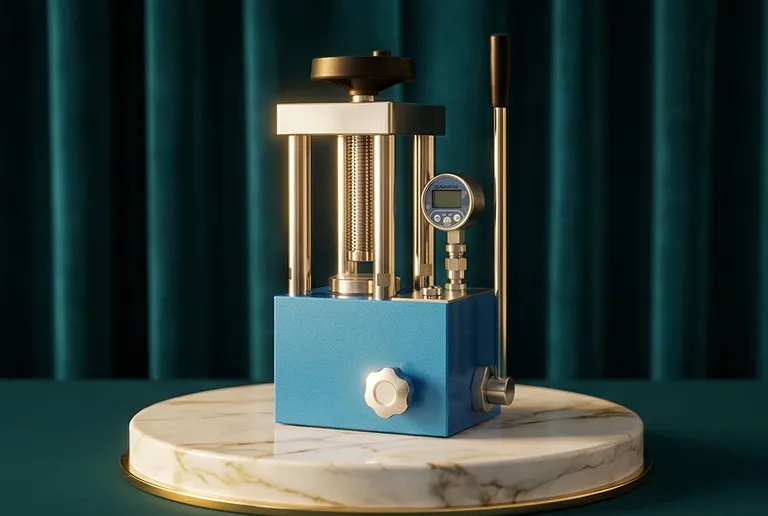
At KINTEK, we understand that the integrity of your research depends on the uniformity of your samples. Our laboratory pressing solutions are designed to eliminate the variables that lead to failure.
From Cold and Warm Isostatic Presses (CIP/WIP) for high-density molding to specialized glovebox-compatible models for sensitive battery research, we provide the tools to master the geometry of density.
Maximize your sintering success and eliminate the hidden stresses in your alumina ceramics.
Related Products
- Electric Lab Cold Isostatic Press CIP Machine
- Electric Split Lab Cold Isostatic Pressing CIP Machine
- Automatic Lab Cold Isostatic Pressing CIP Machine
- Manual Cold Isostatic Pressing CIP Machine Pellet Press
- Lab Isostatic Pressing Molds for Isostatic Molding
Related Articles
- Shaping vs. Perfecting: The Strategic Divide Between Cold and Hot Isostatic Pressing
- Beyond Brute Force: The Elegant Physics of Cold Isostatic Pressing
- The Isotropic Imperative: Why Uniform Pressure Defines the Life of a Superconductor
- The Architecture of Uniformity: Why Omnidirectional Pressure Defines Ceramic Destiny
- How Isostatic Pressing Delivers Superior Performance in Critical Industries
















