
The primary purpose of pre-forming solid electrolyte powders using a lab press and PEEK mold is to convert loose, disconnected particles into a dense, cohesive separator pellet. This process eliminates internal voids to minimize impedance and creates a mechanically stable substrate required for the subsequent application of electrode layers.
The performance of an all-solid-state battery relies entirely on the quality of the solid-solid contacts. Pre-forming is the foundational step that transforms raw powder into a continuous ion-conductive medium, ensuring the physical integrity and electrochemical connectivity of the cell.
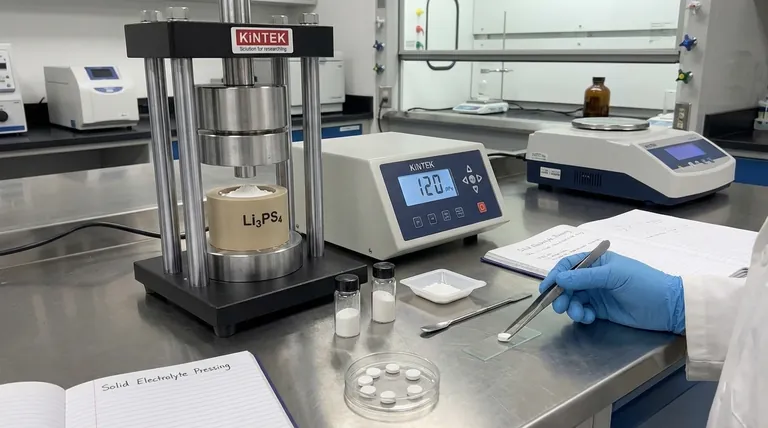
Achieving Critical Density
The transition from loose powder to a solid pellet is a mechanical necessity for ion transport.
Eliminating Microstructural Voids
Loose electrolyte powders contain significant air gaps that block the movement of lithium ions. By applying specific pressures (often around 120 MPa), the lab press forces particles together, effectively closing these voids.
Creating a Low-Impedance Pathway
The densification process creates a continuous solid phase. This ensures that ions have a direct, low-resistance path to travel from the anode to the cathode, which is a fundamental requirement for battery operation.
Establishing a Structural Foundation
The resulting pellet serves as a flat, dense substrate. This structural rigidity is crucial because it acts as the physical base upon which the anode and cathode materials are subsequently coated or stacked.
The Strategic Choice of PEEK Materials
The selection of Polyether Ether Ketone (PEEK) for the mold is not arbitrary; it addresses specific mechanical and electrochemical challenges in battery assembly.
Preventing Electrical Short Circuits
Unlike steel dies, PEEK is an excellent electrical insulator. This allows the mold to act as the cell body during pressing and subsequent testing, preventing short circuits between the positive and negative plungers (current collectors).
Chemical Inertness
Solid electrolytes, particularly sulfides like Li3PS4, are highly reactive. PEEK is chemically inert, ensuring that the mold does not react with the electrolyte powder, which prevents material contamination and degradation during the process.
High-Pressure Durability
Despite being a polymer, PEEK possesses exceptional mechanical strength. It can withstand forming pressures as high as 360 MPa without significant deformation, maintaining the geometric precision of the pellet under high stress.
Optimizing the Solid-Solid Interface
Beyond simple densification, the pre-forming step is about engineering the interfaces within the battery cell.
Maximizing Interfacial Contact
A lab press applies constant, uniform pressure to ensure "intimate" physical contact between the electrolyte and the electrodes (such as lithium foil). This reduces interfacial resistance, which is often the bottleneck in solid-state battery performance.
Ensuring Repeatability
Using a calibrated lab press removes the variability of manual assembly. Precise pressure control allows researchers to produce pellets with consistent thickness and density, ensuring that data regarding ionic conductivity and cycling stability is accurate and reproducible.
Understanding the Trade-offs
While high-pressure pre-forming is essential, it requires balancing force with material limitations.
Pressure Management
While higher pressure generally improves density, excessive force can damage the PEEK mold or induce stress fractures in the pellet upon release. The pressure must be optimized (e.g., 120 MPa for forming) to maximize contact without compromising the equipment or the sample.
Material Compatibility
PEEK is robust, but it is not invincible. It is selected specifically for its balance of hardness and insulation; however, for pressures significantly exceeding 360 MPa, or for specific high-temperature sintering processes, alternative or reinforced tooling might be required.
Making the Right Choice for Your Goal
To ensure your assembly process yields valid data, align your pressing strategy with your specific research objectives.
- If your primary focus is Ionic Conductivity: Prioritize maximizing pellet density to eliminate voids, as this is the primary factor limiting ion transport speed.
- If your primary focus is Electrochemical Stability: Ensure the PEEK mold is perfectly clean and the pressure is uniform to prevent localized hotspots or contamination that could skew cycling results.
- If your primary focus is Prototype Durability: Focus on the "stack pressure" to maintain interface integrity between the electrolyte and the electrodes during long-term cycling.
Success in all-solid-state battery fabrication begins with the mechanical quality of the electrolyte layer.
Summary Table:
| Purpose | Key Benefit | Key Parameter/Consideration |
|---|---|---|
| Achieve Critical Density | Eliminates voids for low-impedance ion transport | Pressure: ~120 MPa (typical) |
| Create Structural Foundation | Provides a flat, rigid substrate for electrode layers | Ensures mechanical stability |
| Prevent Short Circuits | PEEK mold acts as an insulating cell body | Material: Chemically inert PEEK polymer |
| Optimize Solid-Solid Interface | Maximizes contact area, reducing interfacial resistance | Requires uniform, calibrated pressure |
Ready to perfect your all-solid-state battery research?
The quality of your electrolyte pellet is the foundation of your battery's performance. KINTEK specializes in precision lab press machines (including automatic, isostatic, and heated lab presses) and custom tooling like PEEK molds, designed specifically for the demanding needs of battery R&D.
Our equipment helps you achieve the consistent density, perfect interfaces, and reproducible results critical for valid data. Contact us today to discuss how our solutions can enhance your lab's capabilities and accelerate your development cycle.
Contact KINTEK for a consultation
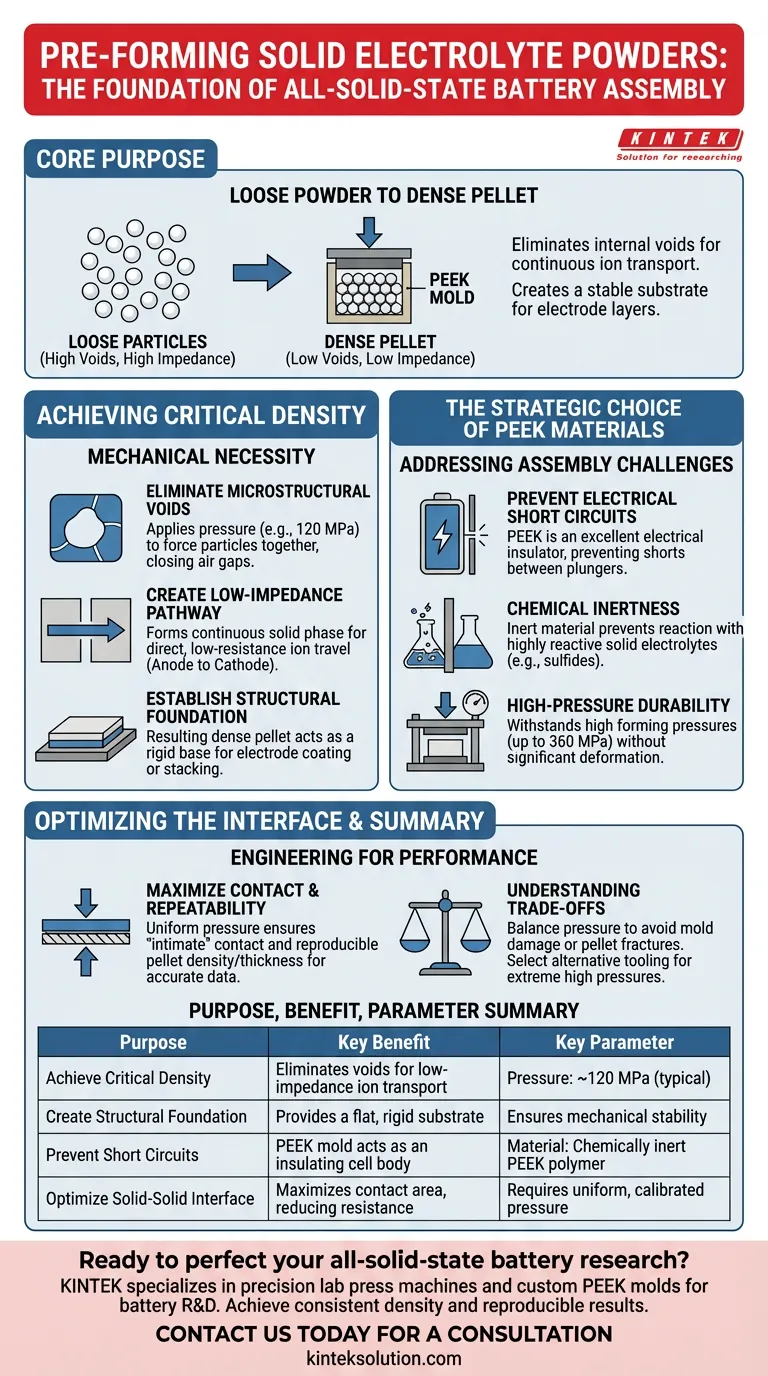
Visual Guide
Related Products
- 24T 30T 60T Heated Hydraulic Lab Press Machine with Hot Plates for Laboratory
- Manual Heated Hydraulic Lab Press with Integrated Hot Plates Hydraulic Press Machine
- Laboratory Hydraulic Pellet Press for XRF KBR FTIR Lab Press
- Lab Infrared Press Mold for Laboratory Applications
- Laboratory Hydraulic Press Lab Pellet Press Machine for Glove Box
People Also Ask
- Function of a Laboratory Hydraulic Press with Heated Platens in SSE? Enhance Battery Density & Conductivity
- Why is a laboratory hydraulic press with heating plates required for PLA/TEC films? Achieve Precise Sample Integrity
- What role does a laboratory heated hydraulic press play in LTCC? Essential for High-Density Ceramic Lamination
- What role does a laboratory heated hydraulic press play in PI/PA based SPE membranes? Optimize Solid Battery Performance
- Why Use a Laboratory Heated Hydraulic Press for SSAB CCM? Optimize Solid-State Battery Interfacial Bonding



















