
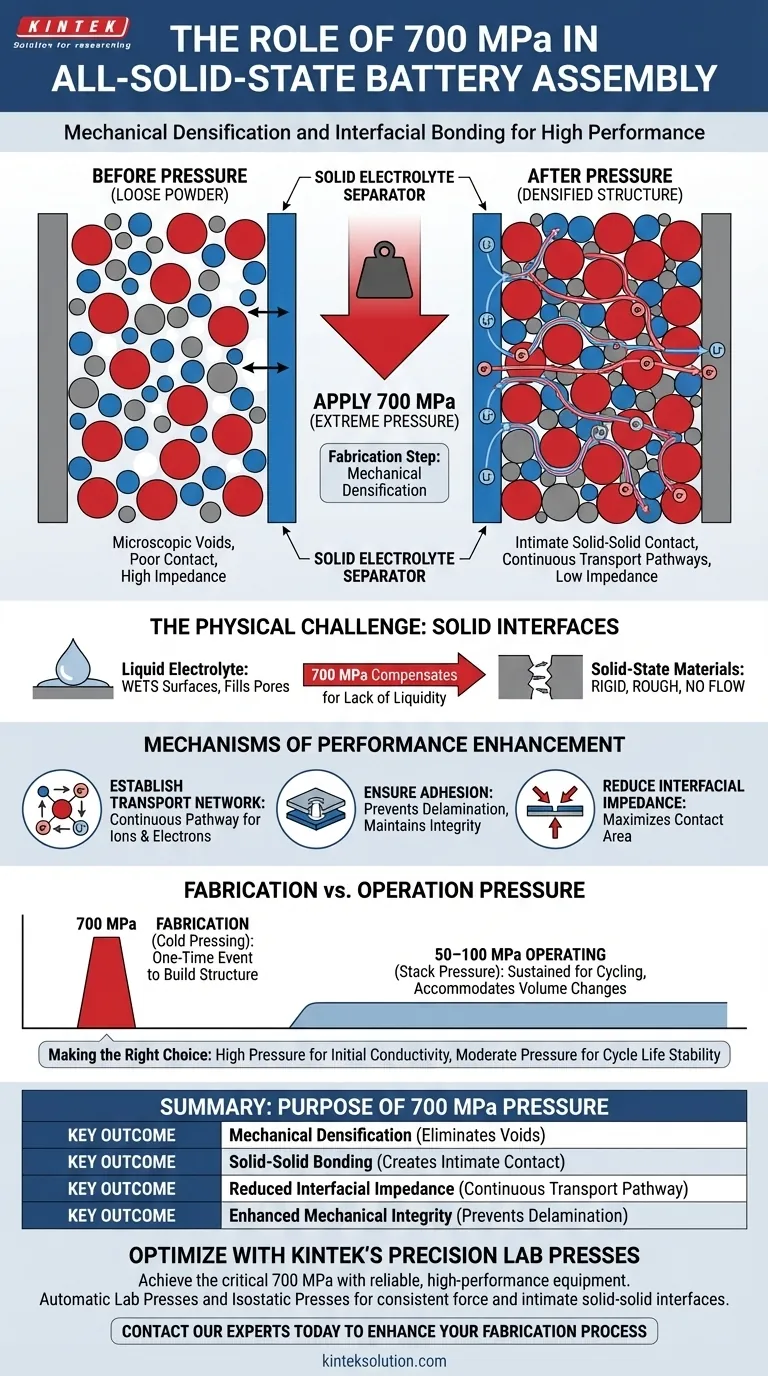
Applying a high pressure of 700 MPa is a critical fabrication step designed to mechanically densify the composite cathode and bond it securely to the solid electrolyte separator. This extreme force is necessary to eliminate microscopic voids and establish a continuous, low-resistance pathway for both ions and electrons to move through the battery.
The Core Insight: Liquid electrolytes naturally "wet" surfaces to create contact, but solid-state materials are rigid and rough. The application of 700 MPa compensates for this lack of liquidity by physically deforming the materials to create the intimate, solid-solid contact required for the battery to function.
The Physical Challenge of Solid Interfaces
Overcoming the Lack of Wetting
In traditional lithium-ion batteries, liquid electrolytes seep into every pore of the electrode. In all-solid-state batteries (ASSBs), the electrolyte is a solid powder or ceramic. These materials do not flow. Without significant intervention, gaps remain between the electrode particles and the electrolyte.
Eliminating Voids and Pores
Air voids acts as insulators, blocking the flow of ions. Applying pressure up to 700 MPa serves to mechanically crush these voids. This process compacts the loose particles into a dense, unified structure, ensuring that the active material is fully accessible to the electrolyte.
Mechanisms of Performance Enhancement
Establishing the Transport Network
The primary goal of this high-pressure assembly is to create a continuous network for transport. References indicate that 700 MPa establishes an efficient pathway for ion and electron transport across the interface. Without this densification, the internal resistance (impedance) of the battery would be too high for practical use.
Ensuring Adhesion and Mechanical Integrity
The interface between the cathode layer and the solid electrolyte separator is a weak point in ASSBs. The 700 MPa pressure forces these two distinct layers to adhere to one another. This strong adhesion is critical for maintaining mechanical integrity and preventing delamination during handling or subsequent processing.
Reducing Interfacial Impedance
By maximizing the surface area where particles touch, the contact resistance is minimized. A "well-formed interface" created by this pressure is a fundamental prerequisite for achieving high rate performance, allowing the battery to charge and discharge efficiently.
Understanding the Trade-offs: Fabrication vs. Operation
Fabrication Pressure vs. Stack Pressure
It is vital to distinguish the 700 MPa assembly pressure from the operating (stack) pressure. The 700 MPa force is a one-time "cold pressing" event used to manufacture the cell. In contrast, a much lower sustained pressure (typically around 50–100 MPa) is applied during battery cycling to maintain contact.
Handling Volumetric Changes
While the initial high pressure creates the structure, it does not permanently solve the issue of expansion. Electrode materials expand and contract during charge cycles. The rigid structure created by the 700 MPa press relies on the lower, sustained stack pressure during operation to accommodate these volume changes and prevent the interface from separating over time.
Making the Right Choice for Your Goal
To optimize the performance of an all-solid-state battery, you must view pressure as a precise tool rather than a blunt instrument.
- If your primary focus is Initial Conductivity: Apply high pressure (e.g., 700 MPa) during assembly to maximally densify the cathode and minimize initial interfacial impedance.
- If your primary focus is Cycle Life Stability: Ensure you transition from the high assembly pressure to a constant, moderate stack pressure (e.g., 50–100 MPa) during testing to accommodate particle breathing.
Ultimately, the application of 700 MPa is the mechanical equivalent of "wetting" the electrode, transforming a collection of loose powders into a cohesive, functional electrochemical system.
Summary Table:
| Purpose of 700 MPa Pressure | Key Outcome |
|---|---|
| Mechanical Densification | Eliminates microscopic voids and pores in the cathode composite. |
| Solid-Solid Bonding | Creates intimate contact between cathode and solid electrolyte particles. |
| Reduced Interfacial Impedance | Establishes a continuous, low-resistance pathway for ion and electron transport. |
| Enhanced Mechanical Integrity | Prevents delamination and ensures strong adhesion between layers. |
Optimize Your All-Solid-State Battery Research with KINTEK's Precision Lab Presses
Achieving the critical 700 MPa pressure for densifying composite cathodes requires reliable and precise equipment. KINTEK specializes in high-performance lab press machines, including automatic lab presses and isostatic presses, designed to meet the exacting demands of battery research and development.
Our presses provide the consistent, high-pressure force needed to create the intimate solid-solid interfaces essential for high-performance all-solid-state batteries. Let us help you accelerate your development cycle and achieve reproducible results.
Contact our experts today to discuss how our lab press solutions can enhance your battery fabrication process.
Visual Guide
Related Products
- Warm Isostatic Press for Solid State Battery Research Warm Isostatic Press
- Lab Button Battery Tablet Press Sealing Mold
- Laboratory Hydraulic Press Lab Pellet Press Button Battery Press
- Button Battery Sealing Press Machine for Lab
- Lab Infrared Press Mold for Laboratory Applications
People Also Ask
- Why must composite cathodes be sealed in vacuum lamination bags for WIP? Ensure Battery Stability and Density
- What is the function of elastic molds in warm isostatic pressing? Achieve Uniform Density in Composite Particles
- How do sacrificial volume materials (SVM) maintain microchannels in isostatic pressing? Ensure Structural Integrity
- How does Warm Isostatic Pressing differ from traditional pressing methods? Unlock Uniform Density for Complex Parts
- What is the mechanism of a Warm Isostatic Press (WIP) on cheese? Master Cold Pasteurization for Superior Safety





