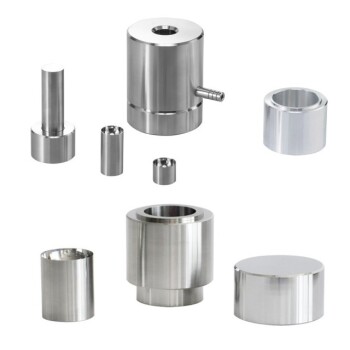
High-strength mold components function as the critical containment system that translates applied vertical pressure into structural integrity. By physically constraining the powder mixture of silicon, solid electrolytes, and conductive additives, these molds force the particles to undergo necessary elastic-plastic deformation rather than simply displacing them.
The rigid constraint provided by these components is essential for forcing ductile sulfide electrolytes to fill particle voids and eliminating internal density gradients. This densification is the primary defense against electrode disintegration caused by the massive 300% volume expansion of silicon particles during battery cycling.
The Mechanics of Structural Densification
Forcing Elastic-Plastic Deformation
In a loose powder state, particles will naturally rearrange to find the path of least resistance when pressed.
High-strength molds eliminate this escape route. They provide a rigid boundary that forces the silicon and additive particles to deform physically—both elastically and technically.
This ensures that the applied pressure results in genuine compaction and inter-particle contact rather than mere rearrangement.
Enabling Void Filling
A critical function of the mold is to facilitate the flow of ductile sulfide electrolytes.
Under the constrained pressure environment, these electrolytes become pliable.
The mold's resistance allows the pressure to drive these electrolytes into the microscopic voids between silicon particles, creating a continuous and dense composite structure.
Eliminating Internal Gradients
Without a high-strength constraint, pressure distribution across the electrode can be uneven.
The mold ensures that the vertical pressure is applied uniformly across the mixture.
This uniform application eliminates internal density gradients, preventing the formation of weak points where the electrode structure could fail under stress.
Managing Silicon Volume Expansion
Counteracting 300% Expansion
Silicon poses a unique challenge due to its tendency to expand by up to 300% during lithiation (cycling).
If the initial electrode structure contains voids or loose contacts, this expansion will rapidly tear the electrode apart.
The mold components ensure the initial "cold pressed" state is sufficiently dense to withstand these extreme volumetric changes without premature disintegration.
Ensuring Geometric Uniformity
Beyond internal density, the mold dictates the external precision of the electrode.
Using high-strength components prevents the mold itself from deforming under high loads (often hundreds of megapascals).
This rigidity ensures the final electrode—often a standardized disc (e.g., 12 mm)—maintains highly uniform geometric size, which is vital for accurate electrochemical testing.
Understanding the Trade-offs
The Risk of Mold Deformation
If the mold components lack sufficient strength, they may yield slightly under high axial pressure (e.g., approaching 500 MPa).
Even microscopic mold deformation acts as a pressure relief valve.
This results in insufficient pressure being applied to the powder, leading to lower structural density and potential defects in the final electrode.
Balancing Pressure and Integrity
While high pressure is needed for density, the mold must be precise enough to prevent mass transport issues.
If the mold clearance is too tight or the material too brittle, the high pressure required for silicon compaction can damage the mold surfaces.
This creates physical shape variations in the electrode, which negatively impacts the accuracy of cycle life assessments and other performance metrics.
Ensuring Electrode Integrity and Performance
To maximize the stability and cycle life of silicon-based composite electrodes, consider the following regarding your tooling choices:
- If your primary focus is Cycle Life Stability: Prioritize mold rigidity to maximize the density of ductile sulfide electrolytes, as this void-filling capability is the main buffer against silicon expansion.
- If your primary focus is Testing Accuracy: Ensure your mold components maintain absolute dimensional stability under load to produce geometrically identical samples, eliminating variables in coin cell assessments.
The effectiveness of your cold pressing process relies not just on the pressure applied, but on the ability of your mold to maintain a strictly constrained environment under that load.
Summary Table:
| Function | Description | Impact on Electrode |
|---|---|---|
| Structural Constraint | Translates vertical pressure into particle deformation | Prevents displacement; ensures genuine compaction |
| Void Filling | Drives ductile sulfide electrolytes into microscopic gaps | Creates continuous structure; buffers volume expansion |
| Gradient Elimination | Distributes axial pressure uniformly across the mixture | Prevents weak points and structural failure |
| Geometric Precision | Resists mold yielding under high loads (up to 500 MPa) | Ensures uniform sample size for accurate testing |
Maximize Your Battery Research Precision with KINTEK
Silicon volume expansion demands uncompromising structural integrity. KINTEK specializes in comprehensive laboratory pressing solutions, offering high-strength manual, automatic, heated, and multifunctional presses, as well as cold and warm isostatic models engineered for the rigors of battery research. Whether you need glovebox-compatible designs or specialized tooling for sulfide electrolytes, our equipment ensures the density and geometric uniformity required for superior cycle life stability.
Ready to optimize your electrode fabrication?
References
- Magnus So, Gen Inoue. Role of Pressure and Expansion on the Degradation in Solid‐State Silicon Batteries: Implementing Electrochemistry in Particle Dynamics. DOI: 10.1002/adfm.202423877
This article is also based on technical information from Kintek Solution Knowledge Base .
Related Products
- Lab Polygon Press Mold
- Lab Anti-Cracking Press Mold
- Special Shape Lab Press Mold for Laboratory Applications
- Lab Isostatic Pressing Molds for Isostatic Molding
- Lab Round Bidirectional Press Mold
People Also Ask
- What is the purpose of incorporating cartridge heaters into a lab press mold for MLCC block compression? Optimize Results
- How do the design and geometric precision of pressing molds and mandrels affect the quality of PTFE composite samples?
- What role do precision positioning and pressure molds play in single-lap joints? Ensure 100% Data Integrity
- What are the requirements for pressing molds when using SSCG? Key Materials for Complex Single Crystal Production
- How do industrial-grade pressure molds affect zinc metal pouch cells? Maximize Energy Density & Performance