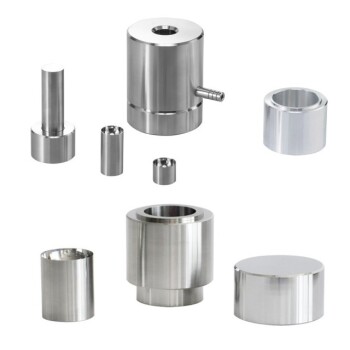
Cylindrical rubber molds serve as essential flexible barriers that translate hydraulic pressure into mechanical force during the Cold Isostatic Pressing (CIP) process.
These molds act as a "pressure transfer medium," functioning as an elastic envelope around the loose tungsten powder. When the CIP chamber is pressurized, the rubber deforms uniformly, transmitting the external hydraulic force directly to the powder surface from all directions without loss. This ensures the tungsten is compressed evenly, regardless of its position within the mold.
Core Takeaway The primary function of the rubber mold is to enable isostatic (equal) compression rather than unidirectional force. By acting as a highly elastic membrane, the mold facilitates the creation of large, high-aspect-ratio tungsten skeletons with uniform internal density, effectively preventing the structural defects and density gradients inherent to rigid die pressing.
The Mechanics of Pressure Transmission
The Role of the "Flexible Envelope"
In the CIP process, the rubber mold is not a rigid container but a flexible interface.
Because rubber has high elasticity, it transmits the pressure generated by the hydraulic system to the tungsten powder almost losslessly. This flexibility allows the mold to shrink and move with the powder as it compacts, ensuring constant contact and force transfer throughout the densification cycle.
Achieving Omnidirectional Force
Unlike traditional pressing, which applies force from the top or bottom, cylindrical rubber molds facilitate hydrostatic pressure.
This means the force is applied perpendicular to every point on the mold's surface simultaneously. This "all-around" pressure is critical for complex geometries, ensuring that the powder is subjected to consistent compression rates from all sides.
Impact on Tungsten Skeleton Quality
Eliminating Density Gradients
A major challenge in forming tungsten skeletons is avoiding "density gradients"—areas where the powder is packed tighter in some spots than others.
Rigid molds often create these gradients due to friction at the die walls. The flexible rubber mold eliminates this issue by applying uniform stress, resulting in a homogeneous internal density distribution. This uniformity is vital for maintaining structural integrity during high-temperature sintering.
Enabling High Aspect Ratios
The primary reference highlights that this method is specifically advantageous for producing large-sized, high-aspect-ratio cylindrical skeletons.
Producing long, thin tungsten cylinders in a rigid mold would typically result in cracking or uneven compaction. The rubber mold supports the powder column evenly along its entire length, allowing for the successful formation of these difficult geometries.
Engineering Nuances and Configuration
Enhancing Green Density
The uniform pressure applied via the rubber mold significantly increases the "green density" (the density of the pressed powder before firing) of the tungsten compact.
This ultra-high pressure consolidation ensures extremely close contact between tungsten particles. High green density can reduce the required sintering temperature significantly—potentially dropping it from the traditional 1800-2200°C range down to roughly 1500°C, saving energy and reducing thermal stress.
Managing Air Entrapment (Double-Layer Molds)
While single-layer molds are common, advanced configurations use a double-layer structure to prevent trapped air, which causes defects.
This setup consists of an inner forming mold and an outer pressure mold with different hardness levels. By ensuring the outer rubber is harder than the inner rubber, engineers can force the mold to compress sequentially from the center outward. This "squeezing" action effectively expels residual air from between the powder particles before the final seal is formed.
Making the Right Choice for Your Goal
When designing a process for tungsten skeleton formation, the mold configuration dictates the final quality.
- If your primary focus is Geometric Complexity: Utilize the high elasticity of rubber to ensure uniform compression on high-aspect-ratio parts (long cylinders) that would crack in rigid dies.
- If your primary focus is Material Homogeneity: Rely on the isostatic pressure transfer of the mold to eliminate density gradients, ensuring predictable behavior during sintering.
- If your primary focus is Defect Reduction: Consider a double-layer mold design with varying hardness to sequentially drive out air and prevent internal porosity.
The use of cylindrical rubber molds is not merely about containment; it is the critical mechanism that transforms raw hydraulic power into a precise, uniform force for high-integrity tungsten fabrication.
Summary Table:
| Feature | Benefit for Tungsten Skeletons |
|---|---|
| Flexible Envelope | Translates hydraulic pressure into omnidirectional force |
| Isostatic Compression | Eliminates density gradients and prevents structural defects |
| High Elasticity | Facilitates forming of large, high-aspect-ratio geometries |
| Double-Layer Design | Sequentially expels trapped air to prevent internal porosity |
| Increased Green Density | Lowers sintering temperatures (from ~2000°C to ~1500°C) |
Optimize Your Materials Research with KINTEK
Are you looking to eliminate structural defects in your powder metallurgy or battery research? KINTEK specializes in comprehensive laboratory pressing solutions, offering a versatile range of manual, automatic, heated, multifunctional, and glovebox-compatible models, alongside high-precision cold and warm isostatic presses.
Our advanced CIP technology ensures uniform density and high integrity for complex tungsten skeletons and specialized ceramic components. Let our experts help you select the perfect pressing system to enhance your lab's efficiency and material performance.
📩 Contact KINTEK Today to Find Your Pressing Solution
References
- Ahmad Hamidi, S. Rastegari. Reduction of Sintering Temperature of Porous Tungsten Skeleton Used for Production of W-Cu Composites by Ultra High Compaction Pressure of Tungsten Powder. DOI: 10.4028/www.scientific.net/amr.264-265.807
This article is also based on technical information from Kintek Solution Knowledge Base .
Related Products
- Lab Isostatic Pressing Molds for Isostatic Molding
- Lab Cylindrical Press Mold for Laboratory Use
- Lab Cylindrical Press Mold with Scale
- Assemble Lab Cylindrical Press Mold for Laboratory Use
- Cylindrical Lab Electric Heating Press Mold for Laboratory Use
People Also Ask
- What is the purpose of incorporating cartridge heaters into a lab press mold for MLCC block compression? Optimize Results
- What is the function of an isostatic lab press in energy storage research? Achieve Superior Material Standardization
- How do laboratory press machines resolve increased impedance in solid-state batteries? Achieve Low-Resistance Interfaces
- How does controlling the parameters of a laboratory isostatic press contribute to reducing deformation in LTCC channels?
- What is the role of a laboratory isostatic press in the preparation of ablative insulation materials? Ensure Density.