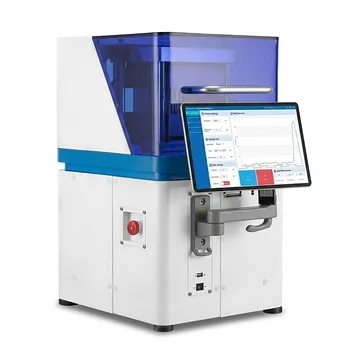
Laboratory presses are utilized in lamination to apply controlled, high-force pressure that bonds multiple distinct layers of material into a single composite. By compressing stacks of materials—such as plastic films, papers, or fabrics—the press forces them to adhere, creating a unified product with specific mechanical or chemical properties.
The core value of using a laboratory press for lamination lies in its ability to replicate industrial bonding conditions on a precise, manageable scale. It allows researchers to investigate how different materials interact under extreme pressure without the waste or cost of a full manufacturing run.
The Mechanics of Pressure-Based Lamination
creating Composite Materials
The primary function of a laboratory press in this context is to merge different substrates. As noted in your primary reference, this often involves stacking alternating layers, such as polymers and fabrics.
When pressure is applied, these layers are forced into intimate contact. This eliminates air pockets and promotes adhesion, resulting in a composite material that possesses the combined strengths of its individual components.
Ensuring Uniformity
Achieving a consistent bond across the entire surface area is critical. Laboratory presses are designed to deliver force evenly across the platens.
This uniformity ensures that the resulting laminate has consistent thickness and structural integrity. Without this precision, the material could delaminate or exhibit weak points, rendering it useless for testing.
Applications in Research and Quality Control
Material Behavior Investigation
Beyond simple bonding, laboratory presses allow scientists to study how materials react to stress during the lamination process.
Supplementary data indicates these presses are vital for investigating material behavior under high pressure. Researchers can determine the exact threshold required to achieve a bond without damaging the delicate individual layers.
Prototyping and Benchmarking
Before a composite material enters mass production, it must be prototyped. Laboratory presses are used to create small-scale samples for performance benchmarking.
Just as researchers compare ceramic samples to verify manufacturing standards, they use laminated samples to test durability and strength. This ensures the new composite meets necessary quality control standards before scaling up to industrial machinery.
Understanding the Trade-offs
The Limitation of Scale
While laboratory presses offer precision, they are inherently limited by size. They are designed for sample preparation and small-batch prototyping, not high-volume production.
Attempting to use a laboratory unit for large-scale output is inefficient. It is best suited for the "proof of concept" phase rather than the manufacturing phase.
Sensitivity to Configuration
The quality of the laminate is heavily dependent on the precise configuration of the press.
As indicated in the supplementary texts regarding sample preparation for spectroscopy, accurate measurements require uniform samples. If the pressure settings are incorrect, the laminate may suffer from uneven bonding, skewing research data and leading to false conclusions about the material's viability.
Making the Right Choice for Your Goal
To maximize the utility of a laboratory press for lamination, you must align your usage with your specific objectives:
- If your primary focus is Research & Development: Prioritize the press's ability to offer precise pressure control to investigate how new material combinations behave under varying stress levels.
- If your primary focus is Quality Control: Use the press to create standardized laminate samples to rigorously test strength and durability against established benchmarks.
A laboratory press transforms a stack of loose materials into a cohesive, testable prototype, bridging the gap between theoretical design and physical reality.
Summary Table:
| Feature | Role in Lamination | Benefit |
|---|---|---|
| Pressure Control | Applies high-force, even compression | Eliminates air pockets and ensures consistent bonding |
| Platen Uniformity | Delivers even force across substrates | Guarantees uniform thickness and structural integrity |
| Material R&D | Bonds polymers, fabrics, and films | Allows investigation of material behavior under stress |
| Prototyping | Creates small-scale sample batches | Reduces waste while benchmarking industrial standards |
Elevate Your Composite Research with KINTEK Precision
Unlock the full potential of your material science projects with KINTEK’s industry-leading laboratory pressing solutions. Whether you are developing next-generation battery components or advanced polymer composites, our comprehensive range of manual, automatic, heated, and multifunctional presses provides the exact pressure and temperature control required for flawless lamination.
From glovebox-compatible models to specialized cold and warm isostatic presses, KINTEK specializes in equipment that bridges the gap between theoretical design and physical reality. Don't leave your bonding results to chance.
Contact KINTEK today to find the perfect press for your lab!
Related Products
- Laboratory Hydraulic Press Lab Pellet Press Button Battery Press
- Laboratory Hydraulic Press Lab Pellet Press Machine for Glove Box
- Laboratory Split Manual Heated Hydraulic Press Machine with Hot Plates
- Laboratory Hydraulic Pellet Press for XRF KBR FTIR Lab Press
- Laboratory Hydraulic Split Electric Lab Pellet Press
People Also Ask
- How is a laboratory hydraulic press used for HAP composite gels? Master Mineral Substrate Standardization
- What role does a laboratory hydraulic press play in the preparation of piezoelectric ceramic discs for DC-PG? | KINTEK
- What role does a laboratory hydraulic press play in reaction pellets? Optimizing Lunar Soil and Metal Fuel Density
- Why is a laboratory hydraulic press required for PBAT and PLA sample preparation? Achieve Flawless Characterization
- What role does a laboratory hydraulic press play in the assembly of all-solid-state battery test cells? Expert Guide