
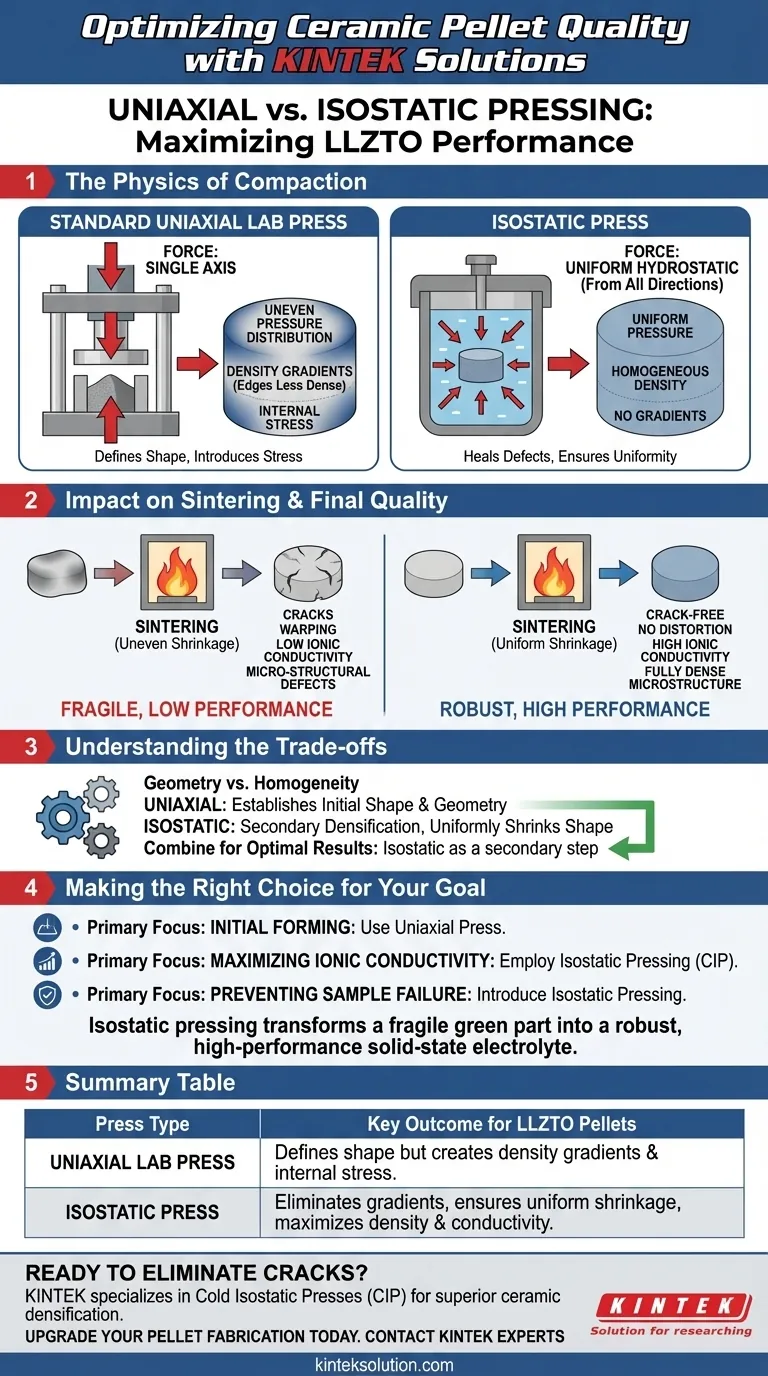
The primary distinction lies in the directionality of force: while a standard uniaxial press applies force along a single vertical axis, an isostatic press applies uniform, hydrostatic pressure from every direction simultaneously.
This multi-directional application eliminates the "density gradients" and internal stresses inherent to uniaxial pressing. For LLZTO (Lithium Lanthanum Zirconium Tantalum Oxide) specifically, this results in a green pellet with superior homogeneity. This uniformity is critical for preventing cracks during sintering and maximizing the ionic conductivity of the final electrolyte.
Core Takeaway Standard uniaxial pressing creates the shape but often leaves internal stress and uneven density. Isostatic pressing acts as a vital quality enhancer, effectively "healing" these density gradients to ensure the pellet shrinks uniformly during sintering, yielding a dense, highly conductive ceramic free of micro-structural defects.
The Physics of Compaction
The Limitation of Uniaxial Pressing
A standard laboratory hydraulic press creates a "green body" (compacted powder) by pressing vertically.
While this effectively creates a defined shape and increases particle contact, friction against the die walls often causes uneven pressure distribution.
This results in density gradients, where the edges or corners of the pellet may be less dense than the center.
The Isostatic Advantage
An isostatic press uses a fluid medium to apply pressure equally to the entire surface area of the sample.
Because the force is hydrostatic (equal from all sides), it compresses the powder without the friction-induced gradients seen in rigid dies.
This creates a uniform internal structure where the density is consistent throughout the entire volume of the pellet.
Impact on Sintering and Final Quality
Eliminating Sintering Defects
The quality of the green body dictates the success of the high-temperature sintering process.
Pellets with density gradients tend to shrink unevenly when fired. This differential shrinkage causes warping, geometric distortion, and cracking.
By ensuring the green body has a uniform density profile, isostatic pressing facilitates uniform shrinkage, significantly raising the yield of usable ceramic pellets.
Maximizing LLZTO Performance
For solid-state electrolytes like LLZTO, physical density is directly linked to electrochemical performance.
Isostatic pressing reduces internal voids and porosity more effectively than uniaxial pressing alone.
A fully dense microstructure is a prerequisite for high ionic conductivity and mechanical strength. Furthermore, eliminating voids is essential for preventing lithium dendrite penetration in the final battery assembly.
Understanding the Trade-offs
Geometry vs. Homogeneity
It is important to understand that these two technologies often function best as a sequence rather than alternatives.
Uniaxial pressing is excellent for establishing the initial shape and geometry of the pellet. However, it introduces internal stress.
Isostatic pressing generally does not define geometry; it uniformly shrinks the existing shape. Therefore, it is most effective when used as a secondary densification step to correct the defects introduced by the initial uniaxial forming.
Making the Right Choice for Your Goal
To optimize your LLZTO pellet fabrication, assess your current failure points.
- If your primary focus is initial forming: Use a standard uniaxial press to establish the defined shape and cohesiveness of the loose powder.
- If your primary focus is maximizing ionic conductivity: Employ isostatic pressing (Cold Isostatic Pressing or CIP) as a secondary step to eliminate voids and maximize the final relative density.
- If your primary focus is preventing sample failure: Introduce isostatic pressing to remove density gradients, which are the root cause of cracking and warping during the sintering phase.
By resolving internal density variations before the furnace, isostatic pressing transforms a fragile green part into a robust, high-performance solid-state electrolyte.
Summary Table:
| Press Type | Force Application | Key Outcome for LLZTO Pellets |
|---|---|---|
| Uniaxial Lab Press | Single vertical axis | Defines initial shape but creates density gradients and internal stress. |
| Isostatic Press | Uniform, hydrostatic pressure from all sides | Eliminates density gradients, ensures uniform shrinkage, and maximizes final density and conductivity. |
Ready to eliminate cracks and maximize the performance of your solid-state electrolytes?
KINTEK specializes in laboratory isostatic presses designed to solve the exact challenges outlined in this article. Our Cold Isostatic Presses (CIP) are the ideal secondary densification step for researchers working with LLZTO and other sensitive ceramic powders, ensuring your pellets achieve the highest possible density and ionic conductivity.
Upgrade your pellet fabrication process today. Contact our experts to find the perfect isostatic press for your laboratory's needs.
Visual Guide
Related Products
- Warm Isostatic Press for Solid State Battery Research Warm Isostatic Press
- Electric Lab Cold Isostatic Press CIP Machine
- Automatic Lab Cold Isostatic Pressing CIP Machine
- Lab Isostatic Pressing Molds for Isostatic Molding
- Manual Cold Isostatic Pressing CIP Machine Pellet Press
People Also Ask
- Why must composite cathodes be sealed in vacuum lamination bags for WIP? Ensure Battery Stability and Density
- What is the function of elastic molds in warm isostatic pressing? Achieve Uniform Density in Composite Particles
- How do sacrificial volume materials (SVM) maintain microchannels in isostatic pressing? Ensure Structural Integrity
- What is the role of the flexible material in warm isostatic pressing? Key to Uniform Density & Precision
- What is the process involved in warm isostatic pressing? Mastering Uniform Density with WIP Technology



















